


True luxury doesn’t need to announce itself. ModernLuxury comes into focus through thoughtful interiors, distinctive homes, considered real estate, and social occasions shaped by a sense of style. Its appeal lies in the balance between contemporary expression and enduring elegance, where each detail feels intentional rather than showy.
If you’re drawn to rooms that feel polished yet welcoming, you’re not alone: beauty matters most when it also feels personal and livable. This article explores how to recognize modern luxury across interiors and homes, how it shapes the way properties are presented, and how it finds expression at social events. Along the way, discover the role of craftsmanship, distinctive furnishings, and carefully composed details in creating spaces with lasting character.
Key Takeaways
- Build an elegant interior around considered choices, balancing distinctive furnishings with a cohesive, livable atmosphere.
- See how enduring design influences the way distinctive homes and real estate are presented.
- Trace Modern Luxury’s story from its founding in 1994 and explore how its presence extends across design, media, and social events.
- Use the In Home Visualizer to preview how selected furnishings may fit within your living space.
Interiors, homes, and real estate
ModernLuxury begins with deliberate choices, not excess. A sculptural chair, a restrained palette, and natural light can shape a room. The aim isn’t to fill every corner. Select furnishings and finishes that suit the space, express its character, and outlast passing trends. Whether exploring collections from JOSMIRLUXE or boutique design houses, let one distinctive piece anchor the room, then give the surrounding details room to breathe.
Begin with the architecture. A tall window, fireplace, or long sightline can guide furniture placement. In a living room, arrange seating for conversation while keeping paths clear. A console can define an entrance; a dining table can anchor an open-plan room. Consider every piece in relation to the room’s proportions. This practical starting point helps a space feel composed rather than crowded.
Next, establish visual rhythm. Pair smooth surfaces with tactile materials, or set a curved silhouette against clean architectural lines. A glass vase, for example, can bring lightness to a substantial wood table. Repeating a finish in a nearby lamp or echoing a shape in smaller decorative objects helps contrasts feel composed. These choices connect elements without making them match.
Restraint gives distinctive details room to matter. Choose one focal point, such as striking artwork or richly veined stone, and let the surrounding elements support it. In a bedroom, layered textiles and considered bedside lighting can create quiet distinction; referencing a duvet tog guide ensures the bedding provides effortless, hotel-style comfort. In a dining room, sculptural chairs can lend presence without crowding the table. ModernLuxury feels personal when each selection has a purpose.
Real estate presentation follows similar principles. A property’s strongest features should stand out, whether they include an expansive view, original millwork, or an open kitchen. Furniture communicates scale and function: a dining table shows how an area may be used, while carefully placed seating can define a living zone within a larger room. The goal is to clarify the home’s possibilities without obscuring its character.
For a polished showing, consider the viewer’s path. Keep the first view from the entrance open and composed, then guide attention toward a feature such as a fireplace or garden-facing window. In photographs, clear surfaces and balanced arrangements keep architectural details visible. This helps viewers understand the layout and notice what defines the home, without making the presentation feel staged beyond recognition.
Design conversations also have a public stage. High Point Market’s fall 2026 edition features design trends and launches. It offers a point of reference for how makers and interiors evolve. Treat trends as inspiration, not instruction. A new silhouette may suit a room; a particular finish may not. Let the home’s architecture and daily use guide which ideas deserve a place.
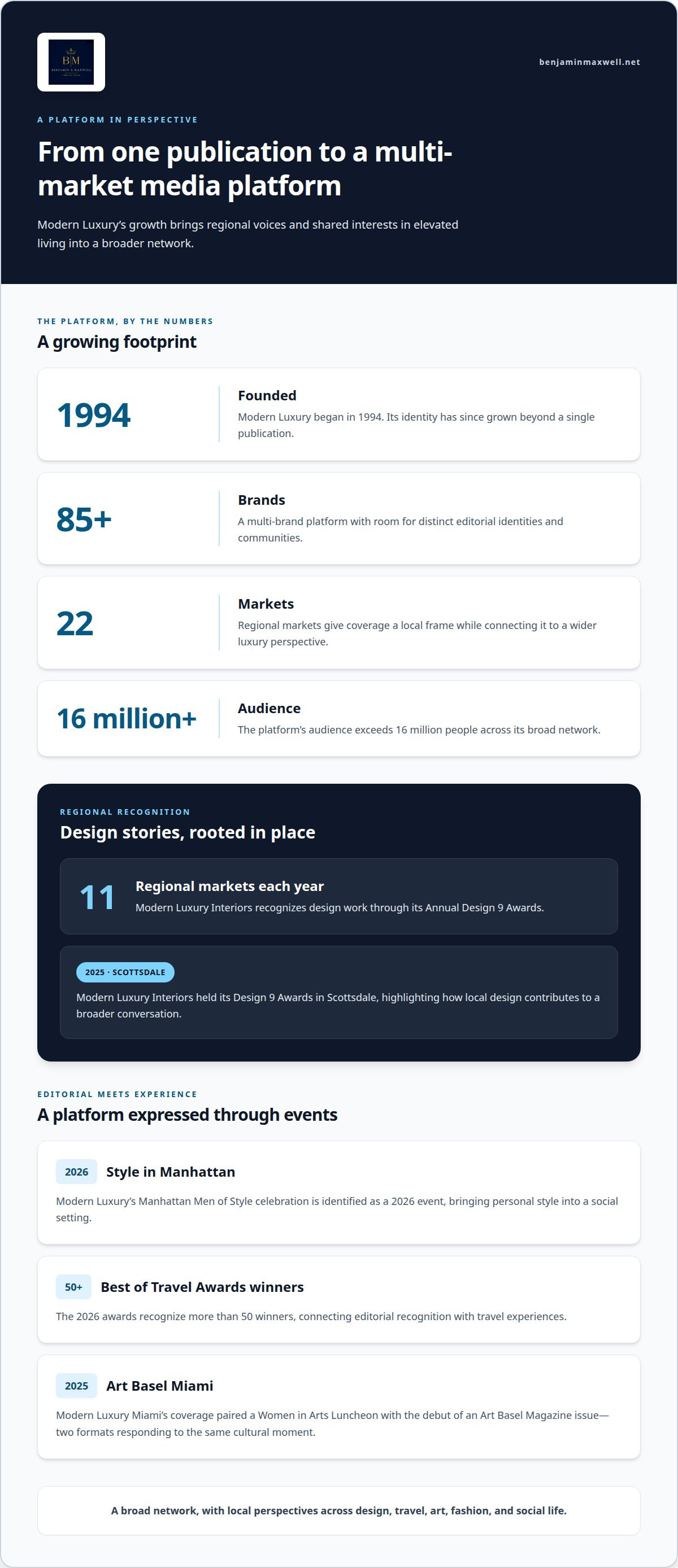
Recognition provides another view of the field. Modern Luxury Interiors recognizes design work in eleven regional markets each year through its Annual Design 9 Awards. The awards offer a way to notice varied approaches across regions. Modern Luxury Interiors held its Design 9 Awards in Scottsdale in 2025. This example highlights how local design contributes to a broader conversation.
Translate inspiration into a home through deliberate steps. First, identify the room’s purpose and architectural focal point. Choose the largest furnishings around those priorities, then refine the palette, lighting, and decorative accents. Finally, assess movement between the entrance, seating, and windows. Check that each area has a clear purpose and that shapes relate without matching exactly. These choices bring contemporary taste and lasting character together.
What is Modern Luxury's history and how has the company changed?
Modern Luxury began in 1994. Since then, its identity has grown beyond a single publication. Today, Modern Luxury describes a media platform spanning more than 85 brands and 22 markets. Its audience exceeds 16 million people. Those figures suggest a broad network, built around regional voices and shared interests in elevated living.
The change is not simply one of scale. A multi-brand platform can speak to distinct communities while retaining an overarching luxury perspective. A reader interested in interiors may encounter different editorial contexts from someone drawn to travel or social events. Regional markets also give coverage a local frame. The result is a wider view of luxury culture, rather than one defined by a single city or subject.
Events show how that editorial identity can extend into gatherings. Modern Luxury’s Manhattan Men of Style celebration is identified as a 2026 event. Its name places personal style at the center, while the event format brings the subject into a social setting. The 2026 Best of Travel Awards offer another example. They recognize more than 50 winners, connecting editorial recognition with travel experiences.
A room comes together through layers: furnishings establish function, while lighting and decorative details add texture and character. Each element should contribute to the composition rather than compete for attention. Together, these choices make a space feel cohesive while leaving room for individual expression.
Modern Luxury Miami’s 2025 Art Basel coverage offers a regional example. The city marked Art Basel Miami with a Women in Arts Luncheon. It also debuted an Art Basel Magazine issue. The pairing brought an editorial product and an in-person gathering into the same cultural moment. It shows how a market-specific edition can respond to a major event through more than one medium.
For readers, this evolution matters because “luxury” rarely belongs to one category. Art, travel, fashion, design, and social life can intersect in a single cultural calendar. A regional platform can reflect those connections through local events and editorial coverage. Its broader network can then place those stories alongside perspectives from other markets.
The platform’s scale also changes how its subjects are encountered. More than 85 brands across 22 markets provide room for varied editorial identities. The audience of more than 16 million people signals reach across those interests. These figures describe the platform’s breadth, not a guarantee that every reader sees the same content. A local event, such as the 2025 Miami luncheon, gives that broad structure a specific place and occasion.
When considering Modern Luxury’s history, separate its founding date from its present-day form. The 1994 founding marks its beginning. Its current footprint reflects a broader media platform, with brands, markets, awards, and gatherings. That distinction helps explain the change without reducing it to a simple story of growth.
Its evolution can be understood through three lenses: reach, format, and locality. Reach appears in the audience and brand figures. Format appears in awards and celebrations. Locality appears in events such as the Miami Art Basel luncheon. Together, these details show how a publication founded in 1994 became a platform for luxury media and experiences.
The company’s development can also be considered through the people and channels associated with it. Modern Luxury has 201-500 employees, while Modern Luxury's LinkedIn page lists 578 employees. These figures present different employee counts, so they are best treated as separate descriptions rather than combined into one total. They nevertheless point to an operation with a workforce behind its broad portfolio of brands and markets. That human dimension helps explain how a media platform can maintain distinct regional identities while producing coverage and experiences under a shared company name.
Modern Luxury's LinkedIn page lists 41,169 followers, offering another indication of how the company’s presence extends beyond its publications and events. A following on a professional network is not the same as the audience figures described elsewhere, but it shows that the company also has a visible profile among people who encounter it through that channel. Taken together, the employee listings and follower count add context to the company’s evolution: its identity now includes not only editorial brands and market-specific programming, but also an organization and public-facing presence capable of connecting with readers, contributors, and industry participants across its wider network.
Benjamin & Maxwell: In Home Visualizer
Benjamin & Maxwell offers an In Home Visualizer to help you consider how selected pieces may fit within your living space. Use it when you’re weighing a furniture choice and want to see it in the context of your home before settling on the room’s composition. It brings the earlier principles of proportion and placement into a practical viewing experience.
Explore furnishings such as Cattelan Italia Furniture alongside distinctive accents from Daum Crystal or Kosta Boda Glassware. Each can contribute a different visual note, from a statement furniture piece to a decorative object. The In Home Visualizer helps you consider those choices within your space.
Contact Benjamin & Maxwell to discuss your home furnishing needs.
Make Your Next Choice With Intention
A considered room takes shape through decisions that reflect how you live. Let one meaningful piece guide the atmosphere, then build around its form, finish, and place in your home. ModernLuxury is most compelling when personal taste meets lasting character, rather than simply following a passing trend.
As you refine your space, Benjamin & Maxwell’s In Home Visualizer lets you consider furnishings in your own setting. Explore how Cattelan Italia furniture might relate to your room, or how Daum crystal could add a distinctive accent. Each choice can help create a setting that feels distinctly yours.
Let your next step be a thoughtful one. Contact Benjamin & Maxwell to discuss your home and the pieces you’re considering. A clear sense of what you want a room to feel like can make the conversation a natural beginning. Move forward at your own pace, and shape a home that welcomes you every day.
Benjamin & Maxwell for ModernLuxury
Benjamin & Maxwell offers luxury furniture and home décor for readers shaping a ModernLuxury interior. Its collections include Cattelan Italia, Bonaldo, Per/Use, and Italia Lounge furniture, alongside sofas, chairs, dining tables, consoles, TV stands, and outdoor furniture.
Explore Benjamin & Maxwell when you’re ready to consider furnishings and finishing touches, from Daum crystal and Kosta Boda glassware to Schuller home décor, glass bowls, vases, statues, and figurines. Use the In Home Visualizer to see how selected pieces may look in your space.

Article by
Spencer Kay
Spencer is the founder and CEO of Benjamin & Maxwell and has created the most advanced technology-based website in the furniture industry. He has extensive experience in both technology and business operations having started a number of technology companies. Spencer holds a BA Degree in Economics and an MBA in International Business
Disclaimer
Benjamin & Maxwell does not intend for any of our products to be used for any specific purpose.


