

What if the glass sculpture that catches your eye is too imposing for the shelf you had in mind, or its color reads differently beside your furnishings? Choosing contemporary glass art sculptures is about more than admiring a piece on its own. Form, hue, and scale all shape how it belongs in a room, so it helps to consider its presence in your space before choosing.
This guide will help you compare those qualities, along with edition details, and build a considered shortlist. Benjamin & Maxwell’s Art Contemporain collection features Daum crystal sculptures by artists including Laurence Bonnel, Natacha Mondon, and Arman. For selected pieces, the collection details include dimensions, weight, and edition information, giving you practical points of comparison as you imagine each sculpture in your space. Use these details to narrow your options and choose a work that suits its intended setting.
Key Takeaways
- Start with the intended placement and viewing distance to judge whether a sculpture will feel balanced or overwhelm the room.
- Compare contemporary glass art sculptures by form, color, and scale, considering how each relates to the room’s existing palette and furnishings.
- Use collection details to make practical comparisons. For example, Seuls au Monde de Laurence Bonnel is blue and gray, measures H 55 x L 8 x W 10 cm, and is marked 125ex.
- Plan a stable surface for larger sculptures, keep pieces away from direct sunlight, and follow the collection’s care guidance.
What Makes Contemporary Glass Art Sculptures Work in a Room?
A contemporary glass art sculpture is an artwork whose material and form create a distinct visual presence. Unlike glassware chosen primarily for use, a sculpture is often selected to be seen and considered, though decorative objects can bring both qualities together. Its effect depends not only on the piece itself, but also on where it stands and how you view it.
Before choosing, picture the room and the distance from which you will usually see the sculpture. A silhouette that feels intricate up close may read differently across a living room. A confident sculpture choice begins where room context, viewing distance, and visual presence meet.
For a closer look at how light interacts with sculptural glass, watch this video:
Start with the space, not the artwork
Decide whether the piece will stand alone or join existing art and décor. Notice the main sightlines, nearby colors, and how much visual activity already fills the area. A busy arrangement may call for a form that complements rather than competes. A quieter setting can give a sculptural silhouette room to command attention. The history and techniques of glassblowing offer useful context for understanding how glass can be shaped into varied forms.
Choose an artistic presence that feels intentional
Figurative works suggest recognizable subjects, while abstract forms draw attention to contour, balance, and material. In the Art Contemporain collection, Daum sculptures by artists including Laurence Bonnel, Natacha Mondon, and Arman offer distinct works to compare. For example, Seuls au Monde de Laurence Bonnel is described in blue and gray. Consider how that palette will relate to the room’s existing colors, as well as how the sculpture’s silhouette will read in its display setting.
Daum’s artistic background and pâte de verre heritage are explored in the related heritage article. Consider how the chosen form and color will appear from the room’s usual viewpoints, then select a piece that feels considered in its setting.
How to Choose a Contemporary Glass Art Sculpture
A considered shortlist begins with the room, not a favorite image. Use this sequence to compare contemporary glass art sculptures and decide whether an expressive form feels in scale and connected to its surroundings.
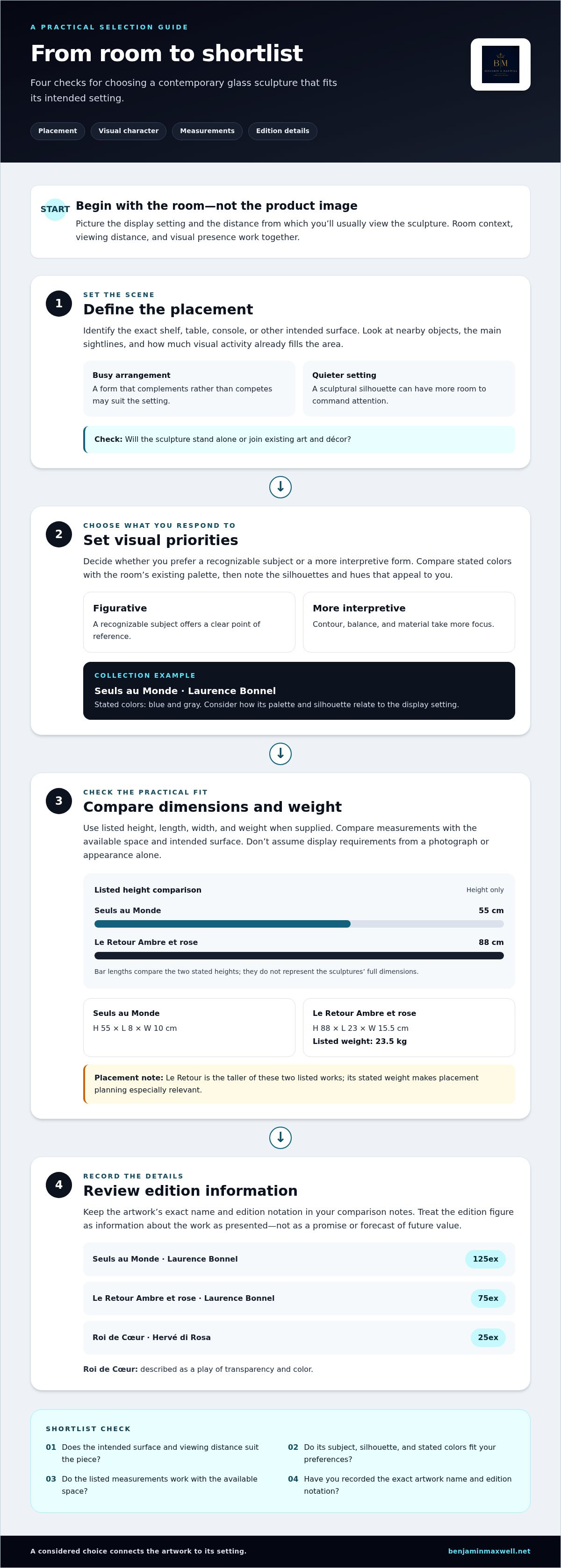
- Define the placement. Identify the exact shelf, table, console, or other intended surface. Consider nearby objects and viewing distance to judge how much visual presence the setting can accommodate.
- Set visual priorities. Decide whether you’re drawn to a figurative subject or a more interpretive form. Compare the sculpture’s described color with the room’s existing palette, then note which silhouettes and hues appeal to you.
- Compare dimensions and weight. Use the listed height, length, width, and weight for each piece when supplied. Compare those measurements with the intended surface and available space. Don’t assume display requirements from a photograph or appearance alone.
- Review edition details. Treat an edition figure as information about the work as presented in the collection, not as a promise of future value. Keep the exact name and edition notation in your comparison notes.
Compare color, form, and subject
A figurative subject may offer a recognizable point of reference, while a less literal form puts more emphasis on contour and composition. Read each sculpture’s description for its stated colors rather than assuming how a hue will appear in your room. A shortlist of preferred subjects, palettes, and silhouettes can help you distinguish an immediate attraction from a piece that feels at home in its intended setting.
Use dimensions and edition details meaningfully
Selected sculptures in the collection include dimensions, weights, and edition details. Compare each available measurement with the planned display area, and use weight as another practical point of reference, not as a substitute for placement guidance. Edition information helps you understand the work as presented, but shouldn’t be treated as a forecast of its value.
With these criteria in mind, browse the Art Contemporain collection and compare the details that matter most for your space.
Standout Daum Sculptures to Compare in the Collection
Specific details make it easier to compare these contemporary glass art sculptures beyond their first impression. Collection descriptions provide useful points of reference, including stated color, measurements, weight, and edition information. Use the table to identify works for a closer look, then consider how their proportions relate to your intended display space.
| Artwork | Stated visual character | Dimensions | Weight | Edition |
|---|---|---|---|---|
| Seuls au Monde de Laurence Bonnel | Blue and gray | H 55 x L 8 x W 10 cm | 125ex | |
| Le Retour Ambre et rose de Laurence Bonnel | Amber and pink | H 88 x L 23 x W 15.5 cm | 23.5 kg | 75ex |
| Roi de Cœur de Hervé di Rosa | Play of transparency and color | 25ex |
Compare intimate forms with larger-scale statements
Seuls au Monde measures 55 cm high, while Le Retour stands 88 cm high and has greater listed length and width. Le Retour’s stated weight of 23.5 kg makes placement planning especially relevant. Consider the intended surface and its available space before settling on this taller piece. These measurements support a practical comparison without assuming how either sculpture will look from a particular angle.
Let the artist and edition inform your shortlist
Artist attribution and edition figures offer useful context: Laurence Bonnel is named for both works, while Roi de Cœur is attributed to Hervé di Rosa. Daum has more than 350 collaborations with artists and designers, a broader history that provides context for its artistic practice without implying that every artist named here is part of that collaboration record. Treat the stated editions as identifying details, not predictions of future value or demand.
Compare the forms, colors, dimensions, and edition details directly in the Art Contemporain sculpture collection to refine your shortlist.
Plan the Display and Care for Your Glass Sculpture
Thoughtful placement helps contemporary glass art sculptures feel at home while giving their forms room to be appreciated. Before setting a piece in place, compare its listed dimensions with the available surface and consider how it will sit among nearby objects. Simple care habits can also help preserve the sculpture’s color and finish.
Check the setting before placing an artwork
Measure the intended display surface, then compare its available space with the sculpture’s height, length, and width. For a larger work, choose a stable surface and allow enough surrounding visual space for the piece to remain easy to appreciate. Use the listed dimensions to plan placement rather than relying on appearance alone, and don’t assume a surface is suitable based only on how sturdy it looks.
Light and routine care deserve attention, too. Keep the sculpture away from direct sunlight to help preserve its colors. For light dusting, use a soft, dry microcloth, following the collection’s care guidance without introducing unlisted cleaning methods.
Browse with a clear shortlist
Return to your priorities as you refine your choice. A short comparison can keep the decision focused:
- Form: Note whether you prefer a figurative subject or a more interpretive sculptural presence.
- Color: Consider how the stated palette relates to the room and your own response to the piece.
- Scale: Compare listed dimensions with the intended surface and available space.
- Collection details: Review artist attribution and edition information where supplied.
This simple process brings practical placement and personal taste together. Explore the Art Contemporain collection to compare the sculptures and find a piece that feels considered in its intended setting.
Let Your Shortlist Lead to the Right Piece
A sculpture can become part of the way a room is experienced, not simply an object placed within it. As you consider contemporary glass art sculptures, take a moment to imagine living with a particular form: where your eye will meet it, what feeling its presence invites, and whether it continues to hold your attention beyond a first glance. That personal response can be as valuable as any measurement.
Let your shortlist narrow naturally. Return to the pieces that feel most compelling, picture each in its intended setting, and choose the one that seems to belong there. There’s no need to rush. Explore the Art Contemporain collection and spend time with the works that speak to your taste. Find a Daum sculpture that brings a considered note of artistry to your home.
Frequently Asked Questions
How do I choose a contemporary glass art sculpture for my home?
Choose a piece whose character suits both your taste and the room’s role. In a reading corner, for example, a sculpture may be viewed at close range, while one in an entryway may be seen in passing. Consider whether it will have its own display area or share attention with other objects, then use the product details to picture it in that particular setting.
What should I compare when buying a glass sculpture?
Compare the details stated for each individual sculpture rather than assuming all glass works share the same construction or care needs. Note its subject and color, then record dimensions, weight, and edition information where provided. If two pieces appeal equally, their product descriptions can help you distinguish their specific attributes and make a more informed selection.
Can a contemporary glass sculpture work in a small room?
Yes, a contemporary glass sculpture can suit a small room if its presence feels proportionate to the setting. A piece displayed on a compact side table, for instance, may become a focal point without requiring a large area. Consider the available space around it and the amount of nearby décor. A simpler arrangement can help the sculpture remain legible rather than visually crowded.
How should I care for a contemporary glass sculpture?
Keep the sculpture out of direct sunlight and use a soft, dry microcloth for light dusting. This restrained routine avoids introducing unlisted products or techniques. Before handling or cleaning a piece, consult any care information supplied specifically for that artwork. If you’re arranging a larger sculpture, decide on its stable resting place first so it doesn’t need to be moved repeatedly.
What makes Daum crystal sculptures distinctive?
Daum brings together hand-crafted crystal glass and an artistic heritage connected with the École de Nancy, Arts Décoratifs, Art Nouveau, and Art Deco. The brand describes its work as a fusion of art and craftsmanship, with sculptural pieces that continue to be reinvented. For an individual sculpture, its product description is the best guide to its artist, palette, dimensions, and edition.

Article by
Spencer Kay
Spencer is the founder and CEO of Benjamin & Maxwell and has created the most advanced technology-based website in the furniture industry. He has extensive experience in both technology and business operations having started a number of technology companies. Spencer holds a BA Degree in Economics and an MBA in International Business
Disclaimer
Benjamin & Maxwell does not intend for any of our products to be used for any specific purpose.


