

What if the most striking desk isn’t the one that best serves your workday? When browsing modern Italian desks, refined finishes and sculptural forms can make options seem alike, yet the right choice depends on how you work and how the piece will live in your room. An open writing desk, a design-led work surface, and a desk with storage each offer a different balance of function and presence.
Choosing well means looking beyond appearance. Consider the room’s scale, the tasks you do, what you need to keep close at hand, and how the desk’s materials and proportions fit your preferred design language. This guide offers practical ways to compare those details and identify a desk that suits both your routine and your space.
Benjamin & Maxwell offers Cattelan Italia furniture, including desks, alongside furniture and home décor from other design brands. As you compare options, consider how office chairs, bookcases, shelving, and lighting can complete the setting. The In Home Visualizer lets you upload a room photo, view furniture and décor in the space, adjust items with AR and 3D tools, and save scenes as you consider the arrangement.
Key Takeaways
- Choose among modern Italian desks by matching the desk’s form and visual presence to your work routine and room.
- Use a practical checklist to weigh your tasks, available space, organization needs, and preferred materials before shortlisting.
- Compare desk formats and product details, including Cattelan Italia’s design-led furniture and the materials listed for each piece.
- Plan a cohesive office setting by considering complementary seating, storage, and lighting, then use the In Home Visualizer to picture furnishings in your room.
What Makes Modern Italian Desks Distinctive in a Home Office?
A modern Italian desk brings together practical use and a considered visual character. Its appeal lies not in appearance alone, but in how form, materials, and intended use work together. Cattelan Italia, for example, is known for bold geometric forms, premium materials, meticulous attention to detail, and a contemporary aesthetic. Its furniture range includes desks, alongside tables, chairs, beds, sideboards, bookcases, lighting, and accessories. The wider tradition of Italian design offers useful context for the relationship between function and aesthetics.
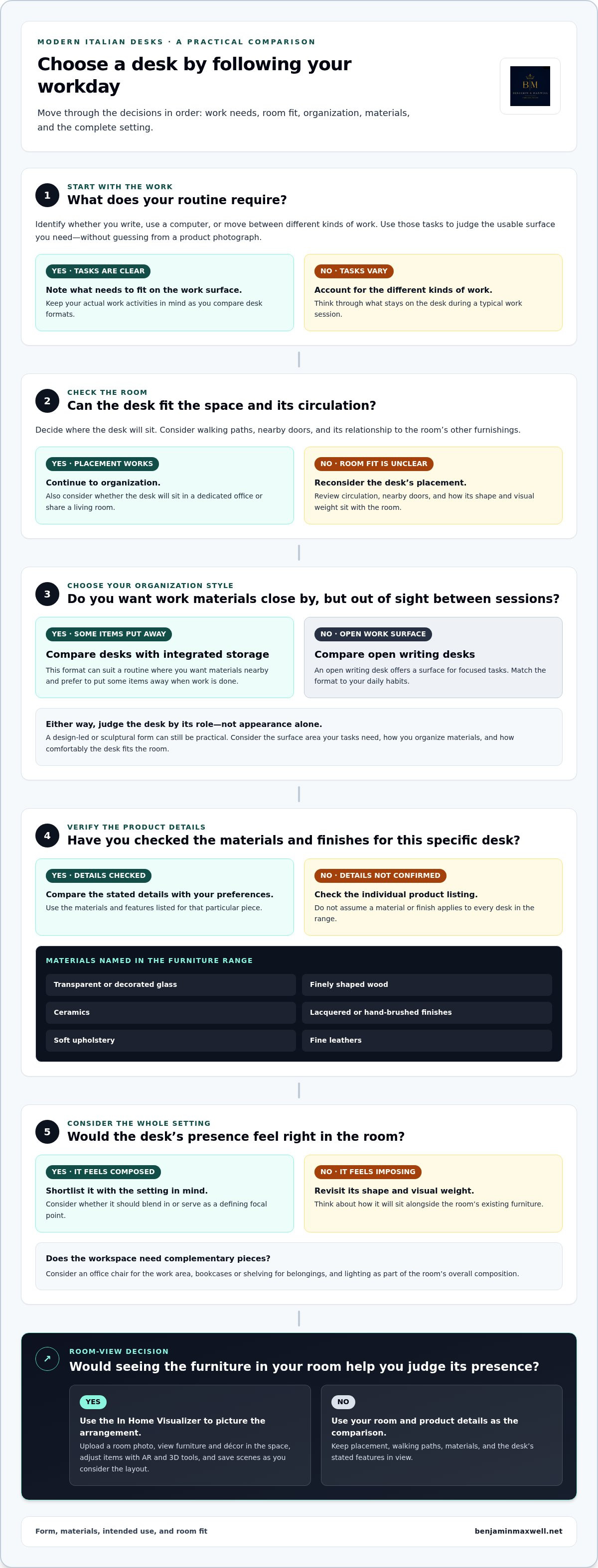
Start with three questions: What does your work routine require? Will the desk sit in a dedicated office or share space with a living room? Should it blend into the setting or serve as a defining focal point? Your answers help distinguish a practical fit from a piece that merely looks compelling in a product image.
A considered desk brings form and function into balance, supporting the work at hand while belonging naturally in the room.
Which desk form suits your work routine?
An open writing desk gives you a surface for focused tasks. A desk with integrated storage can suit a routine where you want work materials close by but prefer to put some items away between sessions. If the desk will share a living room, consider how its shape and visual weight will sit alongside the room’s other furniture. Let your daily routine and the setting guide the choice, rather than assuming one format works for every workspace.
Does a design-led desk work for everyday use?
It can. Judge practicality by the surface area you need for your tasks, how you prefer to organize materials, and how comfortably the desk fits the room. Think through what stays on the surface during a typical work session and what can be stored elsewhere. A sculptural silhouette doesn’t automatically mean less utility. Assess the desk’s form alongside its listed features, and choose a presence that feels composed rather than imposing in its setting.
How to Choose a Modern Italian Desk: A Practical Comparison Checklist
A useful comparison starts with your work needs, not appearance alone. First clarify what the desk must support, then assess its place in the room before weighing finishes and visual character. When reviewing a product page, use the stated materials and features rather than guessing from a photograph. The WIPO’s overview of the Compasso d'Oro award offers broader context on how design can be considered for its purpose as well as its form.
- Define your tasks. Note whether you write, use a computer, or move between different kinds of work. This helps you judge the usable work surface you need without relying on assumptions about a desk’s dimensions.
- Assess the space. Decide where the desk will sit and consider circulation around it, nearby doors, and how it relates to the room’s other furnishings.
- Consider organization. Think about what needs to stay within reach and what can be stored elsewhere. Compare open work surfaces with desk formats that include storage, then match the choice to your daily habits.
- Compare materials. Read the product details carefully. Cattelan Italia’s furniture range includes transparent or decorated glass, finely shaped wood, ceramics, lacquered or hand-brushed finishes, soft upholstery, and fine leathers. Check the individual desk listing to see which materials and finishes apply to that piece.
- Shortlist with the whole setting in mind. Consider whether the room also needs an office chair, bookcase, shelving, or lighting to make the workspace feel composed.
What should you compare before choosing?
Compare each desk by its intended role and the information provided for that specific piece. An open surface may suit focused work, while storage can be useful if you want materials close at hand but out of sight when you finish. Then consider the surrounding furniture as part of the same decision. A chair supports the work area; bookcases and shelving provide places for belongings, while lighting contributes to the room’s overall composition.
How can you judge a desk in your room?
Consider placement, walking paths, and how the desk relates to the room’s existing furniture. To assess its visual presence before deciding, use the In Home Visualizer to visualize furniture in your room. Upload a room photo, select furniture or home décor, and view the items in your space. AR and 3D interaction let you adjust the view and position items. Once your priorities are clear, explore the curated furniture collection for pieces that suit the workspace.
Modern Italian Desk Designs to Compare: Workin Desk, Inkiostro, and Workin
When comparing modern Italian desks, focus on their stated form, materials, and role in the room. Cattelan Italia’s furniture range includes desks and is known for bold geometry, contemporary styling, and carefully considered materials. The table below provides a practical framework for comparing desk formats and product details. Use the individual product listing for specific materials and features, rather than assuming a detail applies to every design.
| Desk | Form and supplied details | Consider it for |
|---|---|---|
| Cattelan Italia desk | A desk from a furniture range known for bold geometric forms, meticulous attention to detail, and premium materials. Check the product listing for its specific materials and finishes. | A workspace where contemporary design and the desk’s stated materials matter to the overall setting. |
| Open writing desk | A work surface without integrated storage; assess the usable surface and listed construction details for each product. | Focused work when you prefer to keep frequently used materials on the desk or store them elsewhere. |
| Desk with storage | A desk format that includes storage; check the product description for its configuration and finish. | A home office or shared room where keeping some work materials close by or out of sight is useful. |
Workin Desk and Inkiostro: writing-desk options
When comparing writing desks, start with what the product description confirms: its form, materials, finishes, and any listed storage. Workin Desk and Inkiostro are not necessary benchmarks for the decision. Instead, compare available Cattelan Italia desk options by their individual product details, then consider how each design’s lines and materials relate to the room. That approach keeps the choice grounded in what the desk actually offers.
Workin: a secretaire for flexible placement
A secretaire is a different format to an open writing desk, with a design that combines a work area and storage. If you are considering this type, check the product details to understand its configuration and finish. Think about whether the combined form suits the room’s role and how you want the work area to sit within it, especially if the desk will share space with living-room furniture.
Compare desk formats and the supplied details against your priorities, then browse the curated office furniture collection to continue exploring desk options.
Find Modern Italian Desks and Complete Your Office Setting
After comparing modern Italian desks, narrow your choices to the designs that answer your practical needs and feel at ease in your room. Start with the work routine each desk can support, then consider its form, the space available, and the details in its product description. A strong shortlist should reflect both how you intend to work and the role the desk will play in the wider setting.
Build a coordinated home-office setting
A desk need not stand alone. Consider how an office chair, bookcase, shelving, and lighting could support the way you use the space and contribute to a composed whole. Think in terms of complementary function and visual balance rather than assuming these furnishings come as a matching set. A chair can complete the work area, while bookcases and shelving help organize the room; lighting adds another considered element to the composition.
Before settling on a combination, picture the furniture in context. The In Home Visualizer lets you upload a room photo and select furniture or décor to view in your space. Use AR and the 3D viewer to interact with the selected items and adjust their placement. Save visualized scenes to your photo gallery to revisit different arrangements. This gives you a way to consider whether your chosen desk and surrounding furnishings feel harmonious in the room, rather than judging each piece in isolation.
Make a confident shortlist
Keep your final comparison focused. Ask whether each candidate:
- Supports the tasks in your regular work routine.
- Fits the intended placement and leaves the room feeling considered.
- Offers the desk form and stated material details that suit your preferences.
- Works with the chairs, bookcases, shelving, or lighting you want nearby.
Once these practical filters are clear, the next step is to explore the curated office furniture collection and find a desk that brings purpose and presence to your workspace.
Shape a Workspace That Feels Entirely Your Own
The desk you choose can set the tone for a room long after the working day ends. Let your shortlist become a starting point for a workspace that reflects your habits and feels at home within the wider interior. The In Home Visualizer can help bring that vision into focus: upload a room photo, select furniture or décor, and consider the scene with AR and 3D interaction.
Give attention to the pieces around the desk, too. Benjamin & Maxwell’s furniture assortment includes desks, office chairs, bookcases, shelving, and lighting, offering possibilities for shaping a cohesive setting without requiring every element to match. Choose each piece for the role it plays and the character it brings.
With your priorities in mind, take the next step and explore the curated office furniture collection. Use the In Home Visualizer to consider how a desk and complementary furnishings work in your room, then choose the modern Italian desk that brings purpose and presence to your workspace.
Frequently Asked Questions
Is a modern Italian desk suitable for everyday work?
Yes, a modern Italian desk can suit everyday work if its form and usable surface support the tasks you perform. For example, consider whether you need room to write beside a laptop or prefer to keep your work materials close at hand. Review the desk description and imagine a typical work session, rather than judging practicality from a photograph alone.
Can I compare office desks before choosing one?
Yes. Benjamin & Maxwell’s product comparison tool lets you compare up to 4 products at one time. Add options that serve a similar purpose, then review their product-page details side by side. For a useful comparison, note which differences matter to you, such as desk form or stated materials. The tool helps organize your choices, while your work habits and room remain central to the decision.
How can I see how a desk may look in my room?
Use the In Home Visualizer to place furniture in the context of a room photo. Select items from the catalog, then explore the scene with augmented reality and the 3D product viewer, which lets you rotate, move, and place items. Save visualized scenes to your photo gallery to revisit different arrangements. This can help you compare how a desk’s position relates to nearby furnishings before settling on a shortlist.
What is the difference between a writing desk and a secretaire?
A writing desk is presented primarily as a surface for writing and focused work, while a secretaire combines a desk with integrated storage or another function. If you tend to put away work materials between sessions, consider whether this form suits your habits; if you prefer an open work area, compare writing-desk options.
Can office furniture work in a living room as well as a home office?
Yes, a desk can be considered for either setting. Picture how it will look beside the room’s existing furnishings, and think about whether its size, form, and visual presence feel appropriate when you’re not working. The In Home Visualizer can help you view furniture in a room photo as you consider its placement.

Article by
Spencer Kay
Spencer is the founder and CEO of Benjamin & Maxwell and has created the most advanced technology-based website in the furniture industry. He has extensive experience in both technology and business operations having started a number of technology companies. Spencer holds a BA Degree in Economics and an MBA in International Business
Disclaimer
Benjamin & Maxwell does not intend for any of our products to be used for any specific purpose.


