

What if the most convincing sign of success is a room that feels considered, not expensive? Furniture to signify personal and professional success needn’t announce itself with grand gestures. A well-chosen piece can express discernment through its design, materials, and role in everyday life.
It’s natural to want furniture that conveys confidence, whether you’re welcoming colleagues into a home office or shaping a living space that reflects your values. But a recognizable name alone won’t tell you whether a piece is comfortable, useful, or suited to its surroundings. Quiet confidence comes from weighing substance alongside appearance.
This guide explains how to assess craftsmanship, proportion, function, and lasting appeal, so your choices feel accomplished without becoming showy. You’ll find practical ways to create a coherent presence across personal and professional spaces, and consider how designer furnishings from Cattelan Italia and Bonaldo might fit your plans. Benjamin & Maxwell’s In Home Visualizer can also help you view selected pieces in a room of your own.
Key Takeaways
- Furniture can express taste, priorities, and professional presence, but it isn’t proof of achievement.
- Purposeful design makes a stronger impression when visual appeal supports comfort, function, and a cohesive room.
- Choose furniture to signify personal and professional success by starting with the room’s purpose, then assessing its dimensions and daily needs.
- Compare shortlisted pieces for design and suitability, and explore curated options from brands such as Cattelan Italia and Bonaldo.
How Furniture Can Reflect Personal and Professional Success
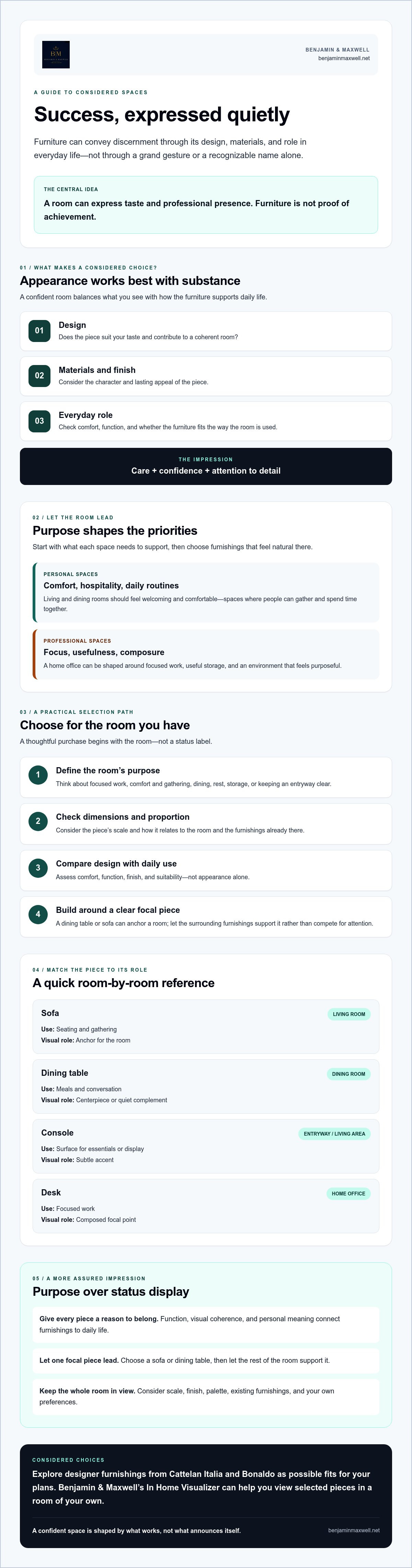
A room can hint at what its owner values before a word is spoken. Furniture shapes that impression through considered choices, not as proof of achievement. Objects have long been used as a status symbol, yet a confident space needn’t rely on conspicuous display. Furniture can express identity, but it cannot establish success.
At home, personal success may be reflected in rooms that support comfort, hospitality, and daily routines. In a study or meeting space, the emphasis shifts toward professional presence: an environment that feels composed, purposeful, and ready for focused work. The goal isn’t to perform an image, but to shape a setting that feels true to its owner. For professionals looking to carry that same balance of durable craftsmanship and understated design beyond the office, visit ALEON to discover how premium travel gear and aluminum cases support an executive lifestyle.
For a visual example of a personal approach to a home office, watch this video:
What does success-signifying furniture communicate?
Proportion affects whether a piece feels at ease in a room. Material and finish shape its visual character, while placement influences how the space is used. Together, these choices can suggest care, confidence, and attention to detail. Furniture to signify personal and professional success is most persuasive when each piece has a clear purpose and contributes to a coherent whole. Choose furnishings that suit the room and your preferences, rather than chasing a trend or making every piece compete for attention.
Which spaces shape personal and professional impressions?
A living room or dining room should feel welcoming and comfortable, making it easy to gather and spend time together. In a home office, a desk, chair, and surrounding furnishings can help create a composed working environment. Consider what each room needs to support, then let that purpose guide your choices. A setting for focused work calls for different priorities than a room arranged for conversation or display.
Why Purposeful Design Feels More Assured Than Status Display
A room designed around its use feels considered; one arranged mainly to display status can feel disconnected from daily life. Function, visual coherence, and personal meaning give furnishings a reason to belong. When each piece supports the room and the way it is lived in, the result feels more assured than status signaling alone.
How can a room feel distinguished without feeling ostentatious?
Choose one focal piece, such as a dining table or sofa, and let the surrounding furnishings support it rather than compete with it. Assess its scale, finish, and palette in relation to the room and your taste. These are useful considerations, not universal rules. A restrained approach can make a memorable impression without asking every object to command attention.
How should buyers weigh design against daily use?
Start with what the room needs to do. Consider comfort in a living area, storage in an entryway, space for dining, or a suitable setting for work and display. Then compare each candidate with the room’s purpose and existing furnishings. Furniture to signify personal and professional success should be compelling to look at and natural to use.
| Piece | Intended use | Visual role | Room fit |
|---|---|---|---|
| Sofa | Seating and gathering | Anchor for the room | Living room |
| Dining table | Meals and conversation | Centerpiece or quiet complement | Dining room |
| Console | Surface for essentials or display | Subtle accent | Entryway or living area |
| Desk | Focused work | Composed focal point | Home office |
Use this comparison as a starting point, then check how each piece works with what you already own. For further ideas, browse curated furniture and home décor from Benjamin & Maxwell.
How to Choose Furniture That Fits Your Ambitions and Your Space
A thoughtful purchase begins with the room, not a status label. Use this process to find furniture to signify personal and professional success while respecting the way you live and work.
- Define the room’s purpose. For a home office, prioritize focused work and useful storage. In living spaces, consider comfort and gathering; in dining rooms, seating and serving; in bedrooms, rest and storage; and in entryways, clear passage and a practical place for essentials.
- Measure and assess. Record the room’s dimensions, doorways, and circulation paths. Note how people move through the space, the intended use, and the furnishings and finishes already in place.
- Shortlist for real routines. Look for pieces that answer everyday household or work needs, rather than an imagined impression of status.
- Compare with care. Weigh material, form, function, scale, and room fit. Check whether each piece complements existing furnishings and finishes, and whether its visual character suits the atmosphere you want.
- Visualize before deciding. See how a shortlisted item may sit in the room, then review its practical fit and relationship to the pieces around it.
What should buyers assess before shortlisting furniture?
Bring your measurements and observations together before browsing. A home-office choice should support your working habits; a dining piece should suit how you gather; bedroom furniture should serve rest and storage. In every room, let actual routines guide the shortlist. Dimensions and purpose matter as much as appearance, so check both before focusing on decorative details.
How can a visualizer help evaluate a furniture choice?
Upload a photo of your room, select an item, and view it in that setting. The In Home Visualizer lets you explore selected products in your home environment, interact with a 3D view, and save visualized scenes to a photo gallery. Use it to consider placement and compare possibilities alongside your room measurements.
A visualized scene is one useful check, not a substitute for thinking through the room’s purpose, dimensions, and daily use. Consider those factors together before choosing a piece.
Where to Find Designer Furniture for a Considered Statement
A considered room takes shape one useful choice at a time. Benjamin & Maxwell offers a curated furniture assortment for living rooms, dining rooms, bedrooms, and home offices, including brands such as Cattelan Italia and Bonaldo. Explore the designer furniture collections, then focus on pieces that suit the room’s purpose, scale, and character.
Which furniture categories can anchor a success-conscious interior?
Let function guide your search. A dining table can provide a natural center for meals and conversation; a desk can help define a home office; seating can invite people to gather. A sideboard may offer storage, while a display piece can give selected objects a place in the room. Assess each category by its intended role, the space available, and its relationship to furnishings already there. For background on one of the brands, consult a Cattelan Italia design guide.
How can shoppers take a confident next step?
Review the furniture assortment and shortlist pieces by room. Note the dimensions, form, material, and function that matter most, then check the current details of each item as you compare. A shortlist built around practical needs and a coherent visual direction is more useful than choosing by brand recognition alone.
Before deciding, use the In Home Visualizer to upload a room photo, view a selected item in context, interact with its 3D model, and save a scene to your photo gallery. Treat the visualization as an exploration aid, not a guarantee of exact in-room appearance. Compare suitable furniture and visualize a shortlist in your own space as you refine your choices.
Choose Pieces That Feel True to Your Success
Furniture can express personal values and professional confidence, but it doesn’t create achievement. The most assured choices serve a clear purpose, feel at home in their surroundings, and bring visual coherence without relying on display alone. Let your routines, available space, and considered preferences guide the decision.
Choosing furniture to signify personal and professional success begins with practical needs, then weighs form, material, and room fit. Benjamin & Maxwell’s curated assortment includes furniture from Cattelan Italia and Bonaldo. Its In Home Visualizer lets you view selected items with a room photo, interact with 3D models, and save scenes as you compare possibilities.
Take the next step at your own pace. Explore designer furniture for your space, shortlist pieces that suit your rooms, and use visualization as one helpful part of your decision. A thoughtful choice can make everyday living feel more personal and a professional setting more composed.
Frequently Asked Questions
What furniture best signifies personal success?
Furniture that reflects your preferences and serves its purpose can suggest personal discernment. A desk, dining table, or seating arrangement may communicate care through its form, materials, and place in the room. For leisure and entertaining areas, well-crafted recreational furnishings from The Family Game Room demonstrate how dedicated hobby spaces can harmonize with sophisticated interior design. There’s no universal success-signifying item. Choose a piece that feels authentic, fits your space, and supports how you actually live, rather than relying on it to represent an achievement.
Can furniture make a professional space look more successful?
How do I choose furniture that looks refined but not showy?
Start with the room’s purpose and choose pieces that suit its scale and existing furnishings. Compare form, material, finish, and practical use instead of selecting an item solely for attention. A focal piece can give the room definition while complementary furnishings maintain balance. For furniture to signify personal and professional success, look for choices that feel meaningful and useful in everyday life.
What furniture is appropriate for a home office that reflects professional success?
Choose home-office furniture according to the work the room needs to support. Assess a desk, chair, storage, and lighting as parts of a coordinated setting, and check dimensions, circulation, and existing finishes before shortlisting. A considered arrangement can feel composed while remaining practical. No single item or brand automatically communicates professional achievement, so let function and personal preference guide you.
How can I see whether furniture will suit my room before choosing it?
Benjamin & Maxwell’s In Home Visualizer lets you upload a room photo, select furniture or décor, view items in the space, interact with 3D models, and save visualized scenes to a photo gallery. Use it to explore placement and how a piece relates to its surroundings. Treat the scene as a useful preview, not a guarantee of the room’s exact finished appearance.

Article by
Spencer Kay
Spencer is the founder and CEO of Benjamin & Maxwell and has created the most advanced technology-based website in the furniture industry. He has extensive experience in both technology and business operations having started a number of technology companies. Spencer holds a BA Degree in Economics and an MBA in International Business
Disclaimer
Benjamin & Maxwell does not intend for any of our products to be used for any specific purpose.


