

A fixture that looks striking on a standard ceiling can feel unexpectedly small beneath a double-height one. Choosing Schuller lighting fixtures for double-height ceilings means weighing the fixture’s scale against the room’s architecture and considering how its light will serve the spaces below.
Start by assessing the room from the viewpoints you use most, such as the entrance, seating area, and any upper-level overlook. Then compare each fixture’s listed dimensions, finish, light direction, and mounting details with your room plan. This guide explains how to make those comparisons and avoid relying on ceiling height alone.
Benjamin & Maxwell carries Schuller lighting and offers tools to help you compare products and picture them in your home. Use the product comparison tool to compare up to four products at one time, or use the augmented-reality visualizer to see most products in a photo of your room.
Key Takeaways
- Compare a fixture’s listed dimensions and silhouette with the room’s architecture and principal furnishings.
- Review light direction, finish, mounting information, and the fixture’s intended role before choosing.
- Map seating, dining, circulation, and focal areas to clarify where a ceiling fixture will make the most sense.
- Explore Schuller lighting through Benjamin & Maxwell, and use the product comparison tool or augmented-reality visualizer to help assess options.
Why Double-Height Rooms Need a Different Approach to Schuller Lighting
A double-height room has a ceiling well above the height of an ordinary room. That extra volume changes how a ceiling fixture relates to the space: it sits farther from people below, and its shape appears against a larger expanse of wall and ceiling. Consider Schuller lighting fixtures for double-height ceilings in relation to the entire room, rather than as isolated decorative objects.
In a tall room, successful lighting balances the fixture’s visual presence with the needs of the space below.
What changes when the ceiling rises above the everyday scale?
Distance affects how a fixture is perceived. A modest design may seem lost when viewed from the floor, while a more prominent one can dominate the architecture or compete with furnishings. Look at the room from its usual viewpoints, including the entrance and any upper-level overlook. Compare the fixture’s silhouette and listed dimensions with nearby features such as a tall wall, stairwell, or large furniture grouping.
Why one ceiling fixture may not answer every lighting need
A ceiling fixture can provide general illumination and act as a focal point, but those roles are not the same. Reading or dining may call for light closer to the activity, while artwork and architectural details may benefit from focused accent lighting. Think through how people use each part of the room: seating, dining, and circulation areas have different lighting needs.
Consider decorative impact and practical light separately. A striking fixture can shape a room’s character without supplying all the useful light needed at every level. The principles of architectural lighting design offer a useful framework for considering how daylight and electric light serve people and spaces. Plan for the room as a whole instead of expecting one fixture to do everything.
How to Compare Schuller Lighting Fixtures for a Tall Ceiling
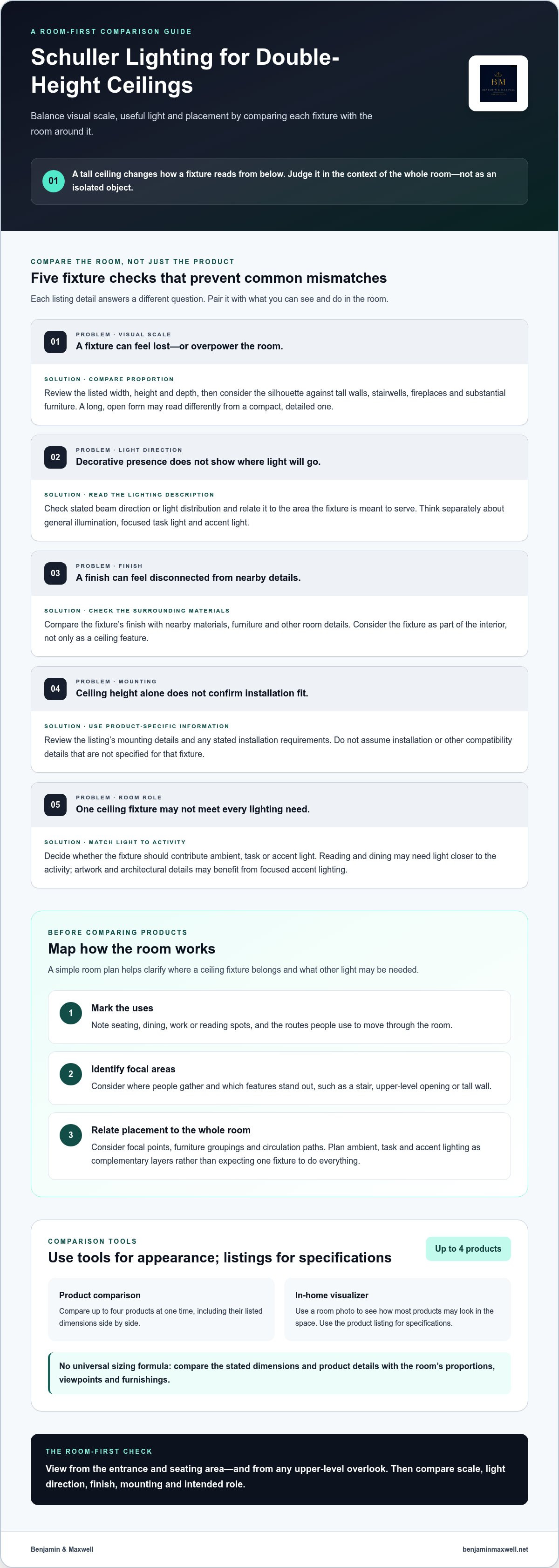
Compare each fixture with the room, not just with another product. Begin with its dimensions and visual presence, then review light direction, finish, mounting information, and the role it needs to play. There is no universal sizing formula for a double-height room, so use the product details alongside the room’s proportions and furnishings.
| What to compare | What to look for |
|---|---|
| Visual scale | Stated dimensions, silhouette, and how the fixture relates to focal features and major furnishings. |
| Light direction | Listing descriptions of where light is directed and how that suits the intended area. |
| Finish | How the fixture’s finish relates to nearby materials, furniture, and other room details. |
| Mounting | Product-specific mounting information and any stated installation requirements. |
| Room role | Whether the fixture is intended to contribute ambient, task, or accent light. |
Which fixture proportions feel balanced in a double-height room?
Dimensions describe a fixture; visual scale describes how it feels in the room. A long, open silhouette can read differently from a compact, detailed form. Compare the listed width, height, and depth with the room’s focal points, such as a stairwell or fireplace, and its substantial furnishings, such as a dining table or seating arrangement. If the product comparison tool is useful, compare up to four products at one time and consider their dimensions side by side.
Which product details deserve a closer look?
Read each listing for dimensions, mounting information, and lighting specifications. Descriptions of beam direction or light distribution can help you understand how the fixture is intended to illuminate an area. Use those details to assess how its placement may work with the room’s activities and other light sources. Do not assume dimming, bulb, or installation compatibility; rely on the specifications stated for the particular fixture.
Benjamin & Maxwell’s in-home visualizer lets you use a photo of your room to see how most products may look in the space. Treat the visualized image as a way to assess appearance and placement, and use the listing for product specifications.
Plan Placement and Layered Light Before Choosing a Schuller Fixture
A simple room plan can clarify what a ceiling fixture should contribute before you compare products. Start with the activities below, then consider how the fixture relates to the architecture and other sources of light. This gives your search for Schuller lighting fixtures for double-height ceilings a practical foundation.
- Map the room’s uses. Mark the main seating area, dining space, work or reading spots, and routes people use to move through the room. These areas have different lighting needs and may call for different sources of light.
- Identify focal areas. Note where people gather and which architectural features stand out, such as a stair, upper-level opening, or tall wall. These details help establish the room’s visual centre and inform where a ceiling fixture will feel connected to the space.
- Assess fixture placement. Consider the fixture in relation to focal points, furniture groupings, and circulation paths. Then plan how ambient, task, and accent lighting can work together, rather than expecting one ceiling fixture to meet every need.
How should the room’s focal points guide fixture placement?
Placement can reinforce the room’s composition. A fixture positioned in relation to a gathering area can help anchor that zone, while a feature wall or stair may create a different visual focus. Consider views from the entrance and seated positions as well. The goal is a deliberate relationship between the fixture and the room, not simply filling an open area beneath the ceiling.
What should be planned before installation?
Review the product’s mounting details and installation instructions as part of the selection process. Requirements vary by fixture, so use the information provided for the specific product. Keep the room plan in view as you assess its placement and relationship to other light sources.
With your priorities mapped, browse Schuller lighting and compare each option with your room’s composition and product requirements.
Find Schuller Lighting That Complements Your Double-Height Interior
A considered choice brings together the room’s purpose, architecture, and atmosphere. Before choosing Schuller lighting fixtures for double-height ceilings, use this checklist to assess the whole interior, not just the ceiling height.
- Room role: Decide what the fixture should contribute to the room’s use and lighting plan.
- Proportion: Compare its stated dimensions and visual presence with the architecture and principal furnishings.
- Light direction: Review the listing’s description to understand how the fixture’s light may relate to the space.
- Finish: Consider how its appearance sits alongside nearby materials, furniture, and decorative details.
- Product details: Read the specific dimensions, mounting information, and lighting specifications before making a choice.
Match the fixture to the room, not only the ceiling
A tall room’s character comes from its open sightlines, stairways, artwork, and arrangement of seating or dining furniture. Decide what atmosphere you want, then consider whether the fixture supports it and relates to the room’s focal points. The aim is not simply to fill vertical space. A well-considered fixture can draw the eye while allowing furnishings and architectural details to remain part of the composition.
Make the next step simple
Benjamin & Maxwell carries Schuller lighting, mirrors, wall décor, artwork, and home accents. Browse the Schuller listings and compare their product information with your checklist. You can compare up to four products at one time, then use the augmented-reality visualizer to see how most products look in a photo of your room.
Start with the Schuller lighting selection. Compare the listed details and consider each fixture in the context of your room, rather than making assumptions about dimensions, mounting, or performance.
Let the Room Guide Your Final Choice
A double-height interior offers an opportunity to make lighting part of the room’s character, not merely a way to fill the space above. As you narrow your options, picture how the room feels during everyday activities and how each fixture sits within key sightlines. Consider the view from the entrance and from the places where people gather. A thoughtful choice can complement the architecture while leaving furnishings and personal details room to stand out.
Explore Schuller lighting fixtures for double-height ceilings with the room’s proportions and purpose in mind. Benjamin & Maxwell carries Schuller lighting and home décor. Use the augmented-reality visualizer to see how most products look in your home, then review the product details and compare your options.
Explore Schuller lighting and home décor, and use the product comparison tool and in-home visualizer to help choose a fixture that feels right for your space.

Article by
Spencer Kay
Spencer is the founder and CEO of Benjamin & Maxwell and has created the most advanced technology-based website in the furniture industry. He has extensive experience in both technology and business operations having started a number of technology companies. Spencer holds a BA Degree in Economics and an MBA in International Business
Disclaimer
Benjamin & Maxwell does not intend for any of our products to be used for any specific purpose.


