

What if the most compelling wildlife sculpture in a living space isn't defined by rigid anatomical realism, but by how it captures living light? Fine art sculptures animales transcend mere mimicry. In the hands of master artisans, molten glass and pâte de cristal become fluid mediums that capture the raw, untamed spirit of the natural world.
Still, selecting the right piece can feel fraught with uncertainty. You've likely hesitated when trying to distinguish mass-produced decorative figurines from authentic heirloom art glass, or struggled to visualize how a sculpture's scale and optical brilliance will harmonize with your bespoke furnishings and ambient lighting.
This guide reveals how to evaluate, select, and curate luxury glass, crystal, and artisanal animal sculptures to elevate your interiors. From decoding material craftsmanship and light refraction to mastering room placement, you'll gain the clarity needed to build a breathtaking collection with lasting confidence.
Key Takeaways
- Understand how fine art sculptures animales transcend literal anatomical realism to express raw natural energy and sculptural poise within luxury interiors.
- Master the essential distinctions among crystal, pâte de verre, and hand-blown glass to choose works with the ideal light refraction and textural depth.
- Apply a deliberate five-step framework to balance sculpture proportions against fine furniture surfaces and architectural sightlines.
- Curate a harmonious gallery across evocative wildlife motifs while verifying scale, dimension, and ambient light interaction before acquisition.
Defining Fine Sculptures Animales: Elevating Wildlife Motifs into Haute Interior Art
Wildlife sculpture has evolved far beyond the rigid anatomical studies of centuries past. When curated with discernment, fine art sculptures animales become expressive focal points within an architecturally balanced living or dining room. Rather than mimicking literal taxidermy, museum-grade wildlife creations channel universal emotional resonances: the quiet tension of an alert predator, the graceful sweep of an avian wing, or the untamed freedom of a coursing stallion. While mass-market trinkets don't retain aesthetic relevance, authentic artisanal works anchor an interior with permanence, quiet authority, and emotional legacy.
The Artistic Lineage of Animalier Sculpture
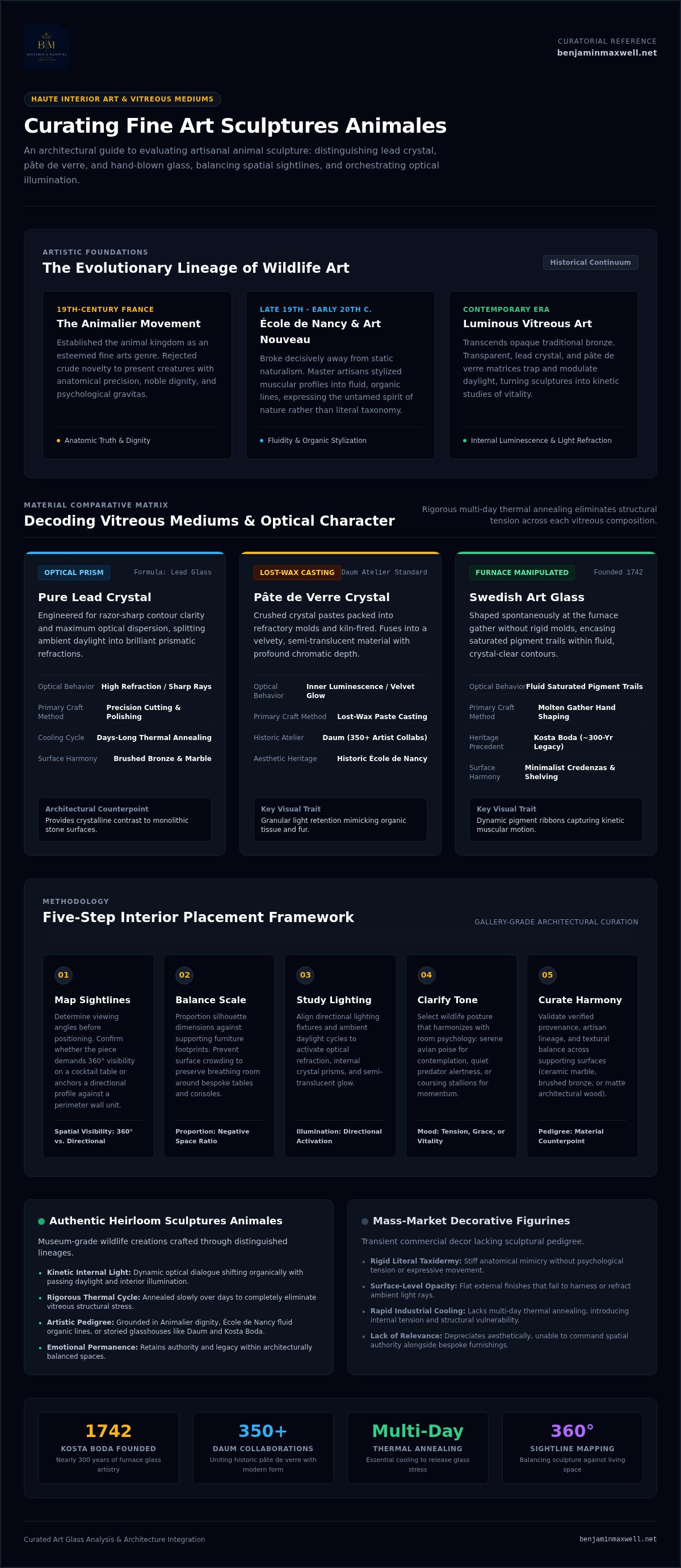
Rooted in nineteenth-century France, the Animalier movement established the animal kingdom as an esteemed fine arts genre dedicated to portraying creatures with dignity, accurate anatomy, and psychological depth. Later, Art Nouveau visionaries and masters from the École de Nancy movement broke away from pure naturalism, stylizing animal contours into fluid, organic expressions of the natural world. Heirloom collectible figures remain distinguished from transient commercial decor through this refined lineage, revealed by master-level finishing, museum pedigree, and undeniable sculptural presence.
Capturing Movement and Soul Through Non-Traditional Mediums
Where traditional opaque bronze emphasizes external silhouette, noble crystal and artisanal art glass unlock kinetic depth from within. Transparent and translucent contours capture ambient daylight and architectural illumination, casting subtle refraction patterns across a room as the sun shifts. This optical dialogue introduces an organic cadence to the sculpture, transforming static crystal into an ever-changing study of vitality and natural grace.
Material Mastery: Comparing Crystal, Pâte de Verre, and Hand-Blown Art Glass
Selecting authentic sculptures animales requires understanding how distinct vitreous mediums respond to fire, chemistry, and light. Pure lead crystal offers razor-sharp clarity and high optical refraction, splitting passing light into prismatic brilliance. Conversely, studio art glass prioritizes fluid transparency, capturing organic movement through spontaneous hand manipulation. Both mediums demand rigorous thermal annealing over days, slowly cooling each silhouette to eliminate structural tension. Resting atop ceramic marble tables or brushed bronze consoles, these luminous mediums provide an ethereal counterpoint to solid architectural surfaces.
The Lost-Wax Radiance of Pâte de Verre Crystal
Mastered through an arduous lost-wax casting method, the ancient technique of pâte de verre involves packing crushed crystal pastes into refractory molds before kiln firing. The granules fuse into a velvety, semi-translucent material with subtle chromatic depth. French atelier Daum remains the peerless standard bearer, with more than 350 collaborations uniting historic École de Nancy craftsmanship with modern sculpture. Discover the peerless artistry of Daum to appreciate how this medium imbues wildlife forms with inner luminescence.
Luminosity and Character in Contemporary Swedish Art Glass
Swedish glasshouse Kosta Boda brings a distinctly vibrant energy to animal sculpture, drawing on a legacy spanning almost 300 years since being founded in 1742. Rather than relying on rigid molds, master glassmakers manipulate molten gathers directly at the furnace, encasing saturated pigment trails within crystal-clear glass. These expressive animal profiles introduce bold personality to minimalist credenzas and open shelving. You can explore these artisanal creations across the wider offerings at Benjamin & Maxwell to find silhouettes that speak to your aesthetic vision.
How to Choose the Right Animal Sculpture: A Five-Step Interior Framework
Integrating fine art sculptures animales into an architectural interior demands a deliberate, gallery-level eye. Successful curation follows five foundational steps:
- Map sightlines: Determine whether your piece requires a 360-degree viewpoint atop a central cocktail table or anchors a directional profile against a wall unit.
- Balance scale: Proportion the sculpture to avoid crowding the supporting surface.
- Study lighting: Position directional fixtures to awaken internal refraction and transparency.
- Clarify emotional tone: Match serene avian forms to restful rooms, reserving dynamic predatory silhouettes for energetic entertaining spaces.
- Harmonize textures: Counterbalance luminous glass against matte ceramic marble, natural stone, or tailored upholstery.
Proportion, Placement, and Surface Harmony
Visual weight governs compositional balance. A dense crystal panther demands generous negative space to command respect, whereas a stylized glass avian figure sits effortlessly on an airy display shelf. When styling pieces atop executive desks or credenzas, ensure the object doesn't compete with adjacent table lamps. Explore complementary anchors within our curated luxury home furnishings to establish seamless architectural dialogue.
Illumination Architecture and Optical Care
Focused illumination reveals the internal soul of vitreous art. Low-heat LED spotlights and soft ambient daylight draw out delicate color gradations without inducing thermal stress. Optical maintenance requires minimal intervention. Never apply harsh chemical solvents or abrasive glass cleaners; gentle dusting with a soft microfiber cloth preserves clarity and protects lustrous finishes indefinitely. Take advantage of the In Home Visualizer to preview how fine crystal silhouettes harmonize with your lighting before acquisition.
Curating Your Animal Sculpture Gallery: Spatial Harmony and Provenance
Building an evocative interior collection requires curating subtle tension and harmony. Within Benjamin & Maxwell's curated gallery of 145 collectible animal figures and wildlife sculptures, authentic sculptures animales channel distinct emotional responses. Feline forms communicate coiled authority and power, avian silhouettes lend soaring grace, and aquatic figures introduce tranquil fluidity. Creating multi-piece groupings with contrasting heights and postures builds a compelling visual dialogue across consoles and display shelving. To refine your choice between competing silhouettes, our digital comparison feature permits you to compare up to 4 products at one time.
Previewing Artworks with In-Home Spatial Visualization
Visualizing how light-refracting crystal interacts with room furnishings no longer requires guesswork. With our photo-based In Home Visualizer, collectors can preview fine art sculptures animales directly within their living spaces. Dynamic 3D rotation and augmented scale validation confirm how translucent contours, optical angles, and shadows align with bespoke furniture before an acquisition occurs.
Selecting Heirloom Centerpieces for Modern Living
An authentic wildlife centerpiece reflects both architectural refinement and personal narrative. True connoisseurs value provenance; each piece represents hours of kiln devotion and master shaping. When curating an enduring display, choose silhouettes that echo your lifestyle while adding dimensional depth to your private sanctuary. Trade specialists and discerning collectors are invited to connect via our dedicated contact channels or discover exceptional works across our wider curated collections.
Bring Enduring Artistry into Your Private Sanctuary
Selecting fine sculptures animales is an investment in lasting heritage and optical vitality. True connoisseurship isn't about mere display; it's about curating works that respond to shifting ambient light and resonate with your home's architectural rhythm. When you balance proportion, illuminate vitreous contours properly, and honor authentic artisanal techniques, wildlife art becomes an evocative personal anchor.
Benjamin & Maxwell celebrates this legacy with a curated gallery of 145 collectible animal figures and wildlife sculptures, uniting master ateliers like Daum and Kosta Boda. Test scale effortlessly using our photo-based In Home Visualizer to ensure every silhouette integrates gracefully with your furnishings. Explore the curated sculptures animales collection today to find an heirloom centerpiece that enriches your interior for generations.
Frequently Asked Questions
What distinguishes fine sculptures animales from everyday animal figurines?
Fine art sculptures animales differ through museum-grade provenance, noble material composition, and expressive sculptural interpretation rather than mechanical mass reproduction. Everyday figurines rely on synthetic resins and assembly-line molds that flatten organic contours. In contrast, heirloom pieces by historic ateliers utilize arduous lost-wax casting or free-hand glassblowing. Each creation captures natural spirit, possesses enduring cultural pedigree, and commands quiet authority within a fine interior.
How should I position an animal sculpture to maximize its light-catching qualities?
Place your sculpture where directional light passes through its contours rather than washing over an opaque front. Positioning the piece near a north-facing window introduces soft, changing daylight that activates internal color gradients without generating damaging heat. For evening display, install dedicated low-heat LED spotlights angled at thirty degrees. This illumination architecture reveals delicate internal refractions, casting subtle, kinetic shadows across adjacent architectural surfaces.
Can crystal and glass animal sculptures be safely integrated into minimalist modern interiors?
Yes, fine vitreous animal sculptures create an exceptional counterbalance within minimalist interior schemes. Their translucent profiles and fluid silhouettes soften the rigid rectilinear geometry of modern architectural spaces without introducing visual clutter. When paired with ceramic marble surfaces, brushed metals, or neutral palettes, a solitary, expressive animal sculpture acts as a deliberate focal anchor, providing organic warmth, textural depth, and sophisticated visual interest.
What is the proper method for cleaning and preserving delicate pâte de verre sculptures?
Preserve pâte de verre sculptures through dry dusting with an ultra-soft microfiber cloth or a natural-hair brush. Avoid chemical window cleaners, alcohol solutions, and abrasive detergents, as these can strip delicate surface patinas and degrade crystalline luster. If deeper maintenance becomes necessary, lightly dampen a cloth with distilled water, wipe the sculpture gently without excess pressure, and dry it immediately to prevent mineral spotting.
How can I ensure an animal sculpture matches the scale of my existing luxury furniture?
Ensure proportional balance by selecting sculptures animales that occupy roughly one-third of the supporting furniture surface's width. Overly large works crowd consoles and cocktail tables, while diminutive pieces feel lost beside substantial upholstered seating. To verify spatial harmony prior to acquisition, utilize digital tools like Benjamin & Maxwell's In Home Visualizer, which lets you examine 3D rotation and confirm proportions against existing room sightlines.

Article by
Spencer Kay
Spencer is the founder and CEO of Benjamin & Maxwell and has created the most advanced technology-based website in the furniture industry. He has extensive experience in both technology and business operations having started a number of technology companies. Spencer holds a BA Degree in Economics and an MBA in International Business
Disclaimer
Benjamin & Maxwell does not intend for any of our products to be used for any specific purpose.


