

What makes a memorable centre de table? It is not necessarily the largest piece, but the one that feels at home on your table. A sculptural design can bring character to a dining room, while the wrong scale or finish may crowd the surface or feel too formal for everyday meals. Choosing well means balancing proportion with artistry.
If you are weighing a petite accent against a more striking centrepiece, or comparing glass with other materials, start with the table and the room around it. The right piece should suit the table’s shape, complement the setting and leave space for dining and conversation.
This guide explains how to assess scale, visual presence and material, so you can choose a piece for everyday dining and special occasions. We’ll consider sculptural designs, including Daum crystal centrepieces, and how to balance distinctive character with ease of use.
Key Takeaways
- Use the table’s available surface and shape to find a centre de table that feels balanced rather than crowded.
- Consider length and width as the piece’s footprint, then assess height separately to judge its visual presence.
- Compare sculptural designs by their listed dimensions and character to find a focal point suited to your setting.
- Follow the collection’s care guidance: maintain these pieces with a soft, dry cloth.
What a Centre de Table Adds to a Dining Setting
A centrepiece gives a table setting a visual anchor. It gathers the eye and gives the arrangement a sense of order, rather than leaving the surface unfinished or filling it with unrelated objects. Simply put, a centre de table is a decorative focal point that brings visual balance to the table and its surroundings. Its purpose is not just to occupy the middle of the table, but to relate thoughtfully to the room as a whole.
A centrepiece may be sculptural, made primarily to be admired, or functional, intended to hold or present items. The two roles can overlap, but do not assume that every decorative accent is suitable for serving food, or that every serving piece should be the room’s principal artwork. For a broader account of the history and purpose of a centre de table, including its varied forms, see Wikipedia’s overview.
For visual inspiration for an occasion-led tablescape, this video offers seasonal ideas:
A Focal Point That Belongs to the Whole Room
Look at the table alongside the chairs, nearby furniture and the room’s overall character. A finely detailed crystal accent can add artistry to a restrained setting; a more substantial sculptural form may feel at home among expressive furnishings. Aim for harmony, not exact matching. Benjamin & Maxwell offers decorative pieces, including Daum crystal, with varied scale and visual presence in its curated centrepiece collection.
Everyday Dining and Special Occasions
A considered focal point can make everyday meals feel composed without turning the table into a formal display. For a gathering, the same piece can bring a sense of occasion and character. Choose a design you enjoy seeing in both settings, and leave room for the practical needs of dining. A centrepiece that works beyond one celebration can become part of the room’s continuing story, rather than a decoration brought out for a single evening.
How to Choose a Centre de Table by Scale, Shape, and Style
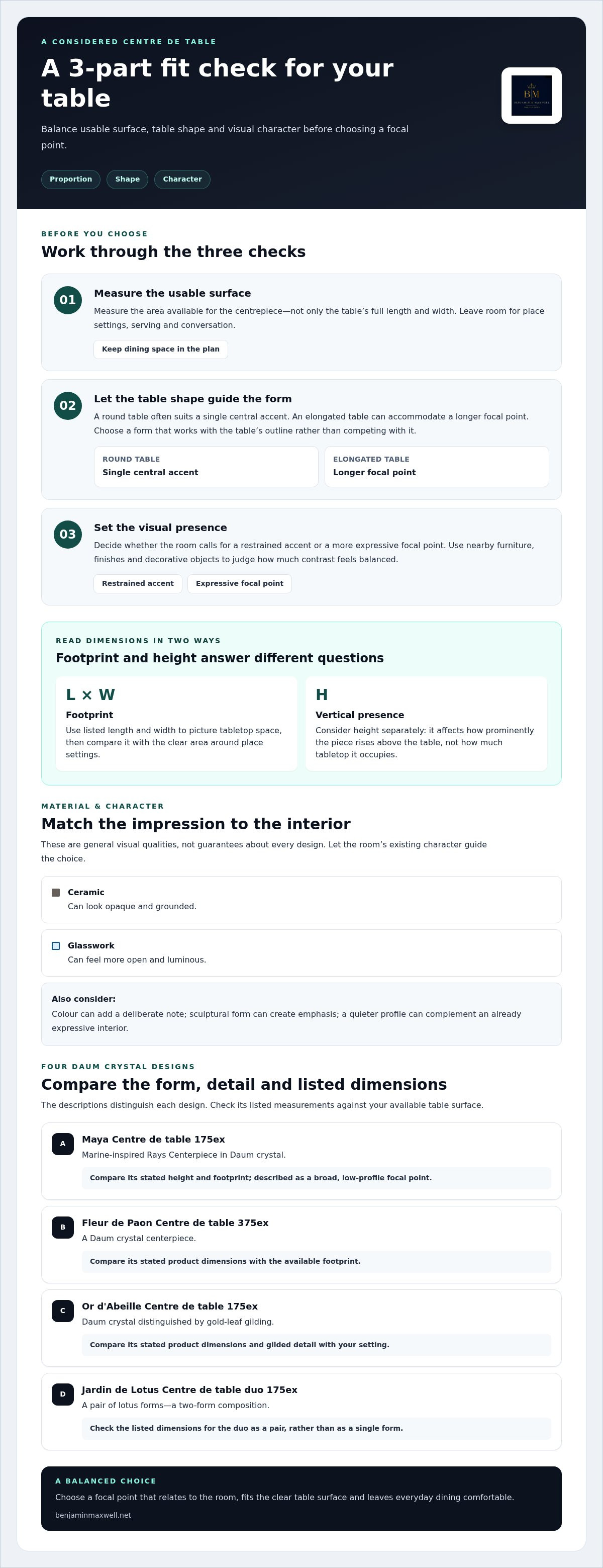
A refined piece should hold the eye without taking more space than the table can spare. Use this sequence to assess the fit before choosing by appearance:
- Measure the available surface. Account for place settings and the room diners need for serving and conversation. Measure the usable area, not just the table’s full length and width.
- Assess the table shape. A round table often suits a single central accent, while an elongated table can accommodate a longer focal point. Choose a form that works with the table’s outline instead of competing with it.
- Compare visual presence. Decide whether the room calls for a restrained accent or a more expressive focal point. Existing furniture, finishes and decorative objects can help you judge how much contrast feels balanced.
Read Dimensions Before Choosing a Shape
Use a listed length and width to picture a piece’s footprint, then compare it with the clear surface around place settings. Consider height separately: it affects how prominently a piece rises above the table, not how much tabletop it occupies. Footprint measures the space a centrepiece uses; height measures its vertical presence. Both matter when the table needs to remain comfortable for dining.
Historical arrangements such as the ‘surtout de table’ show how a centrepiece can shape a table’s visual character. In a contemporary room, apply the same principle with attention to proportion and everyday use.
Match Material and Visual Character to Your Interior
Material affects the impression a centrepiece makes. Ceramic can look opaque and grounded, while glasswork can feel more open and luminous. These are general visual qualities, not guarantees about every design. Let the room guide your choice: colour can add a deliberate note, sculptural form can create emphasis, and a quieter profile can complement an already expressive interior. Daum’s hand-crafted crystal glass objects include bowls, vases, figurines and other décor, offering a sculptural option for a dining setting.
Once you’ve considered footprint, shape and character, browse the centre de table collection and compare designs with your setting in mind.
Standout Centre de Table Designs: Compare Four Distinctive Pieces
Compare distinctive designs by looking beyond their names. Review each piece’s stated dimensions alongside its description, then picture the space it would occupy on your table. The table below highlights four Daum crystal designs. Use the listed measurements to assess how each may fit your setting.
| Product | Stated dimensions | Design description | Suggested visual role |
|---|---|---|---|
| Maya Centre de table 175ex | Compare listed height and footprint | Marine-inspired Rays Centerpiece in Daum crystal | A broad, low-profile focal point |
| Fleur de Paon Centre de table 375ex | Compare stated product dimensions | Daum crystal centerpiece | A sculptural accent whose presence can be judged against its footprint |
| Or d'Abeille Centre de table 175ex | Compare stated product dimensions | Daum crystal with gold-leaf gilding | A decorative focal point with a gilded detail |
| Jardin de Lotus Centre de table duo 175ex | Compare listed dimensions for the duo | A pair of lotus forms | A two-form composition |
A Sculptural Statement or a Pair of Forms?
Maya’s marine inspiration gives it a distinctive character. Its stated height and footprint help you judge how its broad, low profile may relate to your table. Jardin de Lotus offers a different format: its name identifies a duo of lotus forms, so consider the dimensions for the pair rather than treating it as a single centrepiece.
Compare Decorative Details and Listed Dimensions
Fleur de Paon is described as a Daum crystal centerpiece, while Or d'Abeille is distinguished by gold-leaf gilding. Compare each design’s listed measurements to see which scale and detail best suit your dining setting. For a more expressive centre de table, weigh its visual character against the available surface. For a quieter effect, let the surrounding room remain the focus.
Explore the centre de table collection to compare these designs and their listed dimensions.
Care for Your Centerpiece and Choose Your Next Step
A considered choice brings together three things: a footprint suited to your table, a visual character you enjoy and a presence that feels at home in the dining room. Before deciding, revisit the dimensions and description of your preferred centre de table. Picture how its scale relates to the usable surface, then consider whether the design complements your furnishings and the way you use the table.
A Simple Care Note for Your Chosen Piece
The collection’s care guidance is straightforward: maintain these pieces with a soft, dry cloth. Follow that instruction rather than assuming other products or cleaning methods are appropriate. Keep the care note in mind as you compare designs, particularly if you are choosing a decorative piece to enjoy in your dining setting over time.
Browse the Collection with Your Criteria in Mind
As you compare designs, return to their listed dimensions and descriptions. Look at length and width to understand the space each piece occupies, and consider height separately when picturing its visual presence. Then weigh the design description against your priorities: a subtle accent, a sculptural focal point or a distinctive form that gives the table added character. No single choice suits every setting. Look for proportions and an appearance that feel considered in yours.
Compare the options with your table and room in mind. A design that feels at home at everyday meals can also bring distinction to a special gathering, making its character part of your home beyond one occasion.
Explore the centre de table collection and find a piece that suits your home.
Choose a Piece to Live With
The most meaningful choice feels natural in your home, not only on the day it first takes its place. Let your table and room guide you, then choose a design that brings character without asking the setting to become something else. A centre de table can become part of daily life, present at ordinary meals and ready to lend distinction to a gathering.
Selected Daum crystal centrepieces in the collection are presented with named designs and listed dimensions, helping you picture their scale. The collection also brings together decorative pieces suited to everyday dining and special occasions. Take time to look, compare and imagine a piece in your own setting. Explore the centre de table collection and choose a design that feels right for the moments still to come.
Frequently Asked Questions
Can I use a centrepiece on a console table or coffee table?
Yes. A decorative centrepiece can suit a console or coffee table if its scale leaves room for the surface’s other uses. On a console, consider whether you still need space for keys or a lamp. On a coffee table, leave room for drinks or books. Check the piece’s listed dimensions and picture it in the space before deciding.
Does a crystal centrepiece need flowers or candles?
No. A crystal design can stand alone, with its form providing the visual interest. Flowers or candles are optional, not necessary companions. If you are considering them, first decide which object should draw the eye. A simple arrangement can let the crystal remain prominent, while several decorative items together may make a smaller surface feel busy.
Is a centre de table a suitable host gift?
It can be a thoughtful gift for a host who appreciates distinctive home décor. Consider what you know of their interior and where they might display it, such as a dining table, entry console or living-room surface. A design that suits their taste can feel personal beyond the occasion. If you are unsure of their style, a quieter decorative accent may be easier to place.
Can I pair a centrepiece with a table runner?
Yes, as long as the pairing leaves the table comfortable to use. A runner can frame a centrepiece without competing with it. For example, let a sculptural piece take precedence and choose a simple runner, or use a restrained accent if you want the textile to contribute more to the setting. Keep the arrangement open enough to appreciate the object’s form.
What does “centre de table” mean in English?
“Centre de table” translates as “table centrepiece” or simply “centrepiece.” The French phrase refers to a decorative object or arrangement associated with the middle of a table. In English, it can describe a single sculptural piece as well as a composed arrangement. In this guide, it means a decorative focal point chosen to suit a dining setting.

Article by
Spencer Kay
Spencer is the founder and CEO of Benjamin & Maxwell and has created the most advanced technology-based website in the furniture industry. He has extensive experience in both technology and business operations having started a number of technology companies. Spencer holds a BA Degree in Economics and an MBA in International Business
Disclaimer
Benjamin & Maxwell does not intend for any of our products to be used for any specific purpose.


