

What if the Daum crystal sculpture that feels right for your home isn’t the most dramatic one, but the one whose form and color sit naturally in its setting? When several daum crystal sculptures appeal for different reasons, a useful way to choose is to compare what you can see and what the product descriptions say, then picture each piece in its intended spot.
A sculptural portrait and a more abstract interpretation of the female form can create distinct impressions. Color, proportions, and surroundings shape how each artwork reads, too. Art Féminin offers a way to explore these different expressions and decide which feels most at home in your space.
This guide walks through practical ways to compare form, palette, artistic context, and display setting. You’ll learn what to look for in a product description, how to assess a sculpture alongside the colors and objects around it, and how Daum’s handcrafted crystal gives these works their distinctive presence. Use those details to make a considered choice based on your taste and the place you have in mind.
Key Takeaways
- Compare daum crystal sculptures by silhouette, stated palette, and the mood suggested by the product description, rather than relying on a single feature.
- Decide whether the sculpture should be a focal point or a quieter accent, then assess the display surface, sightline, and nearby colors.
- Use a simple selection order: choose a preferred mood, compare palettes, review the artist attribution, and picture the artwork in its intended setting.
- Explore works such as Adèle Grise et violette, Premier Amour, and Petite Muse, using each product description to understand its stated details.
What Makes Daum Crystal Sculptures Distinctive?
Daum crystal sculptures are handcrafted crystal glass artworks, shaped as sculptural objects rather than everyday glassware. Their appeal comes from the relationship between material, artistic design, and craftsmanship. Look at the outline first, then notice how color and surface contribute to the character of the piece.
This perspective helps you consider what a sculpture adds to a room, beyond its material. Daum’s artistic heritage draws on the École de Nancy, Arts Décoratifs, Art Nouveau, and Art Deco. These movements offer context for appreciating the brand’s sculptural and decorative work.
For a closer look at the making of a Daum crystal piece, watch this video:
How Daum’s artistic heritage informs its sculptural work
These influences provide more than historical reference. The École de Nancy, Arts Décoratifs, Art Nouveau, and Art Deco are part of Daum’s artistic lineage, placing its works in a continuing dialogue between decorative art and sculpture. For a broader overview, explore Daum crystal history, including its Art Nouveau period.
Daum’s creative identity also reflects its collaborations with artists and designers. The brand has worked with more than 350 collaborations with artists and designers, bringing a range of perspectives to its crystal artworks. Among the collaborators named by Daum are Majorelle, Dali, Arman, César, Villeglé, Etienne, Texier, Tallon, McConnico, Massaud, and Ghion. When comparing daum crystal sculptures, consider the artist attribution listed for each particular work, then look closely at its form and palette to decide what resonates with you.
How to Compare Daum Crystal Sculptures by Form, Color, and Mood
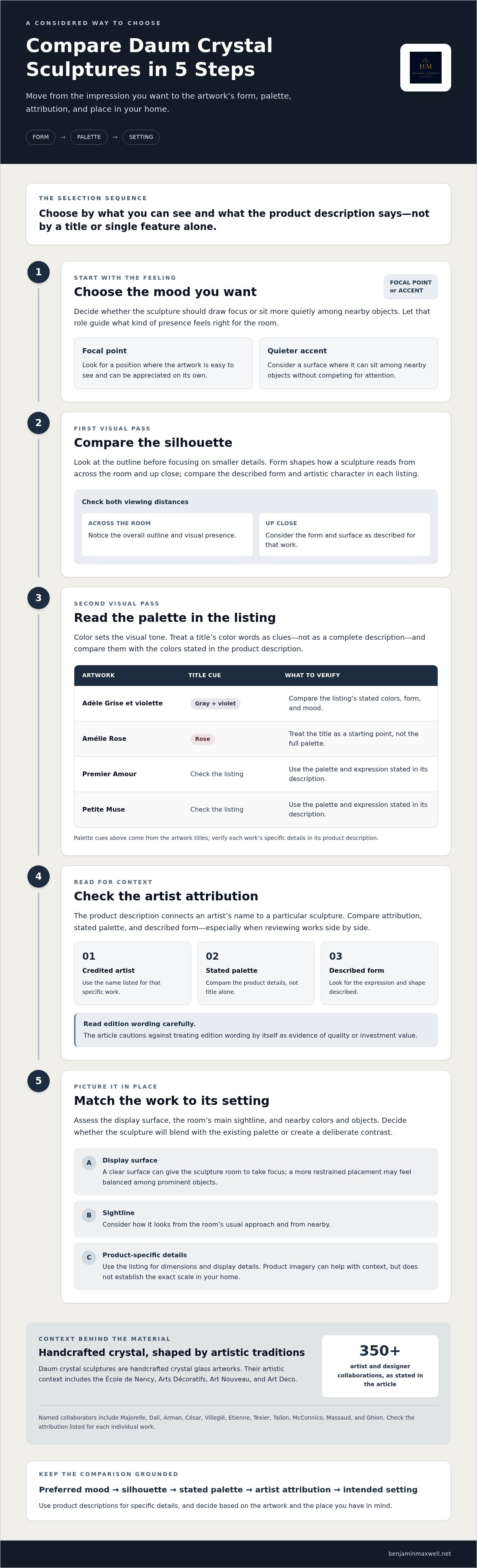
Compare each sculpture in three passes: start with its silhouette, check the palette stated in its product description, and then consider the mood suggested by the description. A title can offer a color cue, but it doesn’t provide all the artwork’s details. Palette sets the visual tone, while form shapes how a sculpture reads from across the room and up close.
For example, Adèle Grise et violette signals gray and violet in its title, while Amélie Rose signals rose. Treat those words as a starting point, not a complete description. Compare the listing’s stated colors and artistic character, and look at how the sculpture’s shape may relate to the other objects around it.
| Artwork | Artist | Described palette | Visual impression |
|---|---|---|---|
| Adèle Grise et violette | See product description | Gray and violet in the title | Compare its described form and mood |
| Amélie Rose | See product description | Rose in the title | Compare its described form and mood |
| Premier Amour | See product description | Use the palette stated in the listing | Look for the artist’s described expression |
| Petite Muse | See product description | Use the palette stated in the listing | Look for the artist’s described expression |
Read artist attribution and product descriptions carefully
Artist attribution adds context, but the product description connects a particular name to a specific sculpture. Read the listings for Premier Amour and Petite Muse side by side. Note the credited artist, stated palette, and description of the form; compare those details rather than relying on the titles alone. Edition wording is another detail to read carefully, but it shouldn’t be treated by itself as evidence of quality or investment value.
For further context on the medium, explore this overview of the pâte-de-verre technique. Use these cues to compare daum crystal sculptures by what you can see and read, then browse the Daum crystal collection to explore the available artworks.
Where Should You Display a Daum Female-Form Sculpture?
Start by deciding what role the sculpture should play. If you want it to be a focal point, choose a position where it is easy to see and can be appreciated on its own. If you want it to act as a quieter accent, consider a surface where it can sit among nearby objects without competing for attention. In either case, aim for a considered arrangement rather than simply filling an empty spot.
Assess the display surface, the main sightline into the room, and the colors and objects nearby. Compare the sculpture’s stated palette with the surroundings: will it blend into the room’s existing colors or create a deliberate contrast? Product imagery can help you picture the work in context, but it doesn’t establish its exact scale in your home. Use the product-specific information for dimensions and display details instead of guessing.
Match the artwork’s visual presence to the room
Look at the room’s existing palette and visual rhythm. If the area already contains prominent objects, a more restrained placement may feel balanced. A clear surface can give a sculpture room to take focus. View the product imagery alongside the intended setting and consider how the work will look from the room’s usual approach as well as from nearby.
Le Soleil and Rêve d'amour can serve as prompts for this comparison. Consult each work’s product description for its stated details, and avoid drawing conclusions about color, form, or scale from its title alone. The same care helps you compare daum crystal sculptures without assuming every piece needs the same kind of display.
For complementary furnishings and décor, explore the complete home collection. To compare female-form works and their individual descriptions, browse the Art Féminin sculptures and consider which piece best suits your chosen setting.
How to Choose Your Daum Sculpture from Art Féminin
Follow a simple sequence to make your choice. First, decide what mood you want the artwork to bring to the room, such as a bold presence or a more delicate note. Next, compare the colors stated in the product descriptions with the palette of the intended space. Review the artist attribution, then picture the sculpture in its planned display setting.
Assess Adèle Grise et violette, Premier Amour, and Petite Muse as individual works rather than using their names as shorthand for assumed features. Read each product description for its stated colors, artistic character, and credited artist. A title doesn’t establish the complete palette or form, and an attribution should be matched to the specific work rather than inferred from another sculpture. For daum crystal sculptures, these details provide a more considered basis for choosing than a first impression alone.
With those points in mind, explore the Art Féminin collection and compare the works that speak to your taste.
A final checklist before selecting a piece
- Mood: Does the work’s described artistic character suit the atmosphere you want?
- Color: Do its stated colors complement or intentionally contrast with the room?
- Artist: Have you reviewed the attribution for this specific artwork?
- Setting: Does the intended surface and sightline give the piece a considered place in the room?
- Details: Have you used the individual product description for stated information instead of guessing about dimensions or display requirements?
Let the details guide your decision while leaving room for your own response. To consider the artworks side by side, browse Daum sculptures and feminine artworks.
Choose a Sculpture That Feels at Home
A well-considered choice involves more than an appealing first impression. Compare each work’s form, palette, and described artistic character, then think about how it relates to the surface, sightline, and colors of its intended setting. Use the individual product description for artwork details, and let your own response guide the final decision.
Daum’s handcrafted crystal glass sculptures and artistic objects bring sculptural expression into the home. Art Féminin presents female-form artworks across a range of styles, making the collection a place to compare different interpretations and consider which suit your taste and surroundings. With a clearer sense of what to look for, you can browse daum crystal sculptures and focus on the work that feels most harmonious in your space.
Explore Daum Crystal at Benjamin & Maxwell to compare the collection and find an artwork that speaks to you.
Frequently Asked Questions
What makes Daum crystal sculptures different from other decorative sculptures?
Daum crystal sculptures are handcrafted crystal glass artworks that bring sculptural design and craftsmanship together. Daum’s artistic heritage draws on the École de Nancy, Arts Décoratifs, Art Nouveau, and Art Deco, giving its works a distinctive place within decorative art. The brand’s more than 350 collaborations with artists and designers have brought a range of creative perspectives to its sculptural pieces.
How do I choose a Daum crystal sculpture for my home?
Consider the mood you want, the colors stated in the sculpture’s product description, its artist attribution, and where you plan to display it. Compare the described form and palette with the room’s existing colors and nearby objects. Decide whether you want a focal point or a quieter accent, and use the individual product description for specific details rather than assuming dimensions or display requirements.
Are Daum crystal sculptures made using pâte de verre?
The linked overview introduces the pâte-de-verre technique, but a technique should not be assumed for every Daum sculpture. For a particular work, use its individual product description for the stated materials and making details. This keeps the answer specific to the artwork rather than applying one description to the entire collection.
Which Daum artists are represented in the Art Féminin examples?
Daum’s collaborators include Majorelle, Dali, Arman, César, Villeglé, Etienne, Texier, Tallon, McConnico, Massaud, and Ghion. To find the artist credited for a specific Art Féminin sculpture, read that work’s product description. Match each attribution to its individual artwork rather than assuming the same artist is associated with another piece.
How should I care for a Daum crystal sculpture?
Follow any care guidance stated specifically for the Daum sculpture you own, rather than applying instructions intended for other materials. Before cleaning or moving the piece, refer to its product-specific recommendations instead of guessing about suitable cloths, cleaners, or handling. This helps you care for a handcrafted crystal artwork without assuming every sculpture has identical care requirements.

Article by
Spencer Kay
Spencer is the founder and CEO of Benjamin & Maxwell and has created the most advanced technology-based website in the furniture industry. He has extensive experience in both technology and business operations having started a number of technology companies. Spencer holds a BA Degree in Economics and an MBA in International Business
Disclaimer
Benjamin & Maxwell does not intend for any of our products to be used for any specific purpose.


