

A crystal sculpture can feel like a living form as much as a decorative object. Daum crystal sculptures draw on the flowing lines of Art Nouveau and the artistic heritage of École de Nancy, taking shape as animals, flowers, vases and other sculptural forms. Their appeal lies in how those forms reveal crystal’s color, texture and craftsmanship.
Collectors may first notice the subject: a flower’s graceful contours, an animal in motion or the presence of a finely worked vase. The surface matters just as much. Daum describes pâte de verre as having a grain, texture and softened contours that blown glass cannot achieve, giving each form its own visual character.
Explore how Art Nouveau and École de Nancy inform Daum’s designs, what to notice in animal and floral pieces, and how vases and decorative sculptures make texture part of the composition. This guide also considers the craft behind pâte de verre, so you can appreciate not only what a piece depicts, but how its color and contours shape the viewing experience.
Key Takeaways
- Notice how Art Nouveau and École de Nancy influence the graceful lines and natural subjects of animal and floral forms.
- Look closely at pâte de verre: its grain, color and softened contours contribute as much to a sculpture’s character as its subject.
- Compare vases and decorative forms by considering how their shape, texture and color work together in a space.
- Use the guide to understand Daum’s artistic heritage, then explore Benjamin & Maxwell’s Daum Crystal offering as a next step in discovering pieces.
Crystal sculptures inspired by animals and flowers
Art Nouveau brings nature into decorative art through flowing contours, asymmetry and forms drawn from plants and animals. Daum’s animal and floral sculptures reflect this sensibility: a flower becomes a sculptural presence, while an animal’s posture suggests movement. École de Nancy’s artistic heritage offers a useful lens for viewing these pieces, where natural subjects meet craftsmanship.
The range extends from Daum’s Camelia decorative flower to animals such as a bison, swan, lion or tiger. Each subject presents a different design challenge. A flower depends on the arrangement of its petals and a clear silhouette; an animal relies on its stance, proportions and distinctive features. In each, subject and technique are closely connected.
For a closer look at pâte de verre craftsmanship, signatures and floral motifs, watch this collector-focused video:
Animal sculptures reward close observation. A bison’s mass differs from a swan’s extended neck or a lion’s composed stance. A bee has its own scale and character, while a tiger’s recognizable markings draw attention to surface and color. Rather than treating these figures as simple replicas, consider how each turns a natural subject into a compact composition.
Plant-inspired pieces offer a related but distinct experience. The Camelia decorative flower emphasizes the shape of its petals, while a flower base paired with a butterfly vase combines botanical and animal forms. View these designs from different angles: notice how the silhouette changes, where color gathers and whether the subject remains clear from across the room.
To assess a piece, start with its outline, then examine the details that define its subject. Compare a swan’s sculpted contours with a flower’s layered form, and notice how color creates depth in each motif. This approach helps you describe what draws you to a work, whether it is graceful movement, botanical detail or a striking animal presence.
Craftsmanship and crystal texture
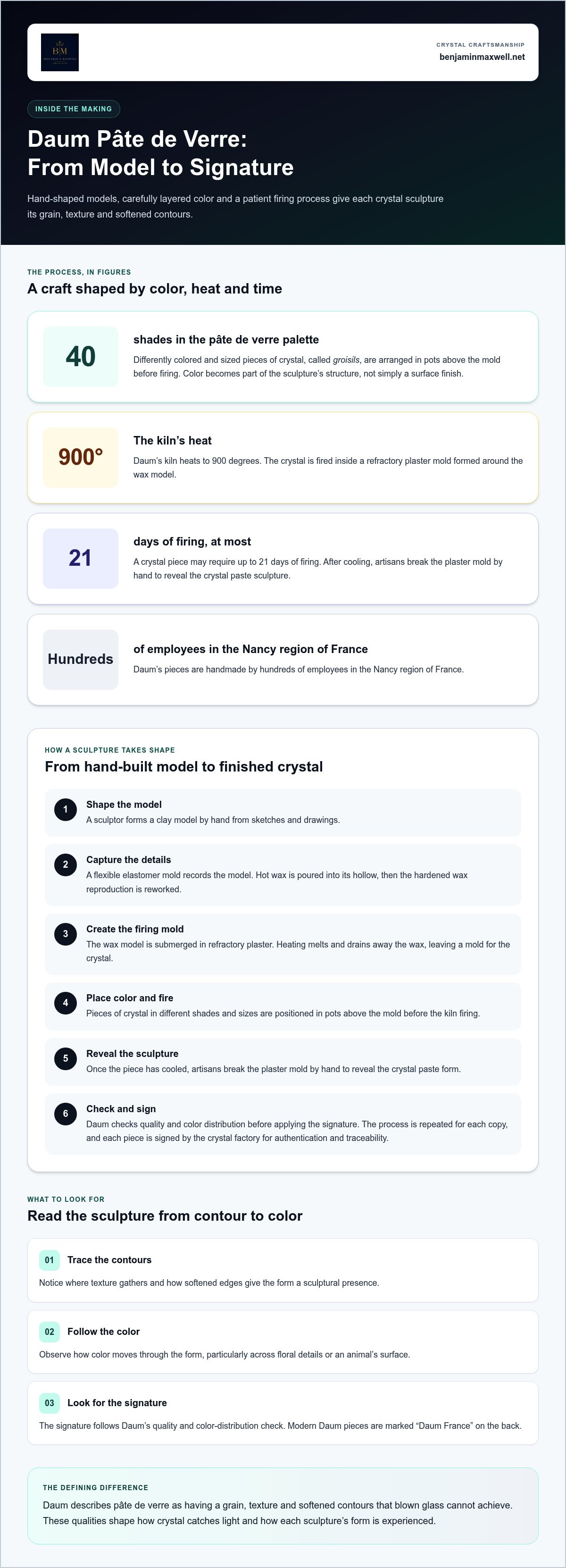
Daum’s pâte de verre technique gives crystal a character distinct from the smooth, even appearance associated with blown glass. Daum describes the material as having grain, texture and softened contours that blown glass cannot achieve. In a sculpture, these qualities matter: textured surfaces can catch light unevenly, while softened edges lend forms a sculptural presence.
The process begins with a sculptor shaping a clay model by hand from sketches and drawings. A flexible elastomer mold records its details. Artisans pour hot wax into the hollow mold, then rework the hardened wax reproduction. Each stage carries the model’s contours forward, so details in leaves, feathers or folds depend on careful preparation.
Next, the wax model is submerged in refractory plaster. Heating melts and drains the wax, leaving a mold for the crystal. Pieces of differently colored and sized crystal, called groisils, are placed in pots above it before firing. Daum’s pâte de verre process uses a palette of 40 shades, allowing color to become part of the sculpture’s structure rather than simply a surface finish.
Firing demands patience. Daum’s kiln heats to 900 degrees, and a crystal piece may require up to 21 days of firing. After cooling, artisans break the plaster mold by hand to reveal the crystal paste sculpture. Daum’s pieces are handmade by hundreds of employees in the Nancy region of France.
For a closer inspection, follow a deliberate sequence. First, trace the contours and note where texture gathers. Then observe how color moves through the form, especially in a floral detail or an animal’s surface. Finally, look for the signature: Daum checks quality and color distribution before applying it. The process is repeated for each copy, and each piece is signed by the crystal factory for authentication and traceability. Together, these details show how technique shapes the finished sculpture.
Daum crystal vases and decorative sculptures
Daum vases sit between functional vessels and sculptural objects. A Ginkgo large vase draws attention through its botanical form, while the Rose Passion vase offers another expression of floral design. Compare silhouette, surface texture and color distribution: these qualities shape how each piece reads from across a room and at close range.
How do Daum crystal sculptures compare with Lalique and Baccarat sculptures? Each maker has its own artistic identity, so compare specific pieces by form, material treatment, subject and finish rather than assuming one style represents all three. Daum’s pâte de verre texture and nature-inspired designs offer useful points of comparison.
How should you clean, handle and display Daum crystal sculptures? Handle each piece with clean, dry hands, support its base and dust gently with a soft cloth. Choose a stable surface away from edges, and position the sculpture so its contours and color remain visible without frequent handling.
What factors affect the value of a vintage Daum sculpture? Condition, subject, rarity, provenance, signature, and the quality of its color and detail can all shape collector interest. A floral vase and an animal figure may appeal to different buyers, while damage or missing documentation can affect an individual work’s desirability.
Are there risks of counterfeit Daum sculptures or damage during shipping? Authenticity and transit condition need separate consideration: modern Daum pieces are marked “Daum France” on the back, while packaging should protect fragile contours from movement and impact. Examine the signature and the sculpture’s condition, including delicate edges, when assessing a piece.
Daum’s decorative forms also extend beyond traditional vases. The Cavalcade chess knight turns a familiar figure into a sculptural object, while the Blooming Rock vases by Hubert Le Gall make form central to the display. Compare these works by considering their purpose, visual scale and relationship to the surrounding decor. A vessel can hold flowers, yet its sculpted silhouette can remain the focal point on its own.
What is the history of Daum crystal and pâte de verre?
Daum began as a crystal studio in Nancy, France, in 1878. Its early history unfolded during a period of artistic change, with Nancy becoming closely associated with decorative arts and the École de Nancy. At the 1900 Universal Exhibition, Daum received a Grand Prix medal, recognition that helped establish its place among France’s notable glassmakers. The studio’s history connects skilled glassmaking with an evolving artistic language.
A defining chapter followed in 1906, when Daum revived the pâte de verre method. The technique has ancient roots, dating back to 5000 BC, but Daum developed its own approach using heated, tiny crystal pieces to create a flexible glass paste. This method supported sculptural forms and richly varied surfaces, extending crystal beyond transparent vessels into objects shaped by color, texture and detail.
Daum continued adapting the material across different uses. By the 1930s, the studio used pâte de verre in window panels instead of leaded or painted glass. In 1968, Daum reworked the technique, renewing its place in the company’s artistic practice. These milestones show that pâte de verre was not a fixed historical method; its renewed applications kept it relevant to changing forms and design ambitions.
The artistic story also reaches beyond one generation or one style. Daum has collaborated with artists for almost 40 years, and its artistic heritage includes more than 350 artist signatures. This range helps explain why its works vary in subject and expression while retaining a connection to crystal craft. For collectors, the Daum Collection at the Museum of Fine Arts of Nancy offers another historical reference, containing more than 600 glasswork items. Together, the dates, collaborations and museum holdings place individual pieces within a broader artistic lineage. A sculpture can be appreciated both as a distinct object and as part of a continuing history of experimentation with glass.
Benjamin & Maxwell: Daum Crystal
Benjamin & Maxwell offers Daum Crystal for collectors drawn to the artistry and heritage explored in this guide. After comparing subjects, texture, signatures and display considerations, explore the Daum pieces available to find forms that suit your collection and home. The selection sits within a wider range of luxury furnishings and decor, including Kosta Boda Glassware and Cattelan Italia Furniture.
If you are considering a sculptural piece, let the details that matter most guide you: its subject, contours, color and place in your display. Benjamin & Maxwell’s In Home Visualizer can help you picture furnishings in your space as you consider how a crystal work might complement the setting.
Contact Benjamin & Maxwell to explore Daum Crystal and find a piece that speaks to your collecting interests.
Choose a Piece That Feels Personal
A collection becomes meaningful through the choices behind it. As you consider Daum crystal sculptures, think about the subjects and forms you want to live with, and how a piece might mark a moment, reflect a long-held interest or begin a family tradition. Let personal connection guide your next step, alongside the qualities you’ve learned to notice.
Benjamin & Maxwell offers Daum Crystal and Cattelan Italia Furniture. Its In Home Visualizer can help you picture furnishings in your space as you consider the setting for a sculpture. Explore at your own pace and choose a work that feels at home in the story you’re creating.
For help exploring Daum Crystal, contact Benjamin & Maxwell. Your next considered choice can become a lasting part of your home.
Benjamin & Maxwell and Daum Crystal Sculptures
Benjamin & Maxwell offers Daum Crystal alongside glass bowls, vases, statues and figurines. If you’re considering how a Daum crystal sculpture might fit into your home, explore these options within a wider selection of home decor and gifts.
For a coordinated interior, Benjamin & Maxwell also offers furniture and decor, including sofas, chairs, dining room tables, consoles and cocktail tables.
Frequently Asked Questions
What types and collections of Daum crystal sculptures are available?
Daum’s sculptural forms include animal and floral figures, vases, bowls and other decorative objects. Its artistic collaborations have involved more than 350 artists and designers, including Majorelle, Dali, Arman and César. Daum crystal sculptures span nature-inspired subjects and more abstract works. Compare the subject, scale and finish of individual pieces to find a direction that suits your collection.
How are Daum crystal sculptures made?
Many sculptural works use pâte de verre, a crystal-paste technique shaped in a mold made from an artist’s model. The process allows sculpted detail and varied color to carry through the finished form. Daum also uses pâte de cristal for specific objects, including the Constellation incense burner. Technique and artistic design together shape each piece’s character.
How can you identify authentic Daum crystal sculptures?
Modern Daum pieces are marked “Daum France” on the back. Treat the mark as one identification detail alongside the object’s form, finish and known history. To assess Daum crystal sculptures, compare the signature’s placement and appearance with the piece, and retain any accompanying documentation or provenance information. A signature can support identification, but it is best considered alongside the sculpture’s other details.

Article by
Spencer Kay
Spencer is the founder and CEO of Benjamin & Maxwell and has created the most advanced technology-based website in the furniture industry. He has extensive experience in both technology and business operations having started a number of technology companies. Spencer holds a BA Degree in Economics and an MBA in International Business
Disclaimer
Benjamin & Maxwell does not intend for any of our products to be used for any specific purpose.


