

Daum crystal vases bring together forms drawn from nature, expressive color, and the glassmaking heritage of Nancy, France. Jean Daum established a glass workshop in Nancy in 1878, giving the Maison a lasting connection to the city. That history helps explain why each vase feels both rooted in tradition and alive with artistic imagination.
A vase may catch the eye with its shape and color, but its origins and making add another layer of meaning. Daum’s designs invite a closer look at the relationship between natural motifs, Art Nouveau influences, and the distinctive qualities of handcrafted crystal.
Explore how Nancy shaped Daum’s story, how nature informs its vase designs, and how color and glassmaking contribute to each piece’s presence. These details reveal why Daum vases are more than decorative objects: they bring a legacy of artistic craftsmanship into the home.
Key Takeaways
- Trace the natural motifs and Art Nouveau influence to see how botanical forms shape each vase’s character.
- Look closely at the interplay of color, texture, and silhouette to understand what makes Daum designs distinctive.
- Connect the glassmaking tradition to Nancy, where Jean Daum established a workshop in 1878.
- When assessing a used vase, examine its condition, markings, and design details together to form a more informed view of its value.
Daum vase designs inspired by nature
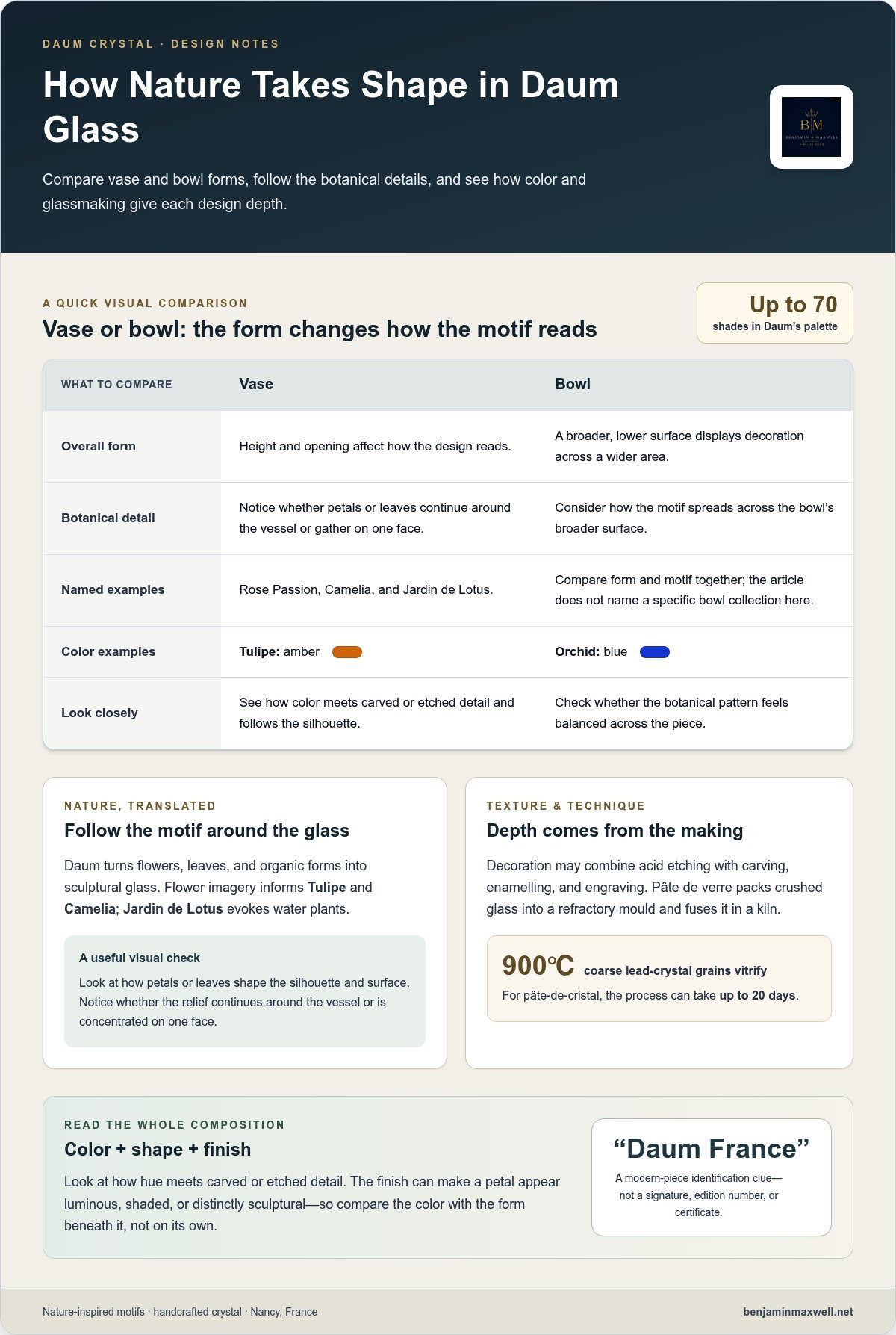
Daum’s nature-inspired pieces transform flowers, leaves, and organic forms into sculptural glass. Color, surface decoration, and the pâte de verre technique add depth to these motifs.
Modern Daum crystal pieces carry the “Daum France” mark on the back. Treat it as an identification clue, not as a signature, edition number, or certificate.
Nature-Inspired Motifs
Look for botanical forms and notice how they shape the vase’s silhouette and surface. Tulipe and Camelia, for example, draw on flower imagery, while Jardin de Lotus evokes water plants. Examine how petals or leaves appear in relief, and whether the motif continues around the vessel or is concentrated on one face.
Decoration can combine acid etching with carving, enamelling, and engraving. Daum’s pâte de verre process packs crushed glass into a refractory mould and fuses it in a kiln. For pâte-de-cristal, coarse grains of lead crystal vitrify at 900℃; the process can take up to 20 days. These techniques create varied textures and depth, rather than relying on a painted surface alone.
Vase and Bowl Collections
Compare vases and bowls by both form and motif. A vase’s height and opening affect how its design reads, while a bowl displays its decoration across a broader, lower surface. Rose Passion, Camelia, and Jardin de Lotus are examples of named vase designs. Consider whether the botanical pattern feels balanced across the piece or changes with its shape.
Color is another useful point of comparison: Daum’s palette includes up to 70 shades. Examples include amber in the Tulipe design and blue in Orchid. Look closely at how color meets carved or etched detail, since the finish can make a petal appear luminous, shaded, or distinctly sculptural.
Daum’s brutalist designs were produced in the late ’60s and ’70s. Daum states that pâte de verre dates back to 5000 BC and that it reworked the technique in 1968. The house has developed relationships with leading artists for more than a century, bringing their artworks to life in crystal and color.
Daum crystal colors and distinctive designs
Color and form work together in Daum’s designs, giving each vase a presence that can feel closer to sculpture than to a simple vessel. Compare the Ginkgo Mini Vase Green with the Arum Ultraviolet Vase: their names point to contrasting palettes, while their silhouettes add another distinction. Consider both elements together rather than choosing by hue alone.
Daum’s nuanced color palette shows how varied the effect can be. The Safran Medium Vase suggests a warm, golden tone; the Kumara Blue Vase offers a cooler alternative. Color also depends on the form beneath it. Notice how the hue relates to the vase’s contours, decorative relief, and surrounding light, then decide whether it reads as a subtle accent or a focal point.
Shape provides another point of distinction. Daum revisited the berluze vase shape in the 1960s, giving it a modern twist. That example shows how a historic form can be reinterpreted without losing its connection to the decorative tradition. As you compare pieces, notice the opening, body, and base. These proportions influence whether a vase appears slender, grounded, or expansive.
- Compare hue: Set a green example, such as the Ginkgo Mini Vase Green, beside a blue or ultraviolet design.
- Study the silhouette: Observe the outline from several angles, especially around the neck and base.
- Read color with form: Notice whether the shade emphasizes the contours or draws attention to the surface decoration.
These comparisons can help clarify your preferences. A saturated shade may make a compact vase feel visually bold, while a restrained tone can let a sculptural outline take precedence. The design comes together through the whole composition: color, shape, and finish considered as one.
Daum’s history and origins in Nancy, France
Daum’s story begins in Nancy, where Jean Daum established a glass workshop in 1878. The city became the home of a maison whose decorative glass evolved alongside the artistic movements shaping the region.
Jean Daum had moved to Lorraine in 1870, after Alsace was ceded to Germany, to remain in France. His sons Auguste and Antonin later helped develop the family business. Their work connected the Nancy workshop with a wider community of artists and makers, bringing new ideas into its glass designs.
Émile Gallé’s glass marquetry drew acclaim at the 1878 Paris Universal Exhibition. In the following 20 years, Antonin Daum developed a broad catalogue of Art Nouveau designs. These works brought the natural forms associated with the movement into decorative glass, giving the Maison a distinct artistic direction.
The company’s reputation grew at the 1900 Universal Exhibition, where Daum received a Grand Prix medal. The same year, Daum rediscovered the pâte de verre technique, then revived the glass-paste method in 1906. These milestones link the Nancy story to a distinctive approach to color and form, not simply to a place of manufacture.
After Gallé died in 1904, Daum became a leading force in decorative glass. Its history continued beyond Art Nouveau, with Daum’s Art Deco period including the 1925 Exposition des Arts Décoratifs in Paris. Later, the company shifted production to clear crystal with extra-high lead content in the 1950s.
Nancy remains central to understanding the Maison’s identity. Daum glass is made in France, with the factory located in Nancy. The Daum Collection at the Museum of Fine Arts of Nancy holds more than 600 glasswork items, offering a substantial record of the company’s artistic legacy.
Daum’s Nancy-based Maison has elevated crystal paste for nearly 150 years, placing the technique at the center of its identity as well as its artistic work. The rediscovery of the pâte de verre technique in 1900 marks a key point in that history.
Jean Daum was born in 1825 and died in 1885; Auguste Daum was born in 1853 and died in 1909. Antonin Daum was born in 1864 and died in 1931. Antonin Daum helped shape the Nancy Maison’s glassmaking tradition. Together, these dates trace successive generations behind the Nancy Maison’s glassmaking tradition.
How can you assess the condition and value of a used Daum vase?
Assess a used vase systematically, separating its physical condition from its identity and appeal. Begin in bright, even light and inspect the rim, body, base, and raised decoration. Look for chips, cracks, scratches, cloudy areas, and repairs. Rotate the piece slowly, as damage can be harder to see from certain angles, particularly around the foot and opening.
Next, examine the underside. Modern Daum crystal pieces carry the “Daum France” mark on the back, a useful identification clue. Compare the mark and the vase’s form with its design name or documented records. A mark alone does not establish the full history of an older piece, so consider any accompanying paperwork and ownership records as part of the evidence.
Then identify the design, size, color, and finish as precisely as possible. Rose Passion and Tulipe vases differ in motif and form, so specific descriptions make comparisons more useful. Note whether the decoration appears carved, etched, or molded, and record distinctive details. Clear photographs of the base, rim, and surface can help organize your observations.
- Condition: Record visible damage and repairs, including their location and extent.
- Identity: Note the mark, design name, color, and distinctive features.
- Documentation: Gather records that connect the vase to its stated history.
A collector’s assessment considers how several factors come together: condition, design, documentation, and the appeal of a particular form. A striking color does not erase a significant chip, while careful preservation can support a stronger impression of quality. Compare like with like rather than treating every Daum vase as interchangeable.
Finally, distinguish repairs from original condition. Glass experts can repair or restore Daum pieces, but visible intervention matters in your assessment. Note what was repaired and where, then weigh that information alongside the vase’s design and overall condition.
Benjamin & Maxwell: Daum Crystal
Benjamin & Maxwell offers Daum Crystal for those drawn to the artistry and heritage behind these vases. Once you have considered a piece’s motif, color, form, and condition, explore Daum Crystal to bring distinctive glasswork into your home.
Use the details in this guide to clarify what matters most to you: a floral design, a sculptural silhouette, or a particular color and finish. Those preferences can help focus your selection among Daum pieces. To consider a vase in a wider home setting, Benjamin & Maxwell also offers an In Home Visualizer, alongside furnishings from Cattelan Italia and Kosta Boda Glassware.
For a conversation about Daum Crystal, contact Benjamin & Maxwell.
Choose a Piece That Feels at Home
Choosing a vase is also a decision about the atmosphere you want to create. Consider which form, color, or natural motif you would enjoy living with over time, and let that preference guide your selection. A thoughtfully chosen piece can become part of a room’s character, not merely an accent.
Benjamin & Maxwell offers Daum Crystal for those drawn to the Maison’s artistry. Its collection also includes Cattelan Italia furniture, and the In Home Visualizer lets you view furnishings in your space. Follow your collecting interest, whether you are considering a single crystal piece or imagining how it might sit within a room.
To continue exploring, contact Benjamin & Maxwell about Daum crystal vases. Let your next choice reflect the beauty and character you value most.
Explore Daum Crystal Vases at Benjamin & Maxwell
Benjamin & Maxwell offers Daum Crystal, including glass bowls, vases, statues and figurines. If you’re ready to explore pieces beyond the information in this article, the collection is a natural next stop.
You can also browse Kosta Boda glassware and home décor, along with luxury furniture and décor for living and dining spaces.
Frequently Asked Questions
What styles and designs of Daum crystal vases are available?
Daum crystal vases range from nature-inspired forms to sculptural contemporary designs. Their artistic vocabulary includes Art Nouveau and Art Deco influences, as well as pieces created through collaborations with artists. Daum’s collaborators include Salvador Dalí, Arman, and César, whose distinct approaches bring varied character to the glass. Compare the overall silhouette and decorative treatment to find a style that suits your space or collecting interests.
How much do Daum crystal vases cost new in the United States?
New Daum crystal vases in the United States typically range from several hundred dollars for smaller, simpler pieces to several thousand dollars for large, highly detailed, or artist-collaboration works, depending on the complexity of the design and craftsmanship involved.
Where can you buy Daum crystal vases in the United States?
Daum has a store on Park Avenue in New York City. Benjamin & Maxwell also offers Daum Crystal.

Article by
Spencer Kay
Spencer is the founder and CEO of Benjamin & Maxwell and has created the most advanced technology-based website in the furniture industry. He has extensive experience in both technology and business operations having started a number of technology companies. Spencer holds a BA Degree in Economics and an MBA in International Business
Disclaimer
Benjamin & Maxwell does not intend for any of our products to be used for any specific purpose.


