

The vase that commands attention online may feel out of place once it reaches your room. Choosing well begins not with a trend, but with its role: will it hold flowers, stand alone as a sculptural accent, or do both? With so many materials, silhouettes, and finishes to compare, it’s easy to admire a piece without knowing whether it will feel balanced at home. A few practical checks can help you move from inspiration to a more considered choice.
This guide will help you choose a vase with intention, considering how material, form, and scale suit your space and the way you plan to use it. You’ll learn what to look for in a floral vessel, when a distinctive design can hold its own without stems, and how to judge proportion before making a choice. Benjamin & Maxwell offers Daum hand-crafted crystal glass décor, including vases and other artistic objects. The In Home Visualizer lets you preview selected décor in a room photo, adjust the scene, and save it.
Key Takeaways
- Decide whether your vase will hold flowers, serve as a decorative object, or do both before comparing designs.
- Consider how the material, silhouette, and finish will read against the room and display surface.
- Compare distinctive pieces such as Orchid Vase Low and Meadow Vase Summer Wide to see how artistic character can complement floral use or stand alone.
- Shortlist designs, then use the In Home Visualizer to view selected décor in a room photo, adjust the scene, and save it.
How to Choose a Vase: Start With Its Purpose in Your Room
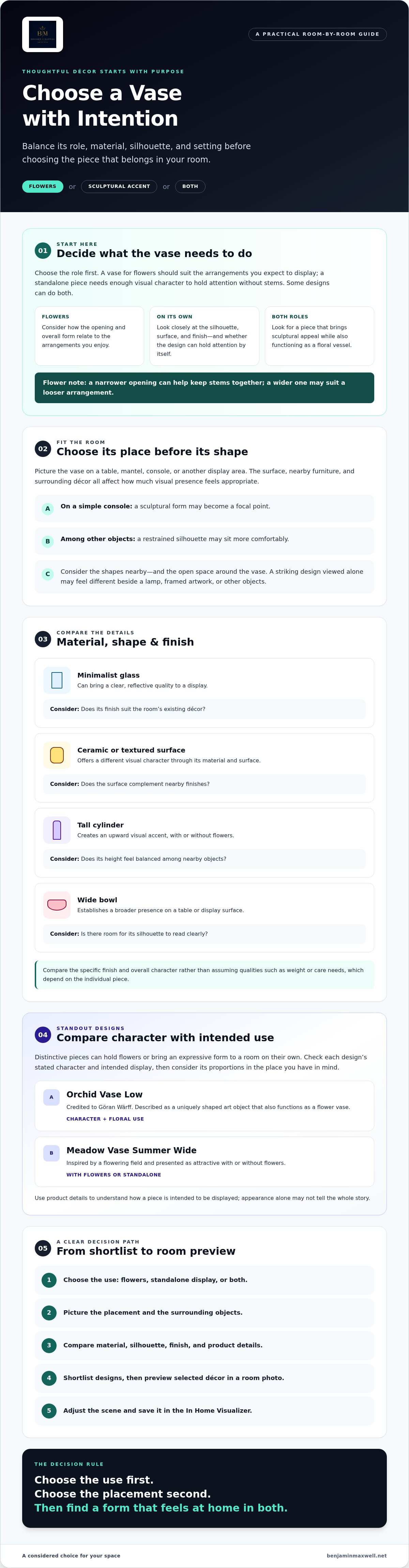
Begin with the role you want the piece to play. A vase selected for fresh flowers should suit the arrangements you expect to display. One chosen as a standalone accent needs enough visual character to hold attention without them. Some designs can do both. Benjamin & Maxwell’s selection includes vases described for floral arrangements and standalone display, bringing practical use and sculptural appeal together.
Flowers or sculptural accent?
Ask yourself whether you’ll display seasonal blooms, feature the vase on its own, or switch between the two. If flowers are the priority, consider how the opening and overall form relate to the arrangements you enjoy. A narrower opening can help keep stems together, while a wider one may suit a looser arrangement. If the vase will usually stand alone, look closely at its silhouette, surface, and finish. For broader context on the history and types of vases, consider how vessels have served both functional and decorative roles across time.
Where will it live?
Picture the intended setting: a table, mantel, console, or another display area. The surface and surrounding décor help determine how much visual presence feels appropriate. A sculptural form may become a focal point on a simple console, while a more restrained silhouette can sit comfortably among other decorative objects. Consider the furniture nearby, the room’s existing shapes, and the open space around the vase. A striking design viewed alone may feel quite different beside a lamp, framed artwork, or other objects; for distinctive paintings and artisan accents to complete the arrangement, visit Wine Art Gallery.
Decision rule: Choose the use first, the placement second, then look for a form that feels at home in both.
Vase Materials, Shapes, and Finishes: What to Compare
Material and silhouette influence how a vase relates to its setting, whether it holds flowers or is displayed alone. Glass can bring a clear, reflective quality to a display, while ceramic and other textured surfaces offer a different visual character. Think about how each option will relate to nearby finishes rather than choosing a material in isolation. For background on how ceramic vases are made, the University of Colorado Boulder offers an overview of pottery production.
Which material suits your interior?
Look at the room’s existing finishes and forms. Consider whether glass will complement the surrounding décor or provide a clear visual contrast, and whether a ceramic or textured surface feels in keeping with the display. Compare the specific finish and overall character rather than assuming qualities such as weight or care needs, which depend on the individual piece. Daum’s hand-crafted crystal glass objects, including vases, combine glassmaking with sculptural design.
How should shape guide your choice?
A tall cylinder creates a different impression from a wide bowl: one draws the eye upward, while the other establishes a broader presence on its surface. Other silhouettes bring their own visual rhythm. Before deciding, consider the usable display area, nearby objects, and whether you plan to add flowers. If you are comparing options, look at each vase from the same viewing position and consider how its outline relates to the furniture around it. The table below can help clarify what to examine.
| Material or form | Intended display role | Questions to consider |
|---|---|---|
| Minimalist glass | A clean, understated accent | Does its finish suit the room’s existing décor? |
| Ceramic or textured surface | A piece with visible material character | Does the surface complement nearby finishes? |
| Tall cylinder | An upward visual accent, with or without flowers | Does the height feel balanced among nearby objects? |
| Wide bowl | A broader presence on a table or display surface | Is there room for its silhouette to read clearly? |
Compare the curated vase selection with these questions in mind. Let material and form serve the room as well as your intended use. If you are curating modern living spaces with functional art accents to complement your vessels, visit Artistry Deco Shop.
Vase Buying Guide: Compare Standout Designs and Avoid Common Mistakes
Distinctive designs can serve different purposes, from holding flowers to bringing an expressive form to a room on their own. Compare each piece by its stated character and intended display, rather than choosing on appearance alone. Check the product details for how it is intended to be used, then consider its proportions alongside the space where you plan to place it.
Match the design to the mood you want
Orchid Vase Low, credited to Göran Wärff, is described as a uniquely shaped art object that also functions as a flower vase. It may appeal if you want sculptural character alongside floral use. Meadow Vase Summer Wide takes inspiration from a flowering field and is presented as attractive with or without flowers, making it suited to either kind of display.
Let’s Vase It! offers another kind of distinction: it’s a collaboration involving Sturm Milano and Florine Offergelt, using additive manufacturing. Consider which design feels in keeping with the mood of your room, and whether you want the piece to draw focus or sit quietly among other décor.
A practical checklist before you decide
Before choosing, pause to confirm the details that can be easy to overlook:
- Location: Which room and display surface have you chosen?
- Use: Will you add flowers, display the piece alone, or do both?
- Character: Which material and silhouette suit the surrounding décor?
- Balance: Will the design stand out without competing with nearby objects?
To assess a design in context, use the In Home Visualizer: upload a room photo, select décor, view it in the scene, adjust the placement, and save the result. This gives you another way to consider how selected décor relates to your existing furnishings before settling on a choice. For a closer look at available designs, browse the curated home décor selection.
Find Your Vase at Benjamin & Maxwell: From Room Preview to Selection
With your priorities in mind, move from broad inspiration to a considered choice. Benjamin & Maxwell offers Daum crystal vases and other hand-crafted glass décor. Compare available pieces against the role and setting you have already defined, paying attention to the form, finish, and stated use of each design.
Use a room preview to refine your shortlist
The In Home Visualizer offers a practical way to consider selected décor in your own surroundings. Upload a room photo, select décor, view it in the scene, make adjustments, then save the result. Treat the preview as a reference for considering how a piece relates to the room, not as a promise of exact scale, color, or fit.
Keep your selection process simple:
- Define whether the piece is for flowers, standalone display, or both.
- Shortlist forms and materials that suit the intended surface and the room’s character.
- Compare designs by their stated details and decorative presence.
- Preview selected décor in a room photo and save the scene for later consideration.
Browse with a clear point of view
As you browse, ask what atmosphere you want to create. A restrained silhouette may sit quietly among existing objects, while a more expressive form can become a focal point. Consider material, shape, intended use, and surrounding furnishings together; no single feature needs to decide the choice on its own. The right piece is one that feels considered in its setting and suits how you plan to display it.
Compare designs by considering their intended use, form, and the space where you plan to display them.
Choose a Piece That Belongs in Your Room
A considered choice begins with purpose. Decide whether your vase will hold flowers, stand as a decorative object, or move between both roles; then compare its material and silhouette with the room and the surface where it will live. This simple order helps you look beyond an appealing image and focus on how the piece may feel in your own setting.
Benjamin & Maxwell’s curated selection includes vases described for display with or without flowers. To refine your shortlist, the In Home Visualizer lets you upload a room photo, select décor, view and adjust the scene, then save it for consideration. Use the preview as another way to reflect on the setting, alongside your own preferences for form and atmosphere.
When you’re ready to explore, browse the curated vase collection with your intended use and placement in mind. A piece chosen with care can bring a distinctive note to its setting, whether presented alone or arranged with blooms.
Frequently Asked Questions
What should I consider when choosing a vase?
Start with how you intend to use it: for fresh flowers, standalone display, or both. Then consider where it will sit, since a table, mantel, or console can call for a different visual presence. Compare the material and shape with nearby furnishings and décor. A well-chosen piece should feel considered in its setting, not merely appealing on its own.
Can a decorative vase be used for flowers?
Some decorative pieces are described as both flower vases and objects for standalone display, but this depends on the individual design. For example, Orchid Vase Low is described as a uniquely shaped art object that also functions as a flower vase. Meadow Vase Summer Wide is presented as attractive with or without flowers. Check the details for each piece rather than assuming every decorative design suits floral use.
Which vase shape works best for a table or mantel?
Choose a silhouette that feels balanced on the intended surface and among the objects around it. A tall cylinder and a wide bowl create different visual effects, so consider whether the display would benefit from an upward accent or a broader form. If you plan to add flowers, include that use in your decision. There’s no single shape that suits every table or mantel.
How can I see how a vase might look in my room before choosing?
Use the In Home Visualizer to preview selected décor in a room photo. Upload a photo, select an item, view it in the scene, make adjustments, and save the result. The preview can help you consider the piece in relation to your surroundings, but it shouldn’t be treated as a guarantee of exact scale, color, or appearance in the room.
What is the difference between a glass vase and a sculptural vase?
Glass describes a material; sculptural describes a form or decorative character. The terms aren’t opposites: a glass piece may also have a sculptural presence, while a sculptural design may be made from another material. Benjamin & Maxwell offers Daum glass décor, including vases. Orchid Vase Low, for instance, is described as a uniquely shaped art object that can also hold flowers.

Article by
Spencer Kay
Spencer is the founder and CEO of Benjamin & Maxwell and has created the most advanced technology-based website in the furniture industry. He has extensive experience in both technology and business operations having started a number of technology companies. Spencer holds a BA Degree in Economics and an MBA in International Business
Disclaimer
Benjamin & Maxwell does not intend for any of our products to be used for any specific purpose.


