

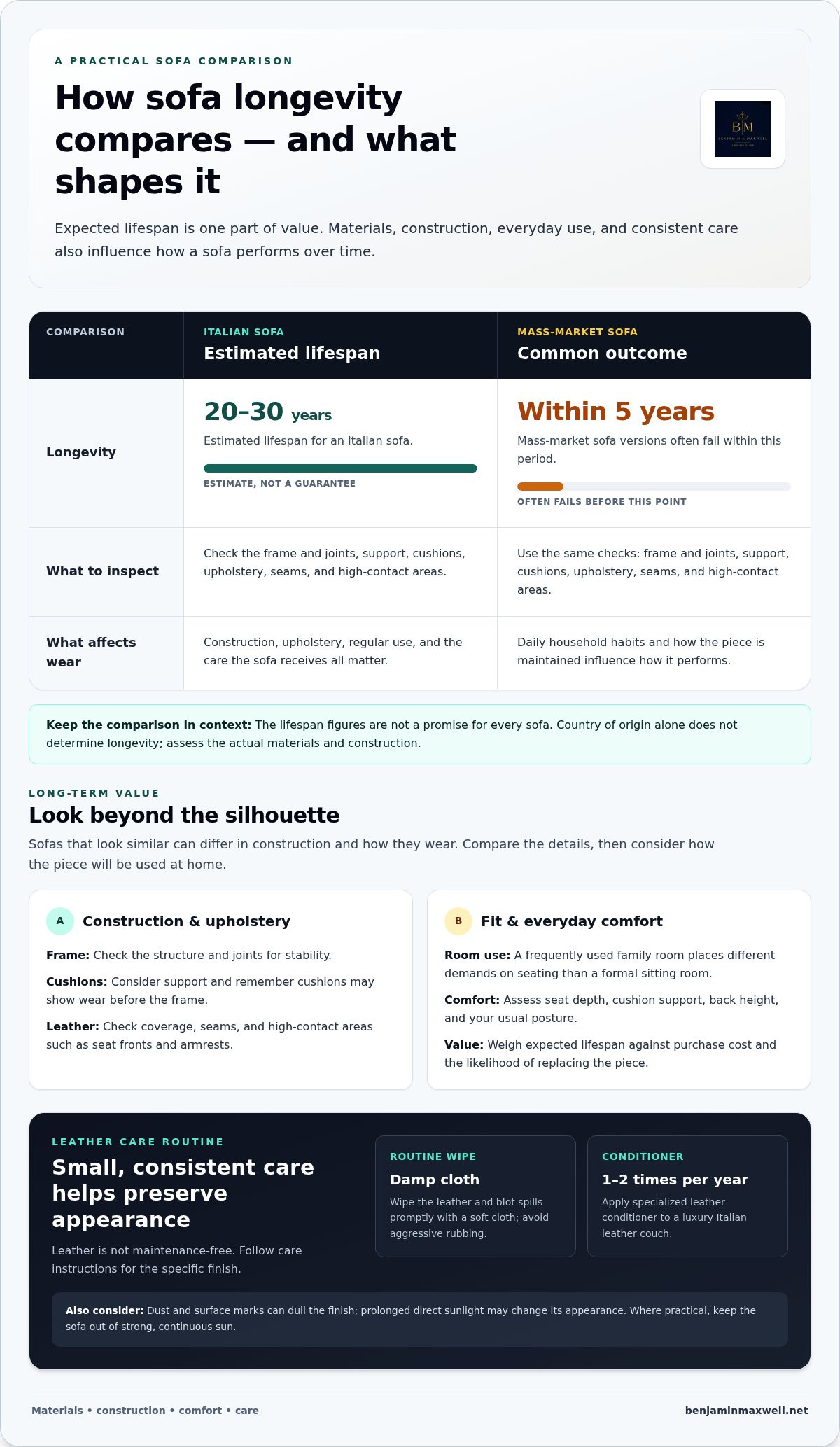
Good leather care is simple, but consistency matters. A luxury Italian leather couch should be wiped with a damp cloth, with specialized leather conditioner applied 1 to 2 times per year. The difference between furniture that merely looks impressive and a piece that remains welcoming over time often lies in this measured routine.
It’s reasonable to expect fine Italian leather to last, and the comparison with mass-market sofas is part of what makes the investment compelling: an Italian sofa is estimated to last 20 to 30 years, while mass-market sofa versions often fail within five years. Yet longevity depends on more than origin alone; material quality, construction and regular care all shape how a sofa lives in a room.
This guide covers practical care, how to compare sofa prices without judging quality by price alone, and which details affect long-term value. It also explains how to assess color and stitching options, so you can consider whether a sofa’s finish, proportions, and craftsmanship suit your home.
Key Takeaways
- Compare leather grades by how each finish looks, feels, and responds to everyday use before choosing a sofa.
- Custom colors, stitching, and configurations can shape a sofa’s character; consider how each choice will complement your room.
- Look beyond the price tag by weighing materials, construction, and expected longevity when comparing Italian and mass-market sofas.
- Explore the sofa selection alongside furnishings and decor, and use the In Home Visualizer to picture how selected pieces may fit your space.
Can I custom order a leather sofa in specific colors and stitching?
Custom orders may let you choose leather, color, stitching, and configuration. Sizes, seat counts, and styles vary by model, from compact sofas to larger modular arrangements. Choose according to your room dimensions and how you plan to use the seating.
Leather Grades and Color Choices
Leather grades describe differences in appearance, feel, and finish, so compare samples in the room’s natural and evening light. Custom-order sofas may offer more than 100 leather color options, giving you a broad palette for coordinating with flooring, artwork, or existing furnishings. Before settling on a shade, consider how its undertone will sit beside nearby materials. A warm brown, for example, can complement wood, while a cooler neutral may suit stone or pale walls.
Stitching and Style Options
Stitching shapes a sofa’s character and construction details. Review the seam treatments available for the specific model, then compare their scale and contrast with the leather. Tonal thread creates a subtle outline, while contrasting thread draws attention to cushions and edges. Match the stitching to the silhouette: prominent seams can emphasize clean lines or create a more tailored, traditional look.
Define the custom order with a complete specification: leather grade, color, configuration, dimensions, and stitching. Note where you plan to place the sofa, and measure doorways and access routes. This helps avoid choosing a piece that feels oversized or is difficult to position after delivery.
Production and quality control depend on the maker’s process and the details in the order. Review the written specification for consistency across the frame, upholstery, seams, and selected dimensions. A sofa made in Italy may take 6 to 9 months to arrive in North America. Allow for that lead time when coordinating delivery with room preparation or other furnishings.
Italian leather sofa selection and prices
Compare Italian leather sofas and other luxury leather couches by material, construction, comfort, and configuration. Italian origin alone does not determine which sofa is the better fit. Assess the same details for each option.
Sofa Selection and Pricing
First, match seating capacity and silhouette to the room. A compact two-seat sofa serves a different purpose from a broad sectional, and arm shape and cushion layout also affect how a piece fits the space. Measure the available area and walking routes before choosing a model.
Price reflects more than a sofa’s country of manufacture. Compare leather grade and coverage, frame construction, upholstery details, configuration, and included features. A luxury Italian leather couch with a more involved design or larger seating arrangement may cost more than a simpler style. Review each quote as a full specification, not just a figure.
Comparing Luxury Leather Sofas
For a useful comparison, place each sofa’s specifications side by side. Check whether leather covers every surface or is combined with another material, then compare the frame, cushions, seams, and finish. Two three-seat sofas may have different leather coverage and construction, even if their dimensions look similar.
Assess comfort directly, too. Consider seat depth, cushion support, back height, and whether the sofa suits your usual posture. A formal, upright luxury Italian leather couch may suit a different room and routine than a relaxed, deep-seated model. These practical differences matter more than the “Italian” label alone.
Before deciding, list your priorities: seating capacity, leather coverage, frame, comfort, and style. Compare the full specification and price against that list. To see how refined furnishings might complement your room, explore luxury furniture and home decor.
Italian sofa longevity compared with mass-market furniture
An Italian sofa is estimated to last 20 to 30 years, while mass-market sofa versions often fail within five years. That contrast makes longevity a meaningful part of value, alongside elegance, comfort, and the way the piece suits your home. It isn’t the country label alone that matters. Construction, upholstery, and the care a sofa receives all influence how it performs through everyday use.
Examine the frame, support, cushions, and upholstery separately. The frame provides structure, and well-made joints help keep the sofa stable as people sit and move. Cushions shape comfort and may show wear before the frame. Inspect seams and high-contact areas, especially seat fronts and armrests, which receive regular use. These details help explain why sofas with similar silhouettes may age differently.
Care affects how leather looks over time. Dust and surface marks can dull the finish, and prolonged direct sunlight may change its appearance. Where practical, keep the sofa out of strong, continuous sun and follow care instructions for its leather finish. Blot spills promptly with a soft cloth instead of rubbing aggressively. A consistent routine helps preserve the material’s appearance; leather is not maintenance-free.
Use a simple comparison before choosing: examine the frame and upholstery, sit on the sofa, and consider the household’s daily habits. A family room with frequent use places different demands on seating than a formal sitting room. Then compare the expected lifespan with the purchase cost and the likelihood of replacing the piece. The 20-to-30-year estimate offers context, not a promise for every sofa. A well-considered selection can make lasting comfort and enduring elegance part of the room’s story.
Which Italian leather types and grades are used in luxury sofas?
Italian origin describes where a sofa or leather was made, not a particular grade. When comparing upholstery, distinguish the hide’s surface category from its finish: full-grain and top-grain describe the hide, while aniline and protected describe how the surface looks and is treated. These distinctions help you assess appearance, feel, and everyday practicality rather than relying on country of origin alone.
Full-grain leather retains the hide’s natural surface, including visible marks and variation. Top-grain leather has a refined surface for a more uniform appearance. Aniline finishes leave natural character prominent, while protected finishes add a surface treatment that can create a more consistent look. These terms describe different qualities, not a universal ranking. Compare samples, since color and finish affect how leather looks and feels.
Traditional Italian tanning methods take months rather than days. This is one part of leather production, but it does not identify a sofa’s grade on its own. Ask which surfaces are leather and whether other areas use a different material. Then inspect a sample for grain variation, softness, sheen, and color consistency. A naturally marked hide, for example, may suit a relaxed interior, while an even finish can complement a formal setting.
Follow a simple selection process: decide how much natural variation you like, compare finish and feel, then consider how you will use the sofa. In a busy living room, routine care may be a priority; in a sitting room used less often, texture or patina may matter more. Read the upholstery description alongside the construction details, since leather grade alone does not establish overall quality.
Explore the furniture selection to see sofa styles and furnishings for your space.
Benjamin & Maxwell: Daum Crystal
Benjamin & Maxwell brings together Daum Crystal, Cattelan Italia Furniture, and the In Home Visualizer. If you’re comparing sofa styles, the visualizer helps you see how selected pieces might fit in your living space. Use it to assess proportions and imagine how a furniture choice will sit alongside your existing surroundings.
Daum Crystal and Kosta Boda Glassware offer distinctive accents for rooms styled with enduring materials and thoughtful details. Explore these pieces as you refine the atmosphere around your seating, from larger furniture forms to finishing touches.
For questions about the available furnishings, contact Benjamin & Maxwell.
Let the Room Take Shape
Choosing a luxury Italian leather couch can start a more considered room, rather than complete it. Picture the atmosphere you want: a sculptural focal point, a quiet place to gather, or an arrangement balanced by thoughtful furnishings. This helps the sofa feel like part of the room rather than an isolated piece.
Before settling on a direction, consider how light, scale, and surrounding objects shape the space throughout the day. A considered arrangement balances visual presence with everyday comfort, letting each piece contribute without competing for attention. Let your routines guide your choices.
Benjamin & Maxwell offers Cattelan Italia Furniture and Daum Crystal, along with an In Home Visualizer to picture selected pieces in your living space. Use it to explore how furnishings and decorative accents might work together in the room.
For a thoughtful next step, contact Benjamin & Maxwell and continue shaping a home that feels distinctly yours.
Frequently Asked Questions
How do I clean and maintain an Italian leather couch?
For routine cleaning, use a soft, damp cloth and follow the care guidance for the sofa’s finish. Remove dust regularly, address visible marks promptly, and use leather care products suited to the material. Do not treat every finish alike: a product suitable for one surface treatment may not work for another. Gentle, consistent care helps preserve the couch’s appearance.
Are Italian leather sofas suitable for homes with children or pets?
Leather sofas can suit family homes, but daily habits matter. Consider whether pets climb on the furniture, whether children eat or draw nearby, and how easily the household can manage spills. Leather may show scratches or marks, so a busy room calls for clear household rules and prompt cleanup. Choose the sofa’s color and finish with your routine in mind, not appearance alone.
How can I tell if a sofa is truly "Made in Italy"?
Look for an explicit country-of-manufacture statement on the sofa’s product information, label, or manufacturer documentation. An Italian brand name or Italian-inspired design doesn’t, by itself, establish where a particular sofa was made. Confirm that the statement applies to the sofa model itself, rather than a component or the brand’s general collection. Cattelan Italia products are described as 100% made in Italy.
What is the difference between top-grain and full-grain Italian leather?
Full-grain leather retains more of the hide’s original surface, while top-grain has a refined surface. Full-grain may show natural marks and variation more clearly; top-grain often looks more uniform. Compare samples in the light and setting where the sofa will be placed. Neither label alone establishes the quality of the complete sofa, so consider its upholstery and construction, too.
What is the highest quality leather for an Italian sofa?
No single grade automatically makes a sofa the highest quality. Full-grain is often valued for its natural surface, but hide selection, tanning, finishing, and upholstery workmanship also affect the finished piece. Look for a clear leather description and inspect a sample for consistency, feel, and finish. Judge the material alongside the sofa’s construction and intended use.
Why are Italian leather sofas more expensive than mass-market options?
Price may reflect leather selection, upholstery work, frame construction, design complexity, and manufacturing standards. The “Italian” label alone does not explain the difference, and sofas can vary substantially in materials and construction. Compare like with like: check leather coverage, frame details, cushion construction, and finish. This makes it easier to understand what a sofa’s price represents beyond its style or origin.

Article by
Spencer Kay
Spencer is the founder and CEO of Benjamin & Maxwell and has created the most advanced technology-based website in the furniture industry. He has extensive experience in both technology and business operations having started a number of technology companies. Spencer holds a BA Degree in Economics and an MBA in International Business
Disclaimer
Benjamin & Maxwell does not intend for any of our products to be used for any specific purpose.


