

A wall sconce does more than illuminate a room: it brings crafted detail and light to the wall. Luxury wall lamps from Italy may feature glass, metal, marble, or stone, and their effect depends on both placement and material. Some designs are made for walls, while others can also be mounted on ceilings.
Choosing a fixture involves more than matching its finish to your furnishings. Glass can feel visually light; metal, marble, and stone bring distinct textures and presence. Placement also matters: a lamp can frame a mirror, brighten a passage, or shape the room’s overall composition.
This guide explains what a wall sconce is and how to compare materials and placement when choosing luxury wall lamps from Italy for a home in the United States. Learn what to consider for wall and ceiling fixtures, how to assess proportion and purpose, and how to bring your choice into harmony with the wider interior.
Key Takeaways
- Compare glass, metal, marble, and stone by the atmosphere and visual weight each brings to a room.
- Choose wall or ceiling placement according to the light’s purpose and the space; ADA-compliant wall sconces project no more than 4 inches from the wall when mounted between 27 and 80 inches above the floor, according to the U.S. Department of Justice.
- When evaluating Italian designer lighting in the United States, consider the maker, materials, and whether the fixture suits your intended placement.
- Explore how Daum Crystal and other refined home accents from Benjamin & Maxwell can complement the character of your interior.
Materials including glass, metal, marble, and stone
Material gives a wall light its first impression, then shapes how it sits within a room. Hand-blown glass shades from Venice bring subtle variation to each form, while recognizable shapes include dollops, ice cubes, and beehives. Choose a rounded shade to soften crisp architectural lines, or a geometric form to complement contemporary furnishings. Glass also allows the fixture’s silhouette to remain visually light, which can suit a narrow entry or stairwell.
Metal contributes structure and defines the fixture’s finish. Brass can appear warm and traditional, while nickel offers a cooler presence; oil-rubbed bronze creates a darker contrast against pale walls. Some designs pair modular brass forms with hand-blown beehive glass, balancing a defined frame with a softly rounded shade. Compare the metal finish with nearby hardware, such as a door handle or cabinet pull, so the wall lights feel considered rather than isolated.
Marble makes its surface part of the composition. Visible veining gives each piece a distinct pattern, so even a compact marble detail can draw the eye without a large silhouette. Stone offers a grounded, tactile character. Against smooth plaster or painted walls, it can introduce texture; beside patterned wallpaper, a simpler shape may keep the overall effect composed. Consider the surrounding surfaces before choosing either material.
Narrow your options with a simple sequence: decide whether the fixture should blend into the wall or stand apart, then compare its shape and finish with the furnishings already in the room. Finally, assess its visual weight against the wall’s scale. A glass-and-brass fixture may suit a layered living space, while a restrained marble or stone accent can bring focus to a quiet passage. A strong choice connects material, proportion, and room character.
Wall and ceiling lamps
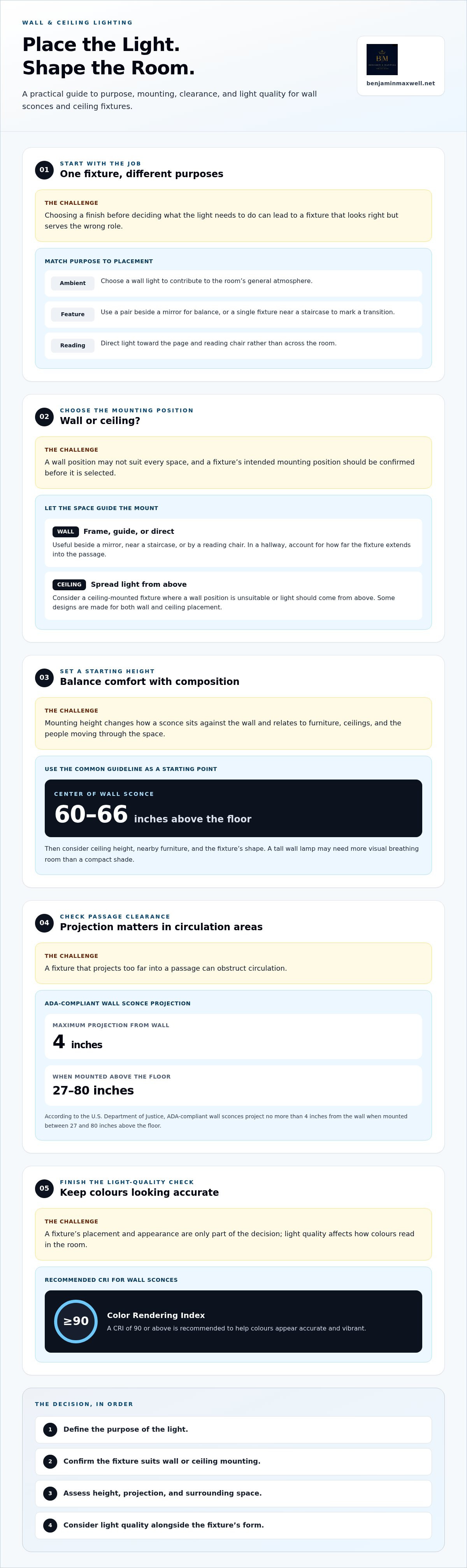
A wall lamp can provide ambient light, frame a feature, or direct light toward a reading chair. Start by identifying its main purpose. A pair beside a mirror can create balance, while a single fixture near a staircase can mark a transition between spaces. For a reading area, look for a design that directs light toward the page rather than across the room. Establishing the function helps narrow the form before you consider its finish or decorative character.
Mounting height affects both comfort and composition. A common guideline places the center of a wall sconce 60 to 66 inches above the floor. Use that range as a starting point, then consider the ceiling height, nearby furniture, and the fixture’s shape. A tall wall lamp may need more visual breathing room than a compact shade. In a hallway, also consider how far the fixture extends into the passage.
For accessibility, ADA-compliant wall sconces project no more than 4 inches from the wall when mounted between 27 and 80 inches above the floor, according to the U.S. Department of Justice. This precise projection limit matters in locations where a fixture could obstruct circulation. A shallow profile can preserve a clear route while still contributing a considered detail to the wall.
Where can I buy authentic Italian designer wall lamps in the United States?
In the United States, Italian designer wall lamps can be found through specialist lighting retailers, design showrooms, and furniture stores with curated lighting selections. Compare the maker, design, materials, and intended placement as part of your search. An authentic Italian design is more than a silhouette inspired by Italian style. Look for product information that names the designer or manufacturer and states the lamp’s country of origin.
Begin with the room and purpose, then narrow your search by form. A glass wall lamp beside a console, for example, serves a different role from an adjustable reading light beside a chair. Compare the lamp’s dimensions with the available wall space, and consider whether its light should be directed, diffused, or mainly decorative. If you’re choosing a pair, assess both fixtures together for balance around a mirror, bed, or artwork.
Use these steps to assess a listing or showroom display:
- Identify the maker. Match the manufacturer and model name across the product description, packaging, and accompanying documentation.
- Read the origin details. Distinguish the designer’s nationality from the stated place of manufacture; they describe different aspects of a lamp’s identity.
- Review the specification. Compare materials, finish, dimensions, bulb requirements, and whether the fixture suits wall or ceiling mounting.
- Consider the room. Relate the fixture’s scale and light direction to its position, nearby furniture, and intended task.
A clear listing should make the lamp’s maker and defining details easy to understand. A brass fixture with a glass shade, for example, should be described by its materials, finish, and mounting type, not just a broad label such as “Italian style.” Specific details make it easier to compare designs and choose a piece for its craftsmanship, function, and character.
Which Italian wall lamp brands offer made-to-order or custom finishes?
Nella Vetrina is one Italian maker associated with made-to-order wall lights. Its listed lead time is 10-14 weeks, distinguishing these pieces from designs presented as ready for immediate dispatch. Made-to-order describes how an item is produced; it doesn’t, by itself, mean buyers can select a bespoke finish. Keep those terms separate when comparing Italian wall lamps.
Handcrafted examples offer another useful point of comparison. The Il Pezzo Mancante Il Pezzo 12 Black and Gold Brass Wall Sconce is listed as handcrafted in 6-7 weeks. Officina Ciani’s Petalux Large Polychrome Wall Lamp is listed as handcrafted in 17-18 weeks. These stated production periods relate to specific pieces, not every lamp from either maker. They also describe handcrafted production, not a general promise of custom finishes.
When considering a finish for your room, distinguish listed options from custom requests. A listed finish is a defined option for a particular model; a custom finish means the maker offers an alternative beyond those options. Compare the model description, finish names, and production details. A black-and-gold brass fixture, for example, has a stated finish, but that alone does not establish a made-to-order process or other finish choices.
Use this short checklist when comparing a Nella Vetrina, Il Pezzo Mancante, or Officina Ciani design:
- Check the production wording. Separate “made to order” from “handcrafted.”
- Match the timeframe to the model. Nella Vetrina’s 10-14 weeks differs from the specific handcrafted listings above.
- Read finish details precisely. A named finish is not proof of a custom option.
- Compare the intended setting. Relate the fixture’s finish and form to nearby furniture and surfaces.
To explore how Italian design can carry through a wider interior, view Italian furniture brands and consider how their materials and silhouettes relate to your lighting choices.
Benjamin & Maxwell: Daum Crystal
Benjamin & Maxwell offers luxury furnishings and décor to help you consider Italian lighting within a wider home setting. Explore Daum Crystal as an expressive accent, or compare Cattelan Italia furniture and Italia Lounge furniture with the materials and character of your chosen wall lamp. The goal is a cohesive interior in which lighting and furnishings each contribute without competing for attention.
The In Home Visualizer lets you view selected furniture and décor in your own space, helping you consider how pieces may look in the room. Kosta Boda glassware can add a complementary note to a display. These offerings can inform decisions about the surrounding interior while your lamp choice remains guided by its material, placement, and purpose.
For help exploring Benjamin & Maxwell’s home furnishings and crystal, contact Benjamin & Maxwell.
Shape a lighting choice that feels at home
Think of the wall lamp as part of a larger composition, not an isolated finishing touch. Before choosing a design, consider how it will relate to the room’s furniture, art, and collected objects. This perspective can help you select luxury wall lamps from Italy that suit both the architecture and the atmosphere you want to create.
Benjamin & Maxwell offers Daum Crystal and Cattelan Italia furniture, alongside an In Home Visualizer for viewing selected pieces in your own space. These offerings can help you consider how furnishings and decorative accents contribute to the setting around a lighting choice, while keeping the lamp’s distinctive role in focus.
Take the next step at your own pace: explore the pieces that speak to your home, then consider how they might sit within the rooms you know best. Contact Benjamin & Maxwell to continue exploring a thoughtful, lasting interior.
Frequently Asked Questions
What are the top luxury Italian wall lamp brands?
There is no single definitive ranking, but Cattelan Italia is an Italian design brand whose product range includes lighting. Build a shortlist by identifying the fixture’s purpose, then comparing each maker’s design language, materials, and manufacturing details. A sculptural light may suit a feature wall, while a restrained design can complement a room without becoming its focal point.
Which Italian wall lamps are designed and manufactured in Italy?
Look for product information that explicitly identifies both the design origin and manufacturing location. Cattelan Italia states that its products are “100% made in Italy,” making that an example with a clear manufacturing claim. “Italian design” alone describes a design association, not necessarily where an individual lamp was produced. Before choosing, distinguish the designer’s origin from the stated place of manufacture.
How do Italian luxury wall lamps compare in materials, craftsmanship, and design?
Luxury wall lamps from Italy vary in material, construction, and visual character. With glass, consider the shaping and finish; with metal, look closely at the joins and surface. Marble and stone feature natural variation, so veining can influence the appearance of each piece. Compare these details in the context of your room, and decide whether the fixture should read as a discreet accent or a sculptural feature.
What bulb types, brightness, and dimmers do Italian wall lamps use?
A Color Rendering Index (CRI) of 90 or above is recommended to help colors appear accurate and vibrant.

Article by
Spencer Kay
Spencer is the founder and CEO of Benjamin & Maxwell and has created the most advanced technology-based website in the furniture industry. He has extensive experience in both technology and business operations having started a number of technology companies. Spencer holds a BA Degree in Economics and an MBA in International Business
Disclaimer
Benjamin & Maxwell does not intend for any of our products to be used for any specific purpose.


