

Discerning collectors have multiple avenues for acquiring authentic pieces, making Benjamin & Maxwell a fitting destination to encounter Daum Nancy glass and appreciate where its storied tradition began. From carefully curated online galleries to specialized fine art collections, buyers can explore a rich variety of exceptional glassware. Each sourcing channel offers collectors a unique way to experience the house’s enduring glassmaking heritage.
It’s natural to look beyond the surface: Daum’s identity is closely tied to the legendary Art Nouveau movement. This guide explains the best ways to acquire these works and how expert acid-etching and intricate enamel painting create the rich surfaces associated with the brand. It also traces the connection between Daum’s master craftsmanship and the broader artistic culture that shaped its evolution, helping you appreciate not only where to find the work, but what gives it its distinctive character.
Key Takeaways
- Understand how Nancy’s Daum shops differ and what kinds of glassware, from vases to lampshades, you may encounter.
- Learn how acid-etching and enamel painting give glass its layered decoration, and what details to look for.
- Trace the glassmaker’s beginnings, from Jean Daum’s founding of the firm to the brothers’ later partnership.
- See how Daum’s work reflects Nancy’s Art Nouveau heritage and the artistic ideals of the École de Nancy.
Where to shop for Daum in Nancy?
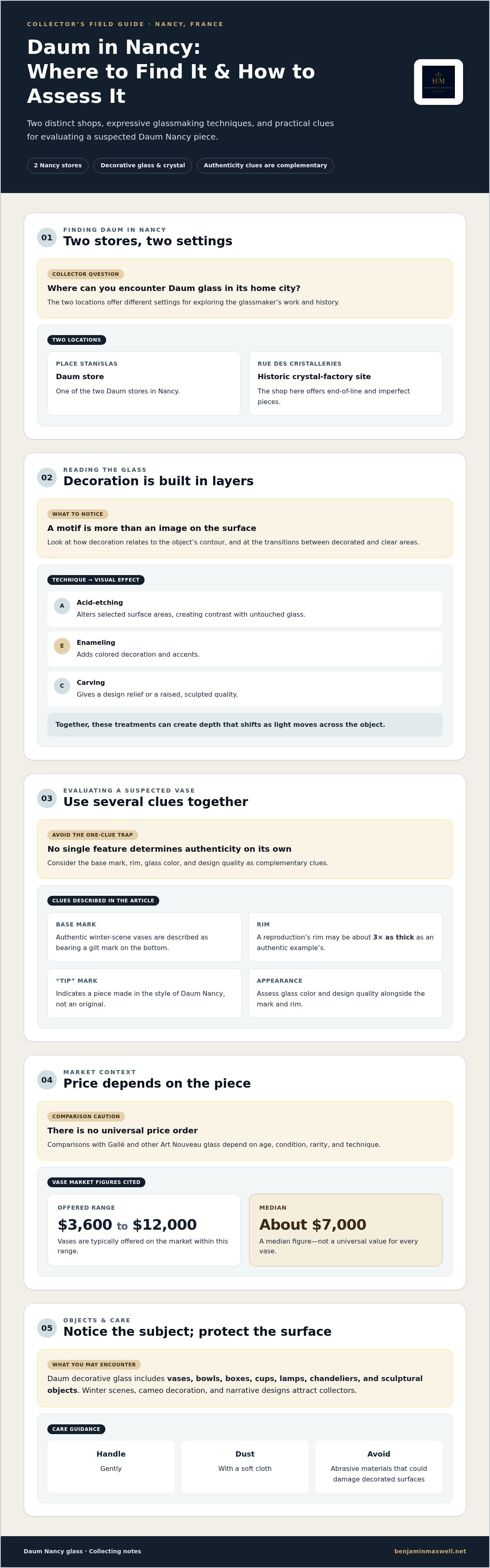
Daum has two stores in Nancy, France. One is at Place Stanislas; the other occupies the historic crystal-factory site on rue des Cristalleries. That factory-site shop offers end-of-line and imperfect pieces. Together, the locations let visitors encounter the glassmaker in its home city and explore its work and history in distinct settings.
Daum’s decorative glass includes vases, bowls, boxes, cups, lamps, chandeliers, and sculptural objects. Early decorative glassware turned practical forms into artistic ones: a bowl could feature an etched motif, while a lampshade could combine color and carved detail. Acid-etching creates contrast across a glass surface, enameling adds colored decoration, and carving gives designs relief. These techniques help make a Daum Nancy vase expressive from different angles.
To assess an antique, consider the base mark, rim, glass color, and design quality together. Authentic winter-scene vases are described as bearing a gilt mark on the bottom. A reproduction’s rim may be about three times as thick as an authentic example’s. A “TIP” mark indicates a piece made in the style of Daum Nancy, not an original. No single feature determines authenticity on its own.
How do Daum Nancy prices compare with Gallé and other Art Nouveau glass? There’s no universal price order; age, condition, rarity, and technique shape each comparison. How much are pieces worth? Vases are typically offered on the market between $3,600 and $12,000, with a median of about $7,000.
Winter scenes, cameo decoration, and narrative designs attract collectors. Examples include the Aesop’s Fable Covered Salt, Alpine Scenic Vase, and Applied Berry Vase. Handle glass gently, dust it with a soft cloth, and avoid abrasive materials that could damage decorated surfaces.
When considering a suspected Daum Nancy vase, assess the rim, glass color, and design quality together as complementary clues.
Acid-etched and enamel-painted decorations
Daum’s glass decoration brings technique and subject together, giving each surface a carefully composed character. Marks, colors, and relief show how a glass object can become an artwork as well as a useful form.
Decorative Crystal Objects
Decorative crystal objects are glass forms intended to enrich a room through color, shape, and surface detail. A Daum Frères bowl circa 1900, made with acid-etched and enameled glass, illustrates how contrasting treatments can lend a piece visual depth. Observe how the decoration relates to the bowl’s contour, rather than viewing the motif separately. That relationship helps explain the artistry behind collectible glass.
Daum Nancy Decorative Art
Daum Nancy decorative art transforms motifs such as flowers and landscapes into integral parts of glass design. A cameo and acid-etched vase with violets and green leaves shows how image and material can work together. This matters to collectors because the pattern’s edges, relief, and color reveal the maker’s approach. Look closely at transitions between decorated and clear areas to appreciate the detail.
Acid-etching alters selected areas of the surface, creating contrast with untouched glass. Enameling adds colored accents, while carving gives a motif a raised or sculpted quality. Together, these techniques create depth that shifts as light moves across the object. A cameo vase with an enameled landscape, for example, can combine distinct layers of relief and color. Each method shapes how the image appears from different viewpoints.
Artists and designers have shaped Daum’s collections through distinctive forms and material choices. A Daum Majorelle Art Deco vase with an iron mount demonstrates how glass can be paired with another material. Consider the mount, glass color, and decorative detail as parts of one composition. To explore contemporary crystal design alongside this heritage, browse crystal and glass brands and notice how different makers interpret form and finish.
Daum’s founding in Nancy
Who is Daum Nancy? It is the name associated with a French glassmaking house founded in Nancy, not a person. Jean Daum founded the glass firm in 1878, establishing the roots of a workshop that would become closely tied to the city. Its origins matter because the place and the craft developed together.
In 1889, Auguste and Antonin Daum partnered under the name Daum Frères. Auguste lived from 1853 to 1909, while Antonin lived from 1864 to 1931. Both helped oversee the studio’s growth, building on Jean Daum’s foundation. Their work contributed to a distinct identity, linking the family name with French decorative glass and Nancy’s artistic life.
The house’s history also reflects changing glassmaking techniques. Pâte de verre, a method dating back to 5000 BC, involves packing crushed glass into a refractory mould and fusing it in a kiln. Daum reworked the technique in 1968. A finished piece passes through modeling, molding, firing, and manual finishing, so its form and surface bear the marks of several stages of skilled work.
Recognition followed early in the firm’s history: Daum received a Grand Prix medal at the Universal Exhibition of 1900. That same year connects the company to a period of international attention for decorative arts. The Museum of Fine Arts of Nancy preserves more than 600 Daum glasswork items in its collection, with nearly 300 crystal pieces on display. Together, the museum holdings offer a way to follow the evolution from family enterprise to enduring regional legacy. In examining a piece, consider its date, material, technique, and finish as parts of that larger story.
Market listings may place an object specifically attributed to Daum Nancy beside a separately described decorative object, so wording matters as much as appearance. The first description explicitly names Daum Nancy as an attribution, while the second identifies the lamp by its French origin, technique, and style. Read descriptions carefully to distinguish documented family history from claims about an individual object.
Art Nouveau and the École de Nancy
In Nancy, Art Nouveau brought artistic design together with close observation of nature. Daum’s glass reflects this approach through organic forms, flowing lines, and decorative surfaces. The city’s École de Nancy brought together artists and craftspeople who treated design as part of daily life, not merely as gallery art. This context helps explain why a vase can feel both useful and sculptural.
Auguste Daum, who lived from 1853 to 1909, and Antonin Daum, who lived from 1864 to 1931, helped oversee the studio’s growth. Their glassmaking flourished alongside Nancy’s artistic movement. At the Universal Exhibition of 1900, Daum received a Grand Prix medal, recognition that placed the house among France’s distinguished decorative arts makers. The award also offers a useful historical reference when tracing the firm’s early reputation.
Nature-inspired designs reward close observation. On a floral vase, notice how stems, leaves, and blossoms guide the eye around the form. Acid-etched, carved, or painted details can set a motif against its ground. Rather than treating decoration as an added finish, consider how it shapes the object’s balance and movement. These features help distinguish expressive art glass from a vessel whose appeal rests chiefly on its silhouette.
Daum also revived pâte de verre in 1906, bringing an older glassmaking method into a modern artistic setting. The technique fuses crushed glass in a refractory mould, allowing forms with rich color and sculptural detail. Nancy’s Museum of Fine Arts holds more than 600 Daum glasswork items, with nearly 300 crystal pieces on display. Its collection gives visitors a way to compare the house’s materials, forms, and decorative ideas across generations.
Explore this visual language in glass bowls, vases, and decorative forms, noticing how each piece balances function with artistry.
Benjamin & Maxwell: Daum Crystal
Benjamin & Maxwell offers Daum Crystal for readers drawn to the artistry of French glass. After exploring antique pieces and Nancy’s Art Nouveau heritage, consider Daum Crystal for a contemporary home. Notice how a glass object’s form, color, and surface shape its presence in a room, whether displayed alone or alongside other decor.
For a broader setting, Benjamin & Maxwell also offers Kosta Boda Glassware, furniture, and an In Home Visualizer to help view selected pieces in your space. Explore these options when you’re considering how glass and furnishings might work together. To continue the conversation, contact Benjamin & Maxwell.
Let the Glass Find Its Place
A Daum Nancy work can be appreciated as more than a collectible: its color, form, and crafted surface can shape a room’s character. As you consider a piece, imagine where natural light falls and how its scale relates to the surrounding furnishings. For those styling an entire interior, pairing high-end statement pieces with everyday home goods and decor from diverse marketplaces like commercepal.com helps create a balanced living space. This turns admiration into a thoughtful choice for your home.
Benjamin & Maxwell offers Daum Crystal alongside Cattelan Italia Furniture, and its In Home Visualizer lets you explore how selected pieces may appear in your space. The next step is to consider which object speaks to you and how you would like to live with it. For guidance as you explore the offerings, contact Benjamin & Maxwell for help. Let your appreciation of glass become the beginning of a considered, personal interior.
Frequently Asked Questions
What is Daum Nancy glass and how is it made?
Daum Nancy glass refers to decorative French glass associated with the Daum house and its artistic history. Artisans shape glass through processes such as modeling, molding, firing, and manual finishing. Depending on the piece, they may add etched, carved, or enameled decoration. Pâte de verre offers another approach: crushed glass is packed into a refractory mould and fused in a kiln.
What is the history of the Daum glassmaking family?
Jean Daum founded the glass firm in Nancy in 1878. His sons Auguste and Antonin joined forces as Daum Frères in 1889, helping develop the family workshop. The name Cristallerie Daum has been used since 1962. This timeline places the firm’s origins in Nancy and gives collectors useful historical context when considering the period and identity of a glass object.
How can you identify authentic pieces?
Assess several details together: the base, rim, glass color, decoration, and signature. Authentic winter-scene vases are described as having a gilt mark on the bottom. A reproduction may have a rim about three times as thick as an authentic example. A “TIP” mark indicates a piece made in the style of Daum Nancy, rather than an original work.
What markings or signatures appear on these glass pieces?
Markings vary by object, so interpret them alongside its design and construction. A gilt mark on the base is associated with authentic winter-scene vases, while “TIP” describes a piece made in the style of Daum Nancy. A signature is another clue, but its presence alone doesn’t establish authenticity; compare it with the glass, rim, and decoration.

Article by
Spencer Kay
Spencer is the founder and CEO of Benjamin & Maxwell and has created the most advanced technology-based website in the furniture industry. He has extensive experience in both technology and business operations having started a number of technology companies. Spencer holds a BA Degree in Economics and an MBA in International Business
Disclaimer
Benjamin & Maxwell does not intend for any of our products to be used for any specific purpose.


