

A home can express status, but status anxiety can turn furnishing choices into a performance. Luxury interiors are about more than displaying expensive objects: they can communicate identity, taste, and the way people want to live. The relationship between social status and luxury home furnishings depends on what a home says about its owner, as well as how its rooms work day to day.
Names, materials, and craftsmanship can distinguish a luxury interior. The most compelling choices, though, also reflect personal taste, a sense of permanence, and daily needs, rather than simply announcing what the owner possesses.
This article explores what affluent buyers value, how furnishings can serve as both status signals and expressions of self, and what changing preferences suggest about the décor market’s direction. Consider the objects, details, and design choices that make a room feel meaningful, not merely impressive.
Key Takeaways
- Look beyond a luxury label: material quality, durability, craftsmanship, and originality are central to what affluent buyers value.
- Understand how projected market growth and changing shopping habits are reshaping demand for refined home décor.
- Choose furnishings that express personal identity as well as taste; conspicuous display is not the only way a home can convey distinction.
- Build confidence in your choices by learning to notice the materials, workmanship, and design details that give an object lasting meaning.
Affluent consumers’ reported luxury-brand priorities
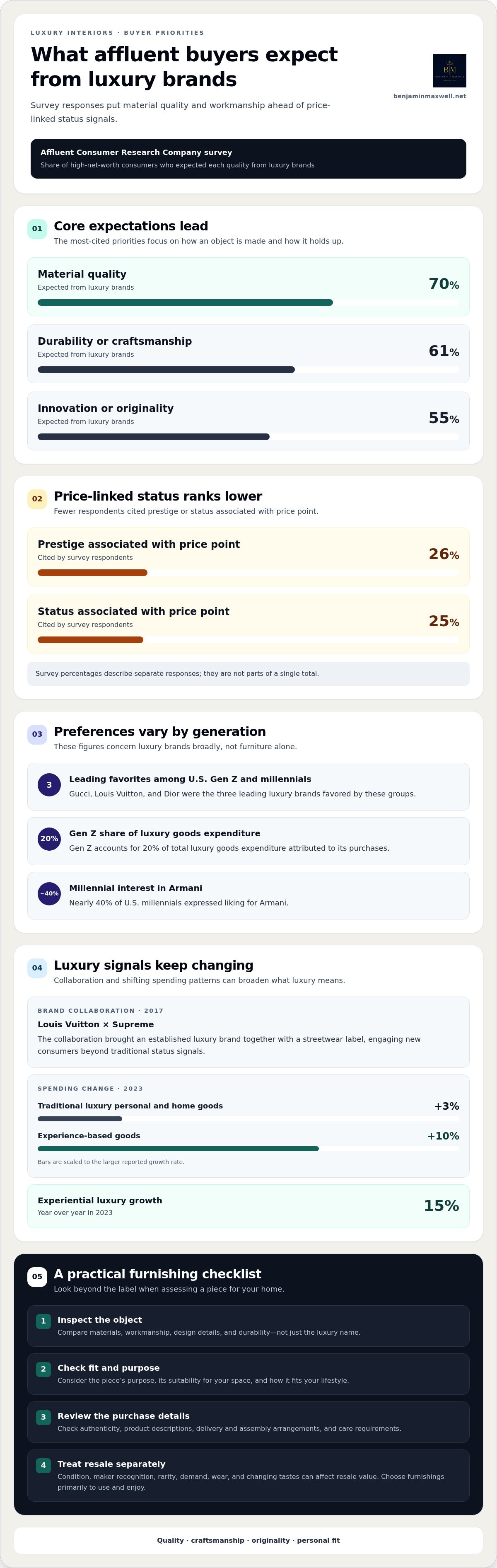
What gives luxury brands standing with affluent consumers? Quality leads, while price-linked status matters to a smaller share. In an Affluent Consumer Research Company survey, 70 percent of high-net-worth consumers expected material quality from luxury brands. The same survey found 61 percent expected durability or craftsmanship, and 55 percent expected innovation or originality. By comparison, 25 percent cited status associated with price point, while 26 percent cited prestige associated with price point. The findings suggest that buyers weigh how an object is made alongside what its name may signal.
Which home furnishing brands are considered luxury in the United States? Cattelan Italia and Bonaldo are examples of luxury furniture brands available to U.S. consumers. Compare their designs, materials, workmanship, and suitability for your space and lifestyle.
Brand preferences also vary by generation and region. Among U.S. consumers, Gucci, Louis Vuitton, and Dior were the three leading luxury brands favored by Gen Z and millennials. Gen Z accounts for 20 percent of total luxury goods expenditure attributed to its purchases. Nearly 40 percent of U.S. millennials expressed liking for Armani. These figures concern luxury brands broadly, rather than furniture alone, but illustrate how age can shape shopping preferences.
Collaboration can bring distinct brand identities together. Louis Vuitton and Supreme collaborated in 2017, combining established luxury with a streetwear label. It demonstrated how luxury brands can engage new consumers without relying only on traditional signals of standing. Economic cycles also shift preferences: traditional luxury personal and home goods advanced 3 percent in 2023, while experienced-based goods rose 10 percent.
What are the risks of buying luxury furniture, including counterfeits and hidden costs? Misrepresented pieces may not match the expected materials, workmanship, or authenticity. Delivery and assembly arrangements, along with care requirements, can also affect the buying decision. Review the product description and purchase terms before placing an order.
Luxury home décor market size and growth forecasts
Luxury home décor is a broad market, though its scale depends on how the category is defined. Its forecast growth rate is roughly 5.17% annually from 2025 to 2034. A separate estimate values the market at USD 151.82 billion in 2025. Together, these figures point to an expanding sector, but market growth does not determine the future value of an individual piece.
Product categories matter. Furniture was the leading type segment in the global luxury home décor market in 2024, spanning traditional and designer pieces for varied rooms and lifestyles. Décor objects and other home products form additional segments, each shaped by different uses and buying priorities. For shoppers, the distinction is practical: compare the piece’s materials, construction, purpose, and fit with the home, rather than treating the broad luxury label as a measure of value.
Demand reflects a mix of household income, wealth, renovation activity, and personal taste. Online shopping also creates a growing route to market: global luxury furniture e-commerce was estimated at USD 13.5 billion in 2023 and is projected to grow at an 11.8% annual rate by 2030. Digital access can widen product discovery, while the physical scale and finish of furniture still matter to buyers who appreciate offerings from brands like Benjamin & Maxwell.
Are luxury home furnishings a good investment, or do they depreciate? Treat them primarily as purchases to use and enjoy, not as reliable financial assets. Resale value can depend on condition, maker recognition, rarity, and demand; wear and changing tastes may reduce it, regardless of the original retail positioning. Economic cycles also affect luxury shopping: buyers may prioritize lasting craftsmanship during uncertain periods, while shifts in wealth and income can change demand. Choose furnishings for their quality and place in your home, and consider resale separately.
Luxury purchases as status signaling and self-expression
A luxury interior can communicate distinction without displaying a room full of recognizable labels. One study found that luxury-boutique employees rated casually dressed clients as higher in status than clients wearing luxury items. The finding challenges the assumption that visible branding always signals greater standing. In a home, material quality, considered proportions, and a coherent selection of pieces can convey discernment more quietly than conspicuous logos.
How do luxury furnishings compare with mid-range furnishings in quality and price? Luxury furnishings generally cost more and often emphasize materials, craftsmanship, design, and finish. Mid-range pieces can serve similar functions, so compare construction and materials directly instead of assuming price alone guarantees quality.
Interior designers communicate wealth and taste through selection and arrangement. They might pair a sculptural table with restrained seating, or use a distinctive light fixture as a room’s focal point. Scale, balance, texture, and placement influence whether a space feels composed or crowded. An artisan rug, for example, anchors a seating area most effectively when all major seating legs rest on it.
Status also increasingly reflects the experiences a home supports. Experiential luxury grew 15 percent year over year in 2023, while about a third of luxury home-goods buyers indulge in spa treatments. A serene bathing area or carefully arranged reading corner can express leisure and personal priorities, not simply purchasing power. These choices make lifestyle part of the message.
Across the past two decades, luxury interiors have shifted from signaling through physical objects toward projecting identity through images, codes, and brand identity. That change gives personal meaning greater influence over a purchase. Sustainability is another emerging consideration: nearly 41% of high-net-worth individuals in North America and Europe prioritize it when buying home décor. A premium piece can signal taste through considered materials and lasting relevance, while a room’s distribution of objects and open space reveals what its owner values. Choose details that feel authentic to daily life, rather than assembling pieces solely for an audience.
Luxury competencies and product expertise
Product expertise can signal status without conspicuous display. Knowing how to distinguish textiles, assess a finish, or discuss a particular design detail shows conscious attention. Prestige then rests partly on discernment, not simply possession. A buyer who can explain why a piece suits a room communicates cultural knowledge as well as taste.
Build that fluency by examining an object before buying. With a chair, identify its upholstery, inspect the seams, and consider how its proportions relate to the room. With glassware, look at its shape, surface, and the way it catches light. These observations make shopping a considered encounter with the object, rather than a search for a conspicuous label.
- Ask what you can see. Describe a textile’s weave or a table’s surface, rather than relying on broad claims of quality.
- Connect form to use. A dining chair should support its role at the table and complement surrounding pieces.
- Notice design choices. Compare silhouette, finish, and proportion to understand what makes one example distinctive.
This knowledge matters in a crowded global sector. More than 5,000 luxury interior homeware and design companies entered the global market between 2020 and 2024. With new brands shaping trends, expertise helps consumers distinguish a lasting design language from a passing style. It also helps them discuss why a particular object feels suited to their home, even when its appeal is quiet rather than immediately recognizable.
Luxury competence need not become a performance. Share the details that genuinely interest you, such as the feel of a textile or the balance of a sculptural form. To compare established furniture brands and their design perspectives, explore luxury furniture brands.
Benjamin & Maxwell: Daum Crystal
Benjamin & Maxwell brings together Daum crystal, Cattelan Italia furniture, and Kosta Boda glassware for those choosing pieces that reflect personal taste. Explore these collections for a distinctive focal point, a considered furniture piece, or glassware that adds character to a room.
For furniture decisions, the In Home Visualizer lets you see how selected pieces look in your living space. Use the room view to consider proportion and placement alongside the design before making a choice. Explore pieces with an eye to how they complement your home and daily routines.
For questions about the offerings, contact Benjamin & Maxwell.
Choose Pieces That Tell Your Story
Before choosing a furnishing, ask what you want the room to express and how you will use it. That answer can guide decisions beyond status, toward objects with personal meaning that belong naturally in daily life. Social status and luxury home furnishings meet self-expression in the details you value and the atmosphere you create.
Benjamin & Maxwell offers Daum Crystal and Cattelan Italia Furniture for distinct ways to bring artistry and design into a home. Its In Home Visualizer can help you picture how selected pieces fit your space, making proportion part of the decision rather than an afterthought.
Take the next step at a pace that suits your home and your taste. Contact Benjamin & Maxwell to explore a thoughtful furnishing choice, and create a setting that feels unmistakably your own.
Frequently Asked Questions
What does status anxiety look like inside a home?
Status anxiety can lead to choices made chiefly to impress visitors. A homeowner might replace a comfortable sofa because it lacks a recognizable label, or keep a formal room untouched to preserve an image. Ask whether a purchase supports daily life or mainly seeks approval. One useful test: would you still choose the piece if nobody else saw it?
How do luxury home furnishings signal social status?
Luxury furnishings can signal status through recognizable design, considered materials, and a room’s overall coherence. But social status and luxury home furnishings also reflect what an owner knows and values. A well-placed object can suggest discernment without dominating the room. A distinctive table chosen to suit a home’s proportions, for example, communicates intention more subtly than branded objects covering every surface.
Which materials and craftsmanship features define high-end furniture?
High-end furniture often stands out for carefully selected materials and precise execution, but assess the individual piece rather than relying on its label. Look for even seams, cleanly finished edges, stable construction, and consistent surfaces. On upholstered seating, inspect how the fabric meets corners and cushions. On a table, examine the finish and the joints. These details help you assess workmanship firsthand.
How have luxury home furnishing status symbols changed over time?
Status symbols have moved beyond simply displaying costly objects toward expressing a more individual point of view. Instead of arranging a room around matching, conspicuous pieces, an owner might show taste through a singular artwork, a considered mix of forms, or an object with personal meaning. Social media also puts interiors before a wider audience, prompting owners to consider how a space looks in photographs as well as how it feels to use.
How do regional tastes in luxury home furnishings vary across the United States?
There is no single furnishing style that represents every U.S. region; preferences depend on home architecture, climate, and routines. In a sunlit room, consider how materials and finishes look in strong natural light. In a compact home, prioritize pieces that preserve movement and proportion. Let the home’s setting and the household’s habits guide scale, texture, and placement instead of relying on regional stereotypes.

Article by
Spencer Kay
Spencer is the founder and CEO of Benjamin & Maxwell and has created the most advanced technology-based website in the furniture industry. He has extensive experience in both technology and business operations having started a number of technology companies. Spencer holds a BA Degree in Economics and an MBA in International Business
Disclaimer
Benjamin & Maxwell does not intend for any of our products to be used for any specific purpose.


