


A true masterpiece of pate de verre crystal art does not merely sit in a room; it breathes. While many admirers often mistake this delicate medium for standard cast glass, the discerning eye recognizes a depth of color and texture that no other method can replicate. It's understandable if you've felt a sense of hesitation when trying to distinguish between mass-produced pieces and authentic "sculptures of light." The terminology can be dense, and the stakes for a collector are high when seeking a legacy piece that will endure for generations.
This guide offers the clarity you need to move from curious observer to confident connoisseur. You'll discover the meticulous craftsmanship that defines the prestige of Daum and learn how to evaluate the sensory depth of these exquisite creations. We'll explore the history of this demanding technique and provide the tools to help you identify quality with ease. From understanding the "sculpting with light" narrative to envisioning how these pieces transform your own space, you're about to master the art of the pâte de verre collection.
Key Takeaways
- Learn to distinguish the painterly translucency of pate de verre crystal art from traditional glass, understanding why it's celebrated as a "sculpture of light."
- Gain an appreciation for the painstaking glass paste process, where crushed crystal and binding agents are transformed through meticulous kiln-firing and artisan precision.
- Trace the evolution of this medium from ancient civilizations to the French Art Nouveau movement, where it was elevated to a pinnacle of luxury and high art.
- Develop a connoisseur’s eye for authenticity by identifying the characteristic "frosted" texture and the essential maker’s marks that signify a true masterpiece.
- Discover how to seamlessly integrate heritage pieces from Daum Crystal into contemporary interiors, creating a bridge between historical artistry and modern elegance.
The Translucent Allure of Pâte de Verre Crystal Art
In the world of fine collectibles, Pâte de verre is often described as the "sculpture of light." This isn't just a poetic label; it's a precise description of how the medium interacts with its environment. Unlike standard crystal that aims for absolute transparency, pate de verre crystal art prioritizes a painterly translucency. It possesses a frosted, ethereal quality that seems to trap light within its walls rather than letting it pass through. This unique characteristic creates a sense of "meticulous permanence," a value we hold dear at Benjamin & Maxwell. These aren't objects that merely occupy space. They're enduring legacies that command it with a quiet, stately confidence.
Beyond Blown Glass: What Sets It Apart?
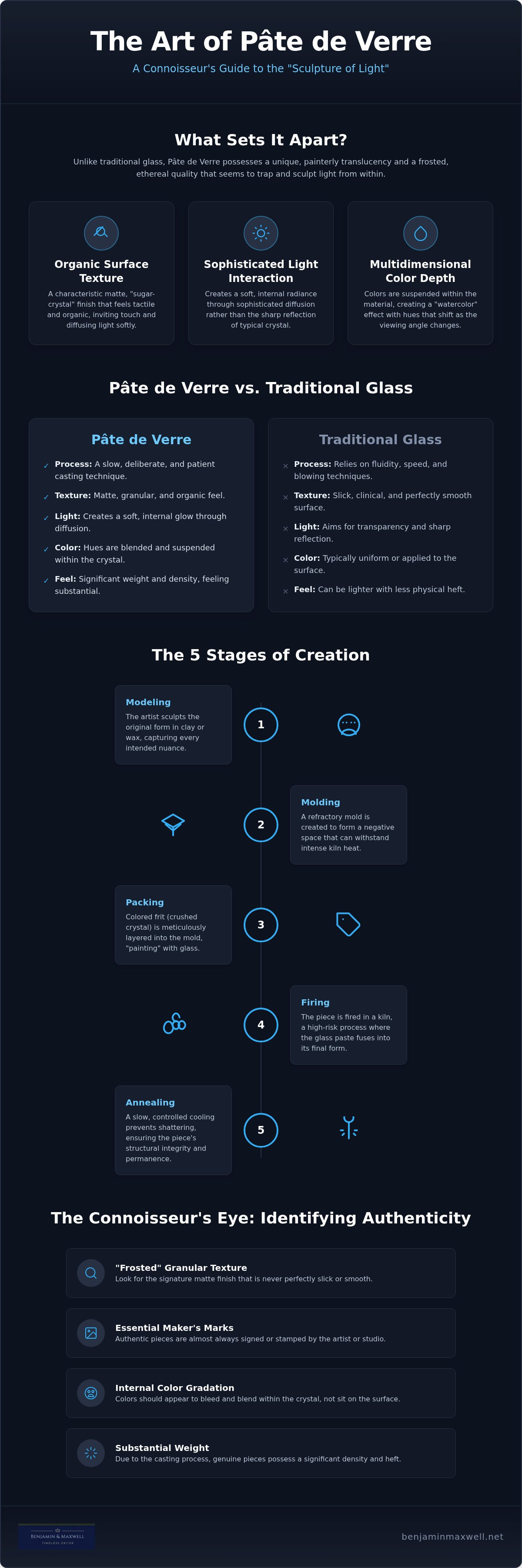
Blown glass relies on fluidity and speed. In contrast, the glass paste technique is a study in deliberate patience. While traditional lead crystal is celebrated for its diamond-like clarity, this medium offers a profound aesthetic depth. The most striking difference is the surface texture. Often described as a "sugar-crystal" finish, the exterior feels organic and tactile. It lacks the slick, clinical feel of industrial glass. Because these pieces are kiln-cast, they possess a significant weight and density. This physical heft provides a prestigious presence, making the art feel as substantial as the heritage it represents. Consider these defining characteristics:
- Surface Texture: A matte, granular finish that invites the touch and feels remarkably organic.
- Light Interaction: Sophisticated diffusion rather than sharp reflection, creating a soft, internal radiance.
- Color Depth: Multidimensional hues that appear suspended within the material, shifting as the viewing angle changes.
The Materiality of Emotion
The emotional resonance of these pieces comes from their internal life. By using finely ground crystal mixed with metallic oxides, artisans achieve a "watercolor" effect that's impossible to replicate in other materials. Colors don't just sit on the surface; they bleed and blend within the crystal itself. This creates an inner glow that changes as the sun moves across a room. At Benjamin & Maxwell, we see this as the bridge between the digital world and physical ownership. It’s a sensory experience that requires presence to fully appreciate. When you observe pate de verre crystal art in person, you aren't just looking at an object. You're witnessing a dialogue between mineral and light.
Pâte de verre is a medium where light acts as the primary sculptor, revealing the soul of the crystal through every subtle gradient and curve.
The Meticulous Craftsmanship Behind the Glass Paste Technique
The creation of pate de verre crystal art is a relentless test of human patience. It's a craft that demands a level of precision rarely found in modern manufacturing. Unlike mass-produced glass, this technique requires the artisan to work with "frit," a specialized mixture of finely crushed crystal and binding agents. This paste is the soul of the object. Master artisans treat every grain with reverence, knowing that the final form depends on the exact chemistry of the mixture. This method is rooted deeply in the history of pâte de verre, where the transition from raw minerals to refined art was considered almost alchemical.
The Five Stages of Creation
The journey from concept to crystal begins with modeling. The artist sculpts the original form in clay or wax, capturing every nuance of the intended design. This is followed by molding, where a refractory material is used to create a negative space that can withstand the kiln’s heat. The artisan then employs the "cire perdue" or lost-wax casting method, a technique that ensures the most intricate details are preserved. Next comes packing, perhaps the most delicate phase. Here, the artisan carefully places the colored frit into the mold, layer by layer. Finally, the piece undergoes firing and annealing. This slow, controlled cooling process is fraught with danger. A single temperature fluctuation can cause the crystal to shatter, instantly erasing weeks of dedicated labor. It's this high risk that contributes to the enduring value of every piece of pate de verre crystal art that survives the kiln.
The Art of Color Gradation
Master artisans effectively "paint" with crushed glass to achieve those iconic, painterly transitions in hue. By layering different shades of frit, they create gradients that appear to float within the solid crystal. The placement must be exact; once the kiln is closed, the artisan can no longer influence the outcome. Temperature plays a critical role here as it determines the final vibrancy and saturation of the colors. Because the packing is done by hand and the kiln reacts differently to every firing, no two pieces are ever truly identical. Each object carries the unique fingerprint of its creator and the specific conditions of its birth. If you're curious to see how these masterpieces might look in your own home, our In-Home Visualizer tool offers a sophisticated way to bridge the gap between digital browsing and physical ownership.
A Heritage of Brilliance: From Ancient Origins to Art Nouveau
The story of pate de verre crystal art begins long before the modern era, stretching back to the sophisticated workshops of ancient Egypt and Rome. While these early civilizations understood the allure of glass paste, the technique eventually faded into the shadows of history for centuries. It wasn't until the late 19th century that French visionaries orchestrated a "Renaissance of the Senses," rediscovering the secret methods that transform crushed minerals into ethereal sculpture. This revival wasn't merely a technical achievement; it was a philosophical shift that positioned glass as a medium for pure artistic expression rather than utilitarian function. For the 19th-century elite, owning such a piece was a profound symbol of prestige and intellectual discernment.
The French Connection: The 19th Century Revival
The modern resurgence of this art form is largely credited to Henri Cros, whose tireless experimentation brought the technique back to the forefront of the decorative arts. Cros and his contemporaries realized that the unique properties of glass paste perfectly captured the organic, flowing lines central to the Art Nouveau movement. Unlike blown glass, which often feels dictated by the physical limitations of the bubble, this medium allowed for a sculptural freedom that mimicked the soft curves of nature. The 1900 Universal Exhibition in Paris cemented this art form’s status as a pinnacle of luxury, ensuring its place among the most coveted treasures of the modern age. During this period, glass transitioned permanently from the dining table to the gallery pedestal, becoming a purely decorative sculpture valued for its internal radiance and complexity.
A Legacy Continued Since 1898
Benjamin & Maxwell was founded in 1898, placing our origins at the very height of this artistic revolution. As the world marveled at the innovations in Paris, our institution was already beginning its journey as a curator of enduring beauty. We've watched the lineage of expertise evolve, yet the fundamental appeal of pate de verre crystal art remains unchanged. There's an undeniable value in pieces that carry such a weight of history. When you acquire one of these works, you aren't simply buying a contemporary object; you're participating in a continuous story that spans millennia. This heritage of brilliance ensures that every piece remains a stable, reliable investment in quality that transcends the fleeting trends of the modern retail landscape.
The Connoisseur’s Eye: Identifying Authentic Pâte de Verre
Developing the eye of a connoisseur requires moving beyond superficial appreciation. Authentic pate de verre crystal art possesses specific physical "tells" that distinguish it from industrial imitations. While mass-produced cast glass often attempts to mimic the matte finish of the real medium, it consistently lacks the internal complexity found in kiln-cast masterpieces. One of the most immediate indicators for the discerning collector is the "weight test." Because of the extreme density of the glass paste used in the kiln-casting process, an authentic piece will feel significantly heavier than its visual volume suggests. This physical heft is not just a technical detail; it's a hallmark of the medium’s prestigious presence and enduring quality.
Evaluating Color and Light
True mastery is most visible in how the material captures and holds radiance. Look closely for an "inner glow," a sign that the metallic oxides were distributed with expert precision throughout the frit before firing. In high-quality pate de verre crystal art, color transitions are painterly and fluid, mimicking the soft gradients of a watercolor painting. Conversely, lesser pieces often show solid, disjointed blocks of color that lack emotional depth. You should also inspect the surface for the presence of "sugar crystals." These tiny, granular textures are a natural result of the kiln casting process and are nearly impossible to replicate through chemical etching or sandblasting. They provide the organic, tactile quality that defines the medium’s unique sensory depth and aesthetic longevity.
Provenance and Documentation
Verification is the final, essential step in securing a piece for your legacy. Maker’s marks and signatures etched into the base provide a roadmap of the object’s history. For example, understanding the subtle evolution from the historical "Daum Nancy" signature of the Art Nouveau era to the more streamlined contemporary Daum marks is vital for accurately dating a piece. Authentic sculptures are almost always accompanied by original certificates of authenticity that document their specific lineage and production number. Purchasing from established, authorized retailers ensures that these documents are genuine and that the piece has been handled with the reverence it deserves. At Benjamin & Maxwell, we act as a knowledgeable guide for the discerning audience, ensuring every acquisition is a verified masterpiece. To begin your journey with a piece of unquestionable heritage, we invite you to explore our curated collection of Daum Crystal.
The Living Legacy: Integrating Daum Crystal into Modern Interiors
Daum Crystal stands as the undisputed sovereign of the glass paste technique. While many workshops have attempted to replicate the depth of this medium, Daum remains the definitive master, preserving a lineage of expertise that dates back to the height of the Art Nouveau movement. Integrating pate de verre crystal art into a contemporary home is an exercise in balancing heritage with modern aesthetics. These pieces act as a bridge, connecting the meticulous craftsmanship of the past with the refined, minimalist sensibilities of today’s luxury interiors. They don't just decorate a room; they elevate its narrative, suggesting a commitment to quality and aesthetic longevity that transcends fleeting trends.
Curating the Space
Success in displaying these masterpieces lies in the intentional contrast between organic forms and architectural precision. A Daum sculpture creates a compelling focal point when placed upon the clean, geometric lines of a Cattelan Italia sideboard or a Bonaldo console. The interplay between the "frosted" texture of the crystal and the polished surfaces of high-end Italian furniture produces a sophisticated visual tension. Choose pieces that resonate with your personal story of permanence. A single, well-placed sculpture can define an entire room, especially when its placement allows for a dialogue with the surrounding light and space.
Lighting is the essential final step in activating the soul of the crystal. To truly reveal the "sculpture of light," consider using subtle backlighting or dedicated spotlights. This directs energy through the material, illuminating the internal gradients and metallic oxides that would otherwise remain dormant. Proper illumination transforms the object from a solid form into a glowing, translucent presence that shifts in character from dawn until dusk. For collectors looking to pair their sculptures with equally evocative fixtures, Shimale Peleg offers custom artistic glass lighting solutions that complement the depth and radiance of fine crystal art.
We understand that selecting a heritage piece is a significant decision. The modern collector requires more than just a digital image; they need to understand how a masterpiece interacts with their specific environment. Our proprietary In-Home Visualizer tool was designed to bridge this gap. It allows you to see the scale, color, and light interaction of a Daum piece within your own room before it ever arrives. This ensures that the "sculpture of light" you choose perfectly complements your existing collection and architectural style. We invite you to Experience the In-Home Visualizer and explore our Daum collection to find the next chapter in your home’s continuing story.
Embracing a Legacy of Light and Form
The journey into the world of pate de verre crystal art is more than a study of technique; it's an invitation to participate in a storied tradition of aesthetic excellence. You've discovered how the meticulous glass paste process creates a "sculpture of light" that traditional blown glass simply cannot replicate. By mastering the connoisseur’s eye for authentic markings and the characteristic frosted finish, you're now equipped to build a collection that reflects both historical prestige and personal discernment. These pieces don't just occupy a space; they anchor it with a sense of permanence and soul that few other mediums can provide.
Benjamin & Maxwell has served as a bridge to this refined artistry since 1898. As an authorized dealer of Daum France, we provide the expertise and documentation necessary for a confident acquisition. We invite you to Discover the Peerless Artistry of Daum Crystal at Benjamin & Maxwell and utilize our complimentary In-Home Visualizer tool to see these masterpieces in your own space. Begin your journey toward owning a piece of living history today. Your home deserves the enduring elegance of a master's touch.
Frequently Asked Questions
Is pâte de verre more fragile than standard lead crystal?
Pâte de verre is not inherently more fragile than standard lead crystal, though it possesses a different structural density. Because it's created through a kiln-casting process rather than being blown, the material is often thicker and more substantial. However, like all fine crystal, it remains susceptible to sharp impacts or sudden temperature shifts. You should handle these pieces with the same reverence you'd afford any significant work of art to ensure their longevity.
Why is Daum crystal so famous for the pâte de verre technique?
Daum is celebrated as the definitive master of this medium because they orchestrated its modern revival during the late 19th century. While the technique has ancient roots, Daum’s artisans perfected the lost-wax casting method to achieve a level of detail and color gradation that remains unmatched. Their commitment to this sculpture of light has made their name synonymous with the finest pate de verre crystal art available to discerning collectors worldwide.
Can I use pâte de verre vases for fresh flowers and water?
You can certainly use these vases for fresh floral arrangements, provided you exercise specific care. It's best to use room-temperature water and avoid placing the piece in direct, harsh sunlight for extended periods. Because the interior surface is often slightly porous or textured, ensure you rinse the vessel thoroughly after use to prevent mineral deposits from settling. This preserves the internal radiance and frosted translucency that defines the medium’s unique aesthetic appeal.
How should I clean and maintain my pâte de verre sculptures?
Maintenance requires a gentle touch and a commitment to preserving the material’s organic texture. Use a soft, lint-free cloth for regular dusting to prevent buildup in the granular surface. If a deeper clean is necessary, lukewarm water with a mild, pH-neutral soap is sufficient. Avoid abrasive sponges or harsh chemical cleaners, as these can dull the delicate sugar-crystal finish. Always dry the piece immediately with a soft towel to prevent water spots.
What is the difference between pâte de verre and kiln-cast glass?
While pâte de verre is a form of kiln-casting, the primary distinction lies in the material and application. Standard kiln-casting often involves solid chunks of glass, whereas this technique utilizes frit, or crushed crystal paste. This granular consistency allows the artisan to paint within the mold, creating the soft color gradients and frosted translucency unique to pate de verre crystal art. It's a more meticulous process that prioritizes painterly depth over mere transparency.
Does pâte de verre crystal hold its value over time for collectors?
These pieces are widely considered stable investments due to the immense labor and high risk involved in their creation. Because each sculpture is essentially unique and produced in limited quantities, they maintain a strong presence in the secondary market. Heritage brands like Daum carry a lineage of expertise that historically supports long-term value. For the serious collector, these objects represent a marriage of artistic merit and enduring material worth that transcends fleeting retail trends.
How can I tell if a piece of Daum crystal is authentic?
Authenticity is confirmed through a combination of physical characteristics and formal documentation. Every genuine piece features a signature etched into the base, such as Daum France or historical variations like Daum Nancy. You should also look for the characteristic sugar-crystal surface and the unexpected physical heft that defines the medium. Authentic acquisitions from authorized dealers always include a certificate of authenticity, providing a verified link to the workshop’s long-standing heritage of excellence.
Does the In-Home Visualizer accurately show the translucency of the crystal?
The In-Home Visualizer tool utilizes sophisticated rendering technology to simulate how light interacts with the crystal’s specific density. While no digital tool can perfectly replicate the sensory experience of a physical object, it provides a highly accurate representation of scale and color saturation within your room. This allows you to observe how the piece might capture the light in your specific environment, bridging the gap between digital browsing and the reality of ownership.

Article by
Spencer Kay
Spencer is the founder and CEO of Benjamin & Maxwell and has created the most advanced technology-based website in the furniture industry. He has extensive experience in both technology and business operations having started a number of technology companies. Spencer holds a BA Degree in Economics and an MBA in International Business
Disclaimer
Benjamin & Maxwell does not intend for any of our products to be used for any specific purpose.


