

The right sculpture feels at home in its setting. Sculptural art can add presence to a tabletop, create a focal point on a wall, anchor a room as a freestanding work, or extend a home’s character outdoors. Start with the available space and the effect you want the piece to create.
A work’s appeal comes from more than its subject: shape, material, scale, and the way it interacts with light and surrounding furnishings all contribute to its presence. This guide explores original sculptures for sale, the distinction between representational and abstract styles, and the design principles that help a piece feel considered rather than simply placed. You’ll also find ways to think through tabletop, wall, standing, and outdoor options, so you can choose a work that complements your home and holds your attention over time.
Key Takeaways
- Match a sculpture’s placement to the space: tabletop, wall, freestanding, and outdoor works each create a distinct presence.
- Choose between representational and abstract forms by considering whether you want recognizable subjects or an emphasis on shape and movement.
- Assess scale, material, balance, and negative space to help a piece feel connected to its surroundings.
- Use Benjamin & Maxwell’s In Home Visualizer to see how selected pieces may fit within your living space.
Original sculptures for sale
Choosing an original sculpture starts with the details that distinguish one work from another. Consider the artist, material, process, dimensions, and edition information together. A cast work may have more than one edition because a mould can produce multiple casts. Read the work’s description closely, then consider how its form and scale will suit the space you have in mind.
Named examples can help you compare artistic approaches. Freedom by Peter Brooke-Ball and Hyakutake by Romain Langlois offer distinct works to explore. The title Small Construction II by Alban Lanore suggests a constructed form. When exploring SculpturalArt, look beyond a title: consider the material, technique, and artist’s approach to understand what gives each piece its character.
How does it compare with similar art brands or studios? Sculptural art is a broad category, not a single studio or brand. Compare individual works by artist, material, technique, dimensions, and edition details rather than assuming they share a catalogue or standard.
How much do these pieces cost? Sculpture prices vary according to the artist, material, scale, production method, and edition. For SculpturalArt, compare these factors with the work’s description to understand how a particular piece is presented.
Who founded it, and where is it based? Sculptural art is an art form, not an organization with a single founder or location. For a specific studio, refer to its published identity and location details.
Are custom commissions or personalized sculptures available? Commissions are arrangements made with individual artists or studios. Look for details about the process from the artist responsible for the work you admire.
Are there customer reviews or complaints? Reviews and complaints relate to particular sellers, galleries, or studios, not sculpture as an art form. Consider feedback about the specific seller and work relevant to your decision.
These examples show how widely listed prices can differ across works.
Representational and nonrepresentational sculpture
Representational sculpture depicts recognizable subjects, such as people, animals, or objects. Before the 20th century, sculpture was considered representational art that imitated forms in life. A figure’s posture, facial expression, or gesture can therefore carry much of its meaning. Auguste Rodin’s The Kiss, dated 1901-4, offers a named example of a sculptural work centered on human figures. Look at what the forms depict, then consider how their details shape the work’s character.
Nonrepresentational sculpture doesn’t depend on recognizable subjects. Since the turn of the 20th century, sculpture has included nonrepresentational forms, often emphasizing shape and movement instead of imitation. That shift widened the ways artists could organize a work: line, mass, rhythm, and open space can become its main visual language. Pablo Picasso’s Still Life, dated 1914, and Alexander Calder’s Untitled, dated 1937, provide distinct examples from this period of changing sculptural expression.
The difference isn’t simply “realistic” versus “modern.” A representational work may simplify a figure, while an abstract work may still suggest movement or a familiar form. Compare the outline, balance, and relationship between solid areas and openings. In Picasso’s 1914 work, consider how a subject can be communicated through construction rather than traditional modelling. With Calder’s 1937 work, observe how the title leaves the form open to interpretation.
For a home, begin by deciding what you want the sculpture to bring to the space. A recognizable figure, such as the human subject in Rodin’s The Kiss, can create a clear focal point and narrative. A nonrepresentational piece may instead draw attention to silhouette, movement, or the interplay between solid form and surrounding space. View a candidate from different angles and note which features remain compelling as your perspective changes. The right choice depends on the work’s visual language and the atmosphere you want it to establish.
Sculptural design elements and principles
Read a sculpture through its form, mass, surface, and relationship to space. These elements reveal how the artist’s choices shape the work’s presence.
Sculptural Design Elements
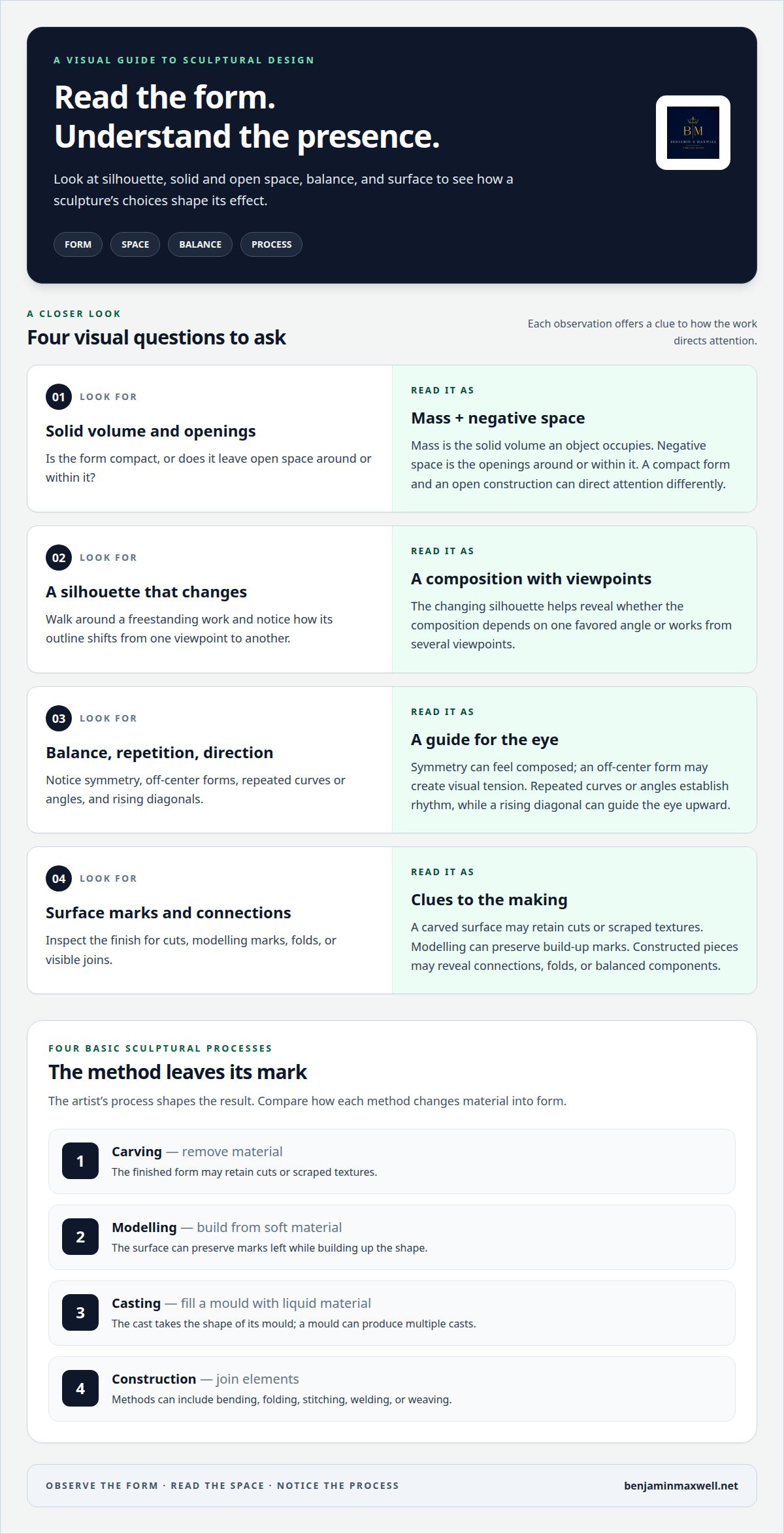
Begin with form: notice the outline, proportions, and changing contours from different viewpoints. Mass describes the solid volume an object occupies, while negative space describes openings around or within it. Before the 20th century, sculpture was considered primarily an art of solid form, or mass. Compare a compact form with an open construction to see how each directs attention differently.
Next, consider balance, rhythm, and movement. A symmetrical figure can feel composed, while an off-center form may create visual tension. Repeated curves or angles establish rhythm; a rising diagonal can guide the eye upward. Walk around a freestanding work and observe how its silhouette changes. This helps reveal whether the composition depends on one favored angle or works from several viewpoints.
Materials and Techniques
Sculpture has no single material or technique: the artist’s process shapes the result. Carving removes material from a solid form, while modelling builds a shape from soft material. Casting uses a mould filled with liquid material, and construction joins elements through methods such as bending, folding, stitching, welding, or weaving. These are four basic sculptural processes.
Look for traces of the method in the finished surface. Carved forms may retain cuts or scraped textures; modelling can preserve marks left while building up soft material. Cast works take the shape of their mould, while constructed pieces may reveal connections, folds, or balanced components. Consider what the finish communicates: a polished surface emphasizes contour, while a textured one draws attention to handling and process.
Assess a piece in sequence: observe its silhouette, identify solid and open areas, then inspect the surface and joins. A work that appears stable from the front may feel dynamic from the side. Light also changes how shadows define edges and openings, so view the sculpture in the room’s natural conditions. These observations connect design choices to the atmosphere the piece creates.
Tabletop, wall, standing, and outdoor sculpture
Placement shapes how a sculpture is seen and experienced. For a tabletop piece, compare its footprint with the surface and nearby objects. A compact work can enliven a console without obscuring what sits behind it. Leave room to view it from more than one angle. On a wall, consider how relief, silhouette, and surrounding space read together. Ludwig Gies’s cast-iron Refugees plaquette, made in 1915, measures 8 by 9.8 centimeters, showing how a sculptural work can occupy a modest wall area. Similarly, contemporary studios such as Tintin produce handcrafted metal art pieces designed to give interior walls distinctive silhouette and texture.
A freestanding sculpture has a distinct relationship with its room. Since you can see it from several directions, assess its outline from the entrance, seating, and nearby circulation paths. A piece with open spaces may look different against a window than against a solid wall. Before placing it, mark its intended footprint on the floor. This helps you judge its relationship with furniture and avoid crowding a passage.
Outdoor sculpture brings the surrounding landscape into the composition. Consider the work against garden lines, paving, planting, and the view from indoors. Material and finish matter in an exposed setting, so consider how the piece relates to its surroundings and care needs. Don’t assume an indoor sculpture is suitable outdoors. A contemporary work may stand out beside natural forms, while a more architectural piece can echo built lines.
Match the work’s scale and visual character to its location. A relief like Gies’s plaquette suits a wall where its compact dimensions can be appreciated; a freestanding form needs room for changing viewpoints. For a tabletop, check the surface and sightlines. Outdoors, consider the landscape and exposure. Then review nearby furnishings: a console or cocktail table can frame a smaller sculpture, while outdoor furniture can help define an exterior gathering space.
Explore furniture to shape the room or outdoor setting around your sculpture.
Benjamin & Maxwell: Daum Crystal
Benjamin & Maxwell offers Daum Crystal for those drawn to sculptural objects with a refined presence. The selection also includes Kosta Boda Glassware, which brings expressive glass forms into a room, and Cattelan Italia Furniture to furnish the space around a focal piece.
Consider the setting first: a glass object may suit a tabletop or display surface, while furniture helps establish the room’s larger composition. The In Home Visualizer lets you see how specific pieces fit within your living space, helping you assess how they relate to their surroundings.
Explore these offerings when you’re ready to consider decorative pieces and furnishings together. Contact Benjamin & Maxwell to continue your search.
Choose a Piece That Grows With Your Home
Let your next SculpturalArt choice begin with the feeling you want a room to hold. A sculpture can create a quiet pause, introduce contrast, or give an everyday setting a more personal character. Rather than rushing toward a particular style, notice which shapes and materials continue to draw your attention. That instinct can guide a choice you value beyond the first impression.
Picture the piece within the rhythms of your home: the light moving across its surface, the views you encounter each day, and the objects that share its setting. Benjamin & Maxwell’s selection can help you consider a sculptural focal point alongside furnishings and decorative works. Take time to picture the possibilities and decide what feels most at home.
When you’re ready to take the next step, contact Benjamin & Maxwell and continue shaping a space that reflects your point of view.
Frequently Asked Questions
What is SculpturalArt?
SculpturalArt is three-dimensional art that gives form, volume, and presence to a space. In a home, it may stand alone as a focal object or become part of a wall or display arrangement. Its impact depends not only on its subject, but also on how people encounter it from different positions and how it relates to the room around it.

Article by
Spencer Kay
Spencer is the founder and CEO of Benjamin & Maxwell and has created the most advanced technology-based website in the furniture industry. He has extensive experience in both technology and business operations having started a number of technology companies. Spencer holds a BA Degree in Economics and an MBA in International Business
Disclaimer
Benjamin & Maxwell does not intend for any of our products to be used for any specific purpose.


