

Furniture can be both a lasting part of a room and a depreciating asset on a business’s books. For U.S. federal tax purposes, office furniture is generally classified as 7-year property under MACRS, according to the Internal Revenue Service. Whether buying furniture as a long-term asset makes sense for accounting purposes also depends on its useful life and the business’s capitalization threshold.
It’s easy to think of a substantial furniture purchase as a single expense, especially when you expect the piece to serve for years. But an expense is generally recognized in the period it’s incurred, while a capitalized asset is recorded on the balance sheet and its cost allocated over time.
This guide explains when furniture, furnishings, and fixtures may be treated as assets rather than expenses, how accounting depreciation differs from market value, and what useful-life periods may apply. It also covers how construction and care affect a piece’s practical lifespan, helping you consider both its accounting treatment and the years of use ahead.
Key Takeaways
- Distinguish a business furniture expense from a capital asset by considering its useful life and the applicable capitalization threshold.
- Understand how the IRS classification of office furniture affects the period over which its cost may be recovered for federal tax purposes.
- Assess materials and construction for their potential to support repair, renewal, and continued use over time.
- Weigh a piece’s expected service life, construction, and role in your space when deciding what to spend.
Furniture as an asset versus an expense
Furniture accounting depends on business use, useful life, and the organization’s capitalization policy. That treatment determines when a purchase is recorded and how its cost appears over time.
When furniture is capitalized, its purchase price is recorded on the balance sheet instead of being recognized entirely as an immediate expense. The cost is then allocated through depreciation expense over the estimated useful life. Delivery, installation, and sales tax generally form part of the cost basis. Consistent asset tracking helps show how these costs relate to income and revenue.
Section 179 of U.S. federal tax law may allow businesses to deduct the full cost of certain office furniture assets in the year of purchase, according to the Internal Revenue Service. For tax years beginning in 2026, the maximum section 179 expense deduction is $2,560,000, according to the Internal Revenue Service.
Quality Furniture and Replacement Costs
Higher-quality furniture may cost less over time if its useful life offsets the higher initial cost. Repeated replacements add new purchase costs and can create more waste, so compare construction, expected use, maintenance, and repair needs, not just the initial expense. There’s no universal winner: a well-made piece offers stronger long-term value when it remains functional and suits the space.
Used or vintage furniture may offer better long-term value if it’s sound, repairable, and suited to its intended use. Consider its condition and any needed repairs. Age and appearance alone don’t establish durability or value.
In the US, warranty coverage, return terms, and consumer protections depend on written terms and applicable rules. Review the coverage and exclusions, along with any return deadlines and conditions, before completing a purchase.
Maintenance for a Longer Lifespan
Routine furniture care helps preserve its function and finish. Follow the maker’s care instructions, clean spills promptly, and limit exposure to damaging heat, moisture, or sunlight. Tighten loose fasteners and address small defects before they worsen. Regular care can reduce avoidable wear, preserve usefulness, and delay replacement, making maintenance part of the long-term cost of ownership.
Maximum useful life of furniture, furnishings, and fixtures
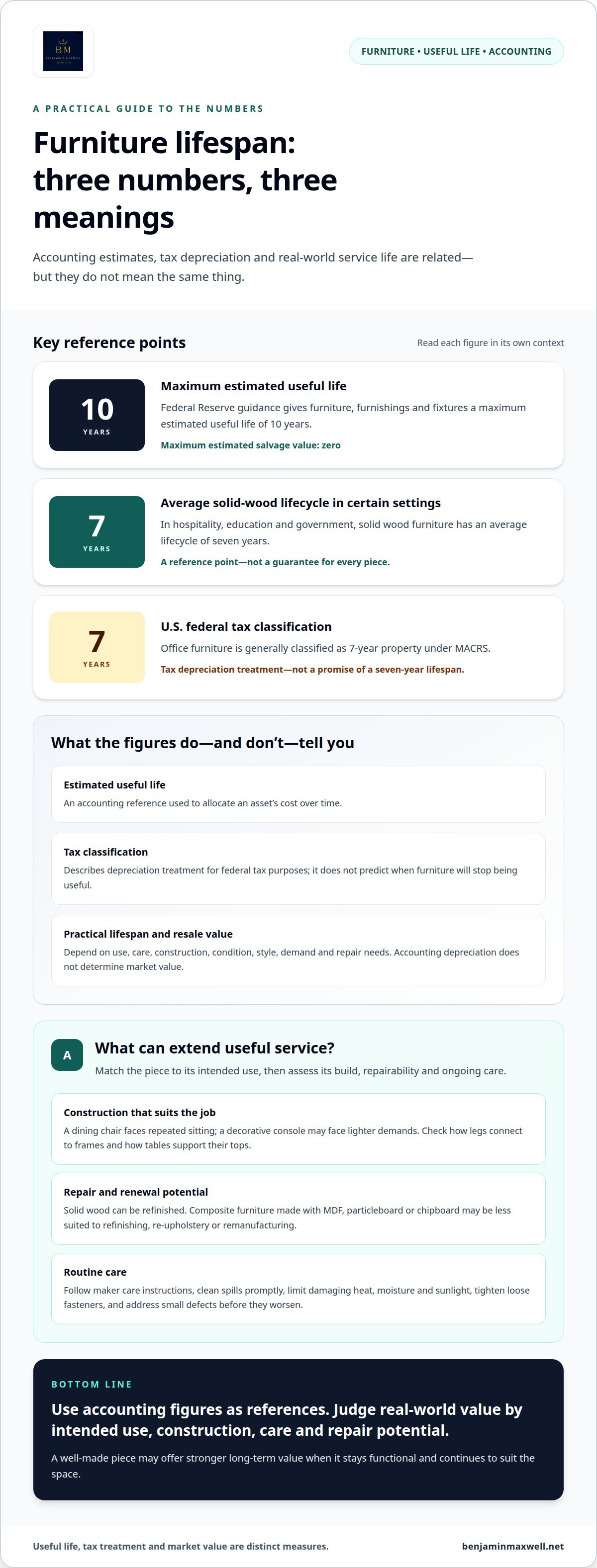
An estimated useful life serves accounting purposes, while a piece’s practical lifespan depends on its use, care, and construction. Keep these measures distinct when considering replacement or resale.
Durable Materials and Construction
Durable materials and sound construction help furniture remain functional through regular use. The Federal Reserve’s guidance gives furniture, furnishings, and fixtures a maximum estimated useful life of 10 years and maximum estimated salvage value of zero. In hospitality, education, and government, solid wood furniture has an average lifecycle of seven years. These are useful reference points, not guarantees for every piece or setting.
Brand Durability and Warranties
A brand’s name alone can’t establish durability or warranty value; examine the construction and written coverage for the particular piece. For U.S. federal tax purposes, office furniture is generally classified as 7-year property under MACRS, according to the Internal Revenue Service. That tax classification describes depreciation treatment, not a promise that furniture will last seven years. Warranty coverage and exclusions are separate considerations.
Spending on Long-Lasting Furniture
Set a furniture budget by weighing intended use, construction, expected care, and replacement costs over time. A dining table used daily has different demands from a rarely used accent piece. Consider whether repairs could extend its service and whether the design will suit the room as its needs change. These factors help define value without relying on an arbitrary price target.
For a considered purchase, explore furniture collections suited to different rooms and uses.
Furniture Resale Depreciation
Resale value is what a future buyer may pay; accounting depreciation allocates an asset’s recorded cost over its estimated useful life. They aren’t interchangeable: depreciation doesn’t determine market value. Condition, style, demand, and repair needs affect resale appeal. For example, a well-maintained table may attract more interest than a damaged one, even if both follow the same accounting schedule.
What furniture materials and construction are most durable?
Durability depends on how a piece’s materials and construction suit its intended use. A dining chair, for example, needs a structure that can withstand repeated sitting, while a decorative console may face lighter demands.
Solid wood provides a useful comparison with composite materials. MDF, particleboard, and chipboard bind wood strands or fibers with adhesives, and are often used beneath veneers as lower-cost alternatives to solid wood. Composite materials may be more appropriate for furniture with lighter demands, depending on the piece and its intended use.
Consider what happens when a surface wears or a component loosens. Composite furniture generally isn’t suited to renewal processes such as refinishing, re-upholstery, or remanufacturing. For example, a damaged veneer over particleboard may be harder to repair than a solid wood surface that can be refinished. A piece that can be renewed may remain useful as its finish or upholstery ages.
Look at construction as well as the material name. Check how a chair’s legs connect to its frame, how a table supports its top, and whether moving parts feel stable in normal use. For upholstered furniture, inspect the seams and where the fabric meets the frame. A well-assembled piece should feel coherent, without loose joints or components that shift during ordinary handling.
Match materials to the room and the demands each piece will face. A frequently used dining table needs a surface and base suited to regular meals, cleaning, and everyday contact. A rarely used accent chair may not need the same structural endurance. Consider, too, whether worn elements can be repaired or renewed rather than discarded.
Before choosing, compare each piece’s materials, visible construction, and likely care needs. Composite furniture may have a shorter service life and end up in landfill when worn or outdated. For a long-term purchase, prioritize sound construction and materials that can stay useful as the room’s needs evolve.
How much should you spend on furniture that lasts?
There’s no single price that makes furniture worthwhile. Set a budget based on how often you’ll use a piece, how long it should serve, and what care or repairs it may need. A frequently used dining table calls for a different investment decision than an occasional accent table. Buying furniture as a long-term asset starts with defining the role it must fulfil.
Start with the room’s purpose and each item’s demands. A sofa used daily should suit household routines, while a guest-room chair may see less frequent use. Compare construction, material, comfort, and repairability. These details connect the purchase price to practical value, instead of making the lowest initial cost the only measure.
Consider ownership costs over the piece’s useful life, including the initial purchase, expected maintenance, and possible repair or replacement. If an inexpensive item needs replacing sooner, repeated purchases may cost more than a durable alternative. Conversely, an expensive piece that doesn’t suit the room or its use may not deliver lasting value. For buying furniture as a long-term asset, choose for the life you expect to lead with it.
Room dimensions and changing needs also shape a sound budget. A dining table should fit the space and the way meals are served; a sofa should accommodate the household without overwhelming the room. A versatile design may remain useful after a move or change in décor. Prioritize the pieces you’ll use most, then choose secondary purchases according to their role.
Before deciding, list the intended use, the construction you value, and the care the piece requires. Compare those criteria across your shortlist, then choose the option that balances function, longevity, and design. Explore furniture for your space while considering the qualities that matter most.
Benjamin & Maxwell
Benjamin & Maxwell brings together considered furniture and home furnishings for those weighing lasting usefulness alongside design. Its selection includes Cattelan Italia Furniture and Bonaldo Furniture, options to assess for their role, construction, and place in your home. The In Home Visualizer lets you view selected pieces in your living space, making scale and placement part of your decision.
Use these resources when you’re ready to move from general durability criteria to considering specific furniture for your rooms. A well-chosen piece should serve your needs and complement the setting over time. Contact Benjamin & Maxwell to continue the conversation.
Choose pieces with a future in mind
A home changes as routines, rooms, and priorities evolve. Let that possibility guide your next furniture decision: choose a piece not only for how it looks today, but also for the role you want it to play over time. Buying furniture as a long-term asset becomes a more considered choice when it’s grounded in everyday life, not a passing trend.
Start with the room that matters most to you. Consider what would make it more useful, what qualities you want to live with, and how a new piece could complement what you already own. Benjamin & Maxwell brings together furniture and home accents, including Daum Crystal, for a considered interior.
When you’re ready to explore what might suit your home, contact Benjamin & Maxwell. Take the next step at your own pace, with a clearer sense of what lasting value means to you.
Benjamin & Maxwell for Buying Furniture as a Long-Term Asset
Benjamin & Maxwell offers luxury furniture and home décor, including Cattelan Italia, Bonaldo, Per/Use, and Italia Lounge furniture. Its selection includes sofas, chairs, poufs, dining tables, consoles, TV stands, wall units, and cocktail tables.
If you’re considering furniture for lasting use, explore options for your rooms and needs at Benjamin & Maxwell. Use the In Home Visualizer to view selected pieces in your space, and explore outdoor furniture, Daum Crystal, Kosta Boda glassware and home décor, and Schuller home décor.
Frequently Asked Questions
Is furniture a good long-term investment or asset?
Furniture can be a useful long-term asset for a business, but it isn’t automatically a financial investment that gains value. For a household, assess it by the years of service, comfort, and suitability it provides, rather than assuming it will appreciate at resale. For example, a durable dining table may justify its cost through sustained everyday use, even if its future resale price is uncertain.
How long does quality furniture typically last?
Quality furniture can remain useful for many years, but its lifespan depends on construction, frequency of use, care, and room conditions. A dining chair used daily experiences different wear from an occasional guest-room chair. Follow care instructions, address loose joints or small defects promptly, and consider whether upholstery or finishes can be renewed. These habits help preserve function and appearance over time.

Article by
Spencer Kay
Spencer is the founder and CEO of Benjamin & Maxwell and has created the most advanced technology-based website in the furniture industry. He has extensive experience in both technology and business operations having started a number of technology companies. Spencer holds a BA Degree in Economics and an MBA in International Business
Disclaimer
Benjamin & Maxwell does not intend for any of our products to be used for any specific purpose.


